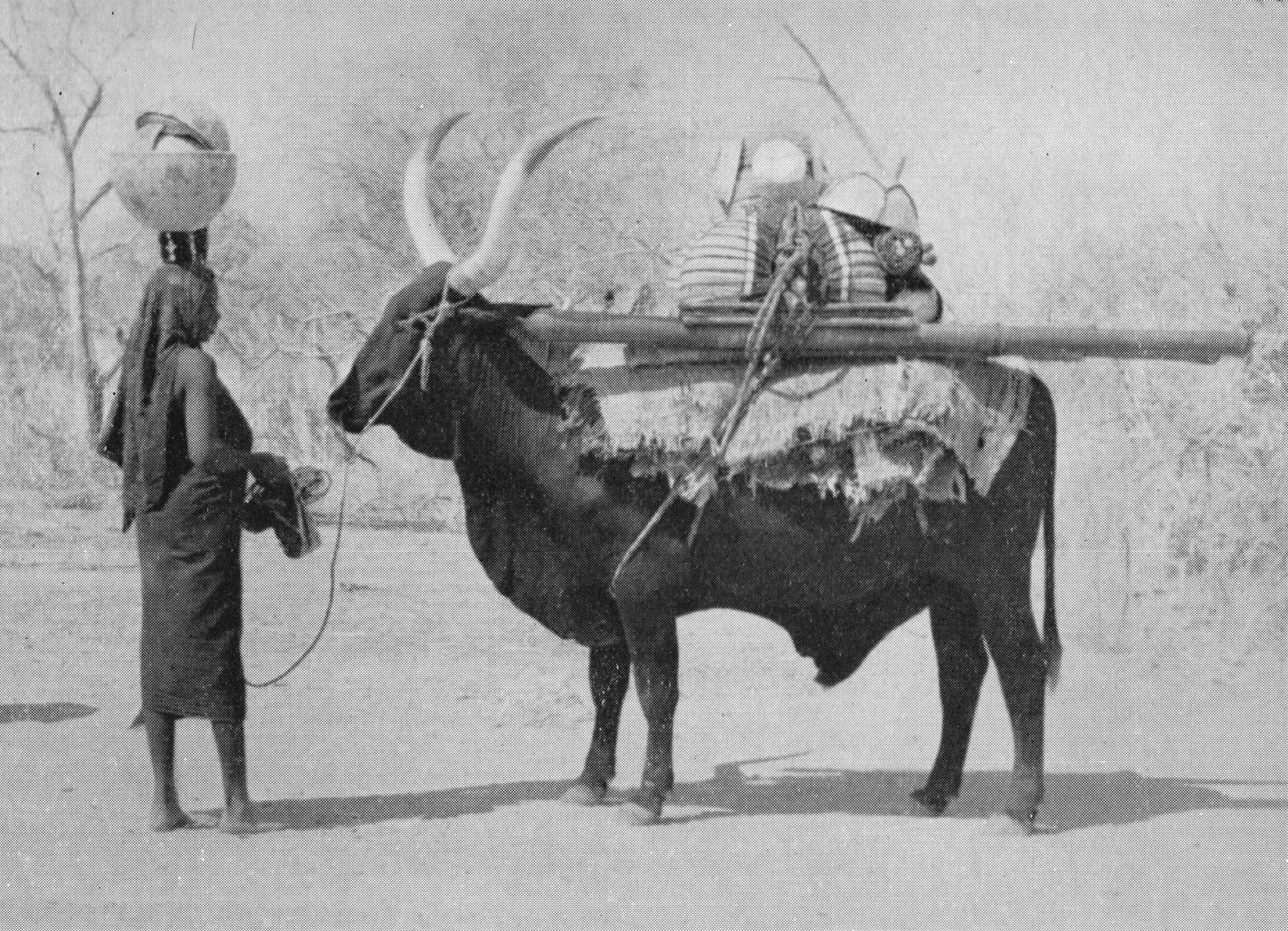
Fulani woman moving camp in the dry season prior to a 28km walk (Source: Stenning 1959, p. ii, plate 1)
This website contains my complete PhD thesis Modelling Early Food Production in the Mid Holocene of the Eastern Sahara. A Sustainable Rural Livelihood Approach, completed and submitted at UCL and awarded in February 2019.
The thesis is available for download as a single document on the UCL website, but due to the size of the entire project, the four sizeable case studies that were submitted on CD-Rom do not appear on the UCL website. I wanted to offer an accessible version of my thesis that included the case studies. Below is a description of how the website is organized. Additional images and illustrations will eventually be added, and certain sections expanded.
Objective of the thesis: The primary objective of the thesis was to use a new approach derived from development economics to examine prehistoric pastoralist livelihoods during the mid-Holocene, when the eastern Sahara was drying up. All aspects of human livelihoods are considered in six inter-related categories: natural, physical, subsistence, human, social (including ideological and religious), and personal. Operating on these are a number of livelihood variables, including vulnerabilities, opportunities and institutional, economic and social structures. As the aim was to recreate prehistoric livelihood strategies, modern ethnographic data was of particular importance in the research, employed to understand some of the many options that may have been available to prehistoric groups and the constraints that may have operated on them. One thread of the research was to gain an understanding of modern livelihoods with a view to exploring prehistoric livelihoods, an approach that is discussed in chapter 1. The thesis abstract is as follows:
The thesis employs an approach adapted from the Sustainable Rural Livelihoods (SRL) model, which was pioneered in development economics. The model provides both descriptive and explanatory components. The purpose of the research is to determine whether the SRL approach can improve the handling of archaeological data and its interpretation. It has been tested in four case studies focusing on early food production in marginal areas of the mid-Holocene eastern Sahara. It assesses how livelihoods were practiced in terms of risk and sustainability. A strength of the SRL approach is that it incorporates the belief that all aspects of a livelihood should be allocated equal value, including economic, ecological, human wellbeing and social assets. In particular it provides the opportunity to evaluate a qualitative model to improve an understanding of the variables that might have influenced livelihood strategies in prehistory. Ethnographic data has been employed to inform an understanding of the risks and opportunities confronting populations living in arid and semi-arid environments. In the penultimate chapter the thesis compares the findings from the four case studies to test the value of the SRL model for drawing inferences about risk, opportunity and sustainability in arid and semi-arid environments. Whilst the research is not problem-orientated it does identify gaps in current research with a view to recommending new research priorities.
The main body of the thesis, including the appendices but minus the case studies, can be downloaded from the Thesis page, or alternatively each chapter can be downloaded separately from the same page.
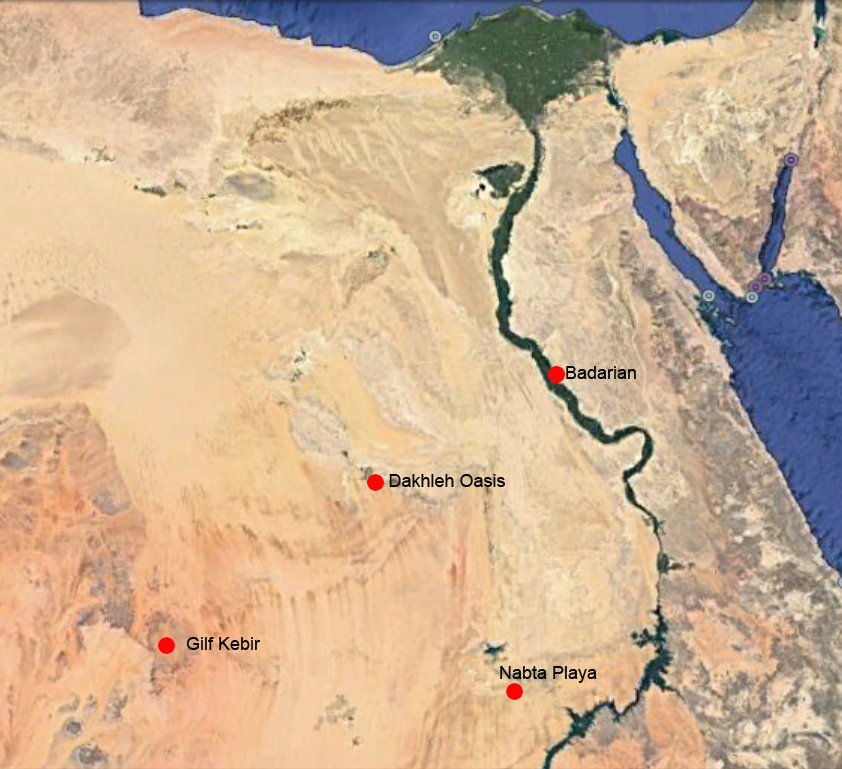 The thesis is supported by four case studies all looking at sites in the late Neolithic (Nabta Playa, the Badarian, Gilf Kebir and Dakhleh Oasis), which are saved on their own tab and are also available as PDFs on the Case Studies home page. For those whose primary interest is in one or more of the case studies, it is strongly recommended that you read Chapters 1 (introduction), 2 (explanation of the modelling approach), 5 (ethnographic research that informed the case studies), the relevant parts of 6 (background information to the case studies, including excavation history and notes about chronology), and 7 (the SRL template used in all the case studies), all of which are essential to an understanding of how the case studies were compiled and what they are designed to achieve. The case studies were never designed to be read as stand-alone pieces. If you do venture into the case studies, I suggest that you download the PDF versions because I have noticed problems with the way in which some of the data in the tables is displayed and it will take time to fix them.
There are seven appendices, of which Appendix C, which looks at lactose intolerance, and Appendix E, tabulated information about human nutritional requirements and the consequences of nutritional shortages, may be of use for those interested in prehistoric nutrition.
The full bibliography is also provided, covering the main thesis, the appendices and the case studies. It probably doesn’t hold any records but it is still embarrassingly long! Some archaeological books and papers and many resources for development economics are available online, so wherever possible links have been provided (all last checked June 2019).
Please note that chapter 5, The Vulnerability context – Risk and Uncertainty in Dryland Environments, which looks at the livelihood options available to pastoralists in dryland areas, has been reproduced in its penultimate form, before it was reduced to conform to the required word count when an additional chapter had to be slotted in. The original version has been chosen because the livelihood options described in this chapter may be of use for other researchers who wish to make use of ethnographic data to attempt to understand livelihood choices made by pastoralists in dryland environments.
Chapter 8 is a substantially abridged version of the Nabta Playa Ru’at al Baqar (Late Neolithic) case study, the full version of which appears under the Case Studies tab.
Contact details are at the end of this page. Please yell if you have any observations, questions, corrections or ideas for building on this research. You can also get hold of me on Facebook at the PREGYPT group page, which I moderate, and which focuses on the prehistory of the eastern Sahara, with particular reference to Egypt and Nubia.
The website’s URL, POL Study, was a very early choice and stood for for Pastoralist Opportunities and Livelihoods. I probably ought to have sorted out a new website address, but the case studies had already been posted here as a back-up for the CD-Rom that was submitted with the thesis, so I took the line of least resistance and retained it.
Version control
This website was an ongoing project following submission to the examiners. After only a month online, and liberated from the constraints of the dreaded obligatory word count, I made a number of significant changes to chapter 5, which originally had to be severely curtailed. Other changes shifted the chapters away from the submitted version. Each change made took the website further from the original thesis, so it is important to highlight where these changes have been made. You will find dates at the end of some pages to indicate that changes to those pages have been made. Please see the Version control page for how version control on this site is managed.
How to use this site
 The content of the thesis has been divided into four sections. The first is the main body of the thesis, which contains all of the chapters that were submitted. The second section contains the appendices, the third contains the four case studies and the final section is the bibliography for both the main thesis and the case studies.
In each case, the menu links at the top of all the pages page perform two functions. First, they act as a home page for each section, so if you click on any menu link (Thesis, Appendices, or Case Studies) you will go to a introductory page that contains explanatory text, including thoughts that have occurred to me since submitting the thesis, as well as hyperlinks that give access to the individual chapters and appendices and links to PDF versions of pages. Second, when you hover the cursor over the menu link (Thesis, Appendices and Case Studies) you will see drop-down menu for faster access to individual chapters and appendices. The text on the drop-down menus is abbreviated in order to fit them in to the confined space, but you will find the full chapter headings on each of the pages.
All of the images on this site, including tables, can be clicked on to see a larger version.
A note on copyright
The text is the copyright of Andie Byrnes 2018 and 2019.
Photographs and illustrations are credited throughout the site and are the copyright of the individual or organization that published the image. A number of images on this website are taken from books and academic papers. I am tracking down the owners of these images with a view to seeking permission to use them both here and for for publishing my thesis on the UCL website, but hope that their use here will be acceptable in the interim. If you are the owner of an image on this site, I would be glad to hear from you. Any images that you do not want me to use will of course be removed.
My thanks
I would like to thank my supervisors Professor Dorian Fuller and Dr Andrew Reid for their support during the completion of the thesis. Particular thanks are owed to Andrew Reid for continuing to advise me during the period of his sabbatical. I would also like to thank Professor Fekri Hassan, Dr Andrew Garrard and Professor Andrew Bevan for their advice, as well as Dr Mark Altaweel (UCL) and Dr Penny Wilson (University of Durham), the examiners at my viva. Many warm thanks are due to my mother and father Barbara and William Byrnes for their ongoing support and encouragement, and to Cheryll Agg for her willingness to undertake proof reading. Mention should also be made of the late, great Geoffrey Tassie, who introduced me to Egyptian archaeology in the field and is much missed.
Contact me


Site updated 18th August 2019, this page updated 11th July 2020
Important changes are shown on the Version Control page.
 Modelling Early Food Production in the Mid Holocene of the Eastern Sahara