
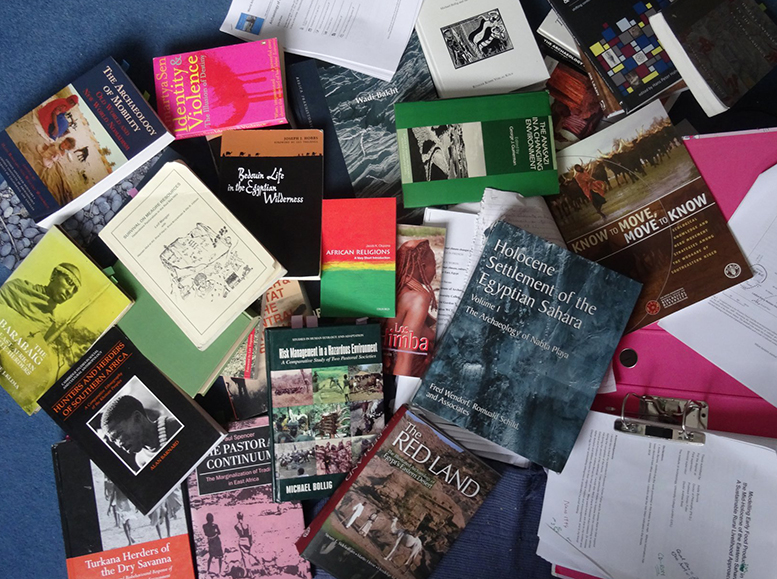
 Please note that where last names begin de, der, di, van, von etc, these are listed under the following proper name. e.g. the name “di Lernia” is listed under L and “de Finetti” is listed under F.
The bibliography includes references for the four case studies and the appendices as well as the main thesis.
If your browser is Mozilla Firefox you can search for individual references using Edit> Find In This Page . . . This produces a search field at the bottom left of your browser window, which will search the page for keywords, such as an author name. If you are using Google Chrome you can locate the search field by clicking the Customize and Control button (grey circle with three dots arranged vertically) and about two thirds down the list you will see Find . . . which produces a search field at top right of your browser window.
Please note that when the site is updated with newly published information, or with information that was not included in the original thesis, this bibliography will be updated. The latest new items were added to bibliography 18th August 2019 (please see Version Control page for details). All URLs last accessed 12th June 2019.
Download as PDF (version date 20th July 2019). The Version Control page shows additions to the bibliography on this page that have not yet been added to the PDF.
Abati, F.G. 1998. 2nd Edition. Los Himba. Etnografía de una cultural ganadera de Angola y Namibia. Amarú Ediciones.
Aboul-Naga, A., Osman, M., A., Alary, V., Hassan, F., Daoud, I., Tourrand, J.A. 2014. Raising goats as adaptation process to long drought incidence at the Coastal Zone of Western Desert in Egypt. Small Ruminant Research 121 (2014), p.100-110.
Abraham, C. 2006. Unsettled Existence. New Scientist, 22nd April 2006, p.18.
Adedayo, A. A. 2012. How the Other Half Live. 119th Inaugural Lecture. University of Ilorin. The Library of Publications Committee, University of Ilorin.
Adelsberger, K.A. and Smith, J.R. 2010. Palaeolandscape and palaeoenvironmental interpretation of spring-deposited sediments in Dakhleh Oasis, Western Desert of Egypt. Catena 83, 2010, p.7-22
Adler, P.B., HilleRisLambers, J., Phaedon C., Kyriakidis, C., Guan, Q., and Levine, J.M. 2006. Climate variability has a stabilizing effect on the coexistence of prairie grasses. Proceedings of the National Academy of Sciences, August 22, 2006 vol. 103 no. 34. http://www.pnas.org/content/103/34/12793
Adriansen, H.K. 1999. Pastoral mobility as a response to climate variability in African drylands. Geografisk Tidsskrift – Danish Journal of Geography 1, p.1-10.
Adriansen, H.K. 2008. Understanding pastoral mobility: The case of Senegalese Fulani. The Geographical Journal, vol.174, Issue 3, September 2008, p.207–222
Agbe-Davies, A.S. and Bauer, A.A. 2010. Rethinking Trade as a Social Activity. An Introduction. In (eds.) Social Anthropology of Trade and Exchange. Left Coast Press, p.13-26
Agorsah, E.K. 1990. Ethnoarchaeology: The search for a self-corrective approach to the study of past human behaviour. The African Archaeological Review 8, p. 189-208
Alger, A.W. 2000. Social and ecological resilience: Are they related? Progress in Human Geography 24 (3): p.347-64
Aldenderfer, M.S. 1987 (ed). Quantitative Research in Archaeology: Progress and Prospects. Sage Publications.
Aldenderfer, M.S. 1987. Assessing the Impact of Quantitative Thinking on Archaeological Research: Historical and Evolutionary Insights. In (ed.) Aldenderfer, M.S. Quantitative Research in Archaeology: Progress and Prospects. Sage Publications.
Almasy, L. 1939. Unbekannte Sahara. Mit Flugzeug und Auto in der Libyshen Wüste. Leipzig.
Amat, P.V. 2010. La Ceramica Black Top. Estudio de Ceramica Predinastica Egipica. Quaderns de la Societat Catalana d’Egiptologia No.1, Societat Catalana d’Egiptologia
Andelkovic, B. 1995. The relations between Early Bronze Age I Canaanites and Upper Egyptians. Belgrade.
Anderson, D.A., Maasch, K.A., and Sandweiss, D.H., Elsevier Press, p.1-23.
Anderson, D.G., Joseph, J.W. and Reed, M.B. 1988. Fort Polk Historic Preservation Plan Comprehensive Cultural Resources Inventory. Garrow and Associates.
Anderson, D.G., Maasch, K.A. and Sandweiss, D.H. 2007. Climate and culture change: Exploring Holocene transitions, in Climate Change and Cultural Dynamics: A Global Perspective on Mid-Holocene Transitions, eds.
Anderson, D. M. Frederickson, E. L. Estell, R. E. 2012. Managing Livestock Using Animal Behavior: Mixed Species Stocking and Flerds. Encompass, February 2012, p.1-11
Anderson, M.K. 2005. Tending The Wild. Native American Knowledge And the Management of California’s Natural Resources. University of California Press
Anderson, N. 1973. Ecological and anthropological ecology. In Honigmann, J. (ed.), Handbook of Social and Cultural Anthropology. Rand McNally, p.179-240
Anderson, W.R.M. 1989. Badarian Burials: Possible Indicators of Social Inequality in Middle Egypt During the Fifth Millennium BC. Thesis Submitted for Degree of Master of Arts. April 1989. Published on McGill University website.
Anderson, W.R.M. 1992. Badarian Burials: Evidence of Social Inequality in Middle Egypt During the Early Predynastic Era. Journal of the American Research Center in Egypt, Vol. 29 (1992), p. 51-66
Andrews, C. 1994. Amulets of Ancient Egypt. University of Texas Press
Appadurai, A. 1996. Modernity at large: cultural dimensions of globalization. University of Minnesota Press.
Applegate, A., Gautier A., and Duncan S. 2001. The North tumuli of the Nabta Late Neolithic ceremonial complex. In (eds.) Wendorf, F. Schild, R. and Associates. Holocene Settlement of the Egyptian Sahara, Volume 1. Kluwer Academic/Plenum Publishers, p.468–88
Applegate, A., and Zedeño, N. 2001. Site E-92-9: A possible Late Neolithic solar calendar. In (eds.) Wendorf, F. Schild, R. and Associates Holocene Settlement of the Egyptian Sahara, Volume 1. Kluwer Academic/Plenum Publishers, p.463–67
Arkell, A.J. 1953. Shaheinab. An Account of the Excavation of a Neolithic Occupation Site Carried Out for the Sudan Antiquities Service in 1949-50. Oxford University Press
ARKive initiative of Wildscreen n.d. http://www.arkive.org
Arnold, D.E. 1985. Ceramic Theory and Cultural Process. Cambridge University Press
Ascher, R. 1961. Analogy in Archaeological Interpretation. Southwestern Journal of Anthropology 17, p.317-325.
Ashley, C. and Carney, D. 1999. Capital and capabilities: A framework for analyzing peasant viability, rural livelihoods and poverty. World Development 27(12), p.2021-2044
Asi, L.N. and Teri, D.L. 2016. Influence of food taboos on nutritional patterns in rural communities in Cameroon
International Review of Social Research 2016; 6(1), p.35–39
Aston, B., Harrell, J.A. and Shaw, I. 2000. Stone. In Nicholson, P.T. and Shaw, L. (eds.) Ancient Egyptian Materials and Technology. Cambridge University Press, p.5-77
Atherton, J.H. 1983. Ethnoarchaeology in Africa. African Archaeological Review. 1, p.75-104
Atta-Krah, K. 2006. Integrated Natural Resource Management in Practice: Enabling Communities to Improve Mountain Livelihoods and Landscapes. In (eds.) Amede, T., German, L., Rao, S., Opondo, C. and Stroud, A. Integrated Natural Resources Management and Genetic Diversity: Two Sides of the Coin for Sustainable Livelihoods and Development. Conference Proceedings: Integrated Natural Resource Management in practice. African highlands initiative, p.7-17
Attenborough, R. 2002. Ecology, homeostasis and survival in human population dynamics. In (eds.) Macbeth, H. and Collinson, P. Human Population Dynamics. Cross-Disciplinary Perspectives. Cambridge University Press, p.186-208
Aumassip, G. 1993. Note sur la péterie du Djebel Ouenat. Dossiers et Recherches sur l’Afrique 1, 1993, p.5-34
Bagnold, R.A. 1931. Journeys in the Libyan Desert 1929 and 1930. Geographical Journal 78(6), p.524-535.
Bagnold, R.A. 1933. A further journey through the Libyan Desert. Geographical Journal 83(2), p.103-126
Bagnold, R.A. 1935. Libyan Sands. London
Bagnold, R.A. 1982. Foreword. In (eds.) El Baz, F. and Maxwell, T.A. Desert Landforms in Southwest Egypt. NASA
Bagnold, R.A. and Harding King, W.J. 1931. Journeys in the Libyan Desert 1929 and 1930. The Geographical Journal 78(6) (December 1931), p.524, 526-535
Bagnold, R.A., Sandford, K.S., Shaw, W.B.K., Moreau, R.E., Riley, N.D., Hutchinson, T. and Craig, V.F. 1933. A Further Journey Through the Libyan Desert (Continued). The Geographical Journal, 82(3) (September 1933), p.211-235
Bagnold, R.A., Myers, O.H., Peel, R.F., and Winkler, H.A. 1939. An expedition to the Gilf Kebir and Uweinat 1938. The Geographic Journal 93, p.281-313.
Bailey, D., Whittle, A. and Cummings, V. 2005. (Un)settling the Neolithic. Oxbow 2005.
Bailey, D. and Whittle, A. 2005. Unsettling the Neolithic: breaking down concepts, boundaries and origins In (eds.) Bailey, D., Whittle, A. and Cummings, V. 2005. (Un)Settling the Neolithic. Oxbow, p.1-7.
Bailey, G.N. 1981. Concepts, Timescales and Explanations in Economic Prehistory. In (eds.) Bailey, G. and Sheridan, A. Economic Archaeology. BAR International Series 96.
Bailey, G.N. 1983. Concepts of time in Quaternary Prehistory. Annual Review of Anthropology 12, p.165-192.
Bailey, G.N. 1987. Breaking the time barrier. Archaeological Review from Cambridge 6, p.5-20
Bailey, G.N. 2007. Time perspectives, palimpsests and the archaeology of time. Journal of Anthropological Archaeology, 26(2), p.198-223.
Bailey, G.N. 2008. Time perspectivism: origins and consequences. In (eds.) Holdaway, S. and Wandsnider, L. Time in Archaeology: Time Perspectivism Revisited. Utah: University of Utah Press, p.13–30.
Balfet, H. 1965. Ethnographic observation in North Africa and Archaeological Interpretation: The Maghreb. In (ed.) Matson, F.R. Ceramics and Man. Viking Fund Publications in Anthropology 41. Wenner-Green Foundation p.161-177
Banks, K.M. 1984. Climates, culture and cattle. In The Holocene archaeology of the Sahara. Institute for the Study of Earth and Man. Southern Methodist University, Dallas
Baran, M., Váradyová, Z., Kráâmar S., Hedbávn, J. 2002. The Common Reed (Phragmites australis) as a Source of Roughage in Ruminant Nutrition. Acta Veterinaria Brno 2002, 71, p.445–449
Barakat, H.N. 1990. Plant Remains from El Omari In (eds.) Debono, F. and Mortensen, B. El Omari: a Neolithic settlement and other sites in the vicinity of Wadi Hof. Mainz
Barakat, H.N. 2001. Part I: Anthracological Studies in the Neolithic Sites of Nabta Playa, South Egypt. In (eds.) Wendorf, F. Schild, R. and Associates, Holocene settlement of the Egyptian Sahara. Volume 1. Kluwer Academic/Plenum Publishers, p.592-600.
Barakat, H.N. 2002. Regional pathways to agriculture in Northeast Africa. In (ed.) Hassan, F.A. Droughts, Food and Culture. Ecological change and food security in Africa’s later prehistory, Kluwer Academic, p.111-122.
Barakat, H.N. and el-Din Fahmy A.G. 1999. Wild grasses as ‘Neolithic’ food resources in the eastern Sahara – a review of the evidence from Egypt. In (ed.) Veen, M. van der 1999. The Exploitation of Plant Resources in Ancient Africa. Kluwer Academic and Plenum Publishers, p.33-46
Bard, K.A. 2008. An Introduction to the Archaeology of Ancient Egypt. Blackwell Publishing.
Bardhan, P. and Ray, I. 2008. Methodological approaches in economics and anthropology. In (eds.) Davis, J.B., Dofsma. The Elgar Companion to Social Economics. Cheltenham, Elgar Publishing Limited, p.427-456.
Bargatzky, T. 1989. Innovation and the integration of sociocultural systems. In (eds.) Van der Leeuw, S.E. and Torrence, R. 1989. What’s new? A Closer Look at the Process of Innovation. One World Archaeology 14. Unwin Hyman, p.16-26
Barkai, R. 2011. The evolution of Neolithic and Chalcolithic woodworking tools and the intensification of human production: axes, adzes and chisels from the Southern Levant. In (eds.) Davis, V. and Edmonds. M. Stone Axe Studies III. Oxbow, p.39-54
Barich, B.E. 1993. Culture and environment between the Sahara and the Nile in the Early and Mid-Holocene. In (eds.) Lech Krzyżaniak, L., Kobusiewicz, M. and Alexander, J. Environmental change and human culture in the Nile Basin and Northern Africa until the second millennium B.C. Poznań
Barich, B.E. 1998. People Water and Grain: Beginnings of Domestication. The Sahara and the Nile Valley. L’Herma di Bretschneider.
Barich, B. 2002. Cultural Responses to Climatic Changes in North Africa: Beginning and Spread of Pastoralism in the Sahara. In (ed.) Hassan, F. Droughts, Food and Culture. Ecological change and food security in Africa’s later prehistory. Kluwer Academic
Barich, B. and Hassan, FA 2000. A stratified sequence from Wadi el-Obeiyd, Farafra: new data on subsistence and chronology of the Egyptian Western Desert. In (eds.) Krzyzaniak, L. and Kroeper, K. and Kobusiewicz, M., Recent Research into the Stone Age of Northeastern Africa. (p. 11-20). Poznan Archaeological Museum.
Barich, B. and Lucarini, G. 2002. Archaeology of Farafra Oasis (Western Desert, Egypt) – A Survey of the most recent research. Archéo-Nil 12
Barich, B.E., Lucarini, G., Hamdan, M.A. and Hassan. F. A. (eds.) 2014. From Lake to Sand: The Archaeology of The Farafra Oasis Western Desert, Egypt. Edizioni All’Insegna del Giglio.
Barker, G. (ed.) 1996. Farming the Desert. The UNESCO Libyan Valleys Archaeological Survey. Volume 1: Synthesis. UNESCO Publishing Department of Antiquities (Tripoli) for Libyan Studies
Barker, G. 2006. The Agricultural Revolution in Prehistory: Why Did Foragers Become Farmers? Oxford University Press
Barker, G. and Gilbertson, D. (eds.) 2000. The Archaeology of Drylands. Living at the Margin. One World Archaeology 39. Routledge
Barnard, A. 1992. Hunters and Herders of Southern Africa. A Comparative Ethnography of the Khoisan Peoples. Cambridge University Press.
Barnard, A. 2007. From Mesolithic to Neolithic modes of thought. In (eds.) Whittle, A. and Cummings, V. Going Over: The Mesolithic-Neolithic Transition in North-West Europe. Proceedings of the British Academy 144, Oxford University Press, p.5-19.
Barnard, H. and Wendrich, W.Z. (eds.) 2008. The Archaeology of Mobility: Nomads in the Old and in the New World. University of California
Baron, A.G. 1981. Adaptive strategies in the archaeology of the Negev. Bulletin of the American Schools of Oriental Research No.242, Spring 1981, p.51-81
Barrett, J.C.B. 1991. The archaeology of social reproduction. In Barrett, J.C.B., Bradley, R. and Green, M. Landscape, Monuments and Society. The Prehistory of Cranbourne Chase. Cambridge University Press.
Barrett, J.C.B. 1994. Fragments from Antiquity. An Archaeology of Social Life in Britain, 2900-1200BC. Blackwell.
Barrow, E., Davies, J., Berhe, S. Matiru, V., Mohamed, N., Olenasha, W., Rugadyar, M. 2007. Pastoralists’ species and ecosystems knowledge as the basis for land management. Policy Brief No.3. June 2007. IUCN Eastern Region Office. World Initiative for Sustainable Pastoralism.
Barth, F., 1969. Introduction. In: Barth, F. (Ed.), Ethnic Groups and Boundaries; the Social Organization of Culture Difference. Universitetsforlaget, Oslo, p. 9–38.
Bassi, M. 1997. Hunters and pastoralists in East Africa: the case of the Waata and the Ormomo-Borana. In (eds.) Barich, B.E. and Gatto, M.C. Dynamics of populations, movements and responses to climatic change in Africa
Bates, D.G. 1973. Nomads and Farmers: A Study of the Yörük of southeastern Turkey. Ann Arbor. University of Michigan.
Baumgartel, E.J. 1955. The cultures of prehistoric Egypt. Published on behalf of the Griffith Institute, Ashmolean Museum, Oxford, by Oxford University Press
Baumgartner R. and Högger R. (eds.) 2004. In Search of Sustainable Livelihood. Managing Resources and Change. Sage.
El Baz, F. and Maxwell, T.A. 1982 (eds.) Desert Landforms in Southwest Egypt. A Basis for Comparison with Mars. NASA
Beadnall, J.J.L. 1931. Zerzura. Geographical Journal 77(3) (March 1931), p.245-250
Beaumont, P. 1989. Drylands. Environmental Management and Development. Routledge
Behnke Jr., R.H. Scoones, I. and Kervon, C. (eds.) 1993. Range Ecology at Disequilibrium. Oversees Development Institute
Behnke Jr, R.H, and Scoones, I. 1993. Rangeland Management in Africa. Range Ecology at Disequilibrium. Oversees Development Institute
Beidelman, T.O. 1967. The Matrilineal Peoples of Eastern Tanzania (Zaramo, Luguru, Kaguru, Ngulu, etc.). Ethnographic Survey of Africa, East Central Africa, Part XVI.) International African Institute.
Bekure, S. and Grandin, B.E. 1991. Introduction. In (eds.) Bekure, S, der Leeuw, P.N., Grandin, B.E., Neate, P.J.H. Maasai herding: analysis of the livestock production system of Maasai pastoralists in eastern Kajiado district, Kenya. Systems Study 4. International Livestock Centre for Africa, p. 1-4. https://cgspace.cgiar.org/handle/10568/4202
Belal, A., Briggs, J., Sharp, J. and Springuel, I. 2009. Bedouins by the Lake. Environment, Change and Sustainability in Southern Egypt. American University in Cairo Press.
Bell, J. 1992. On capturing agency in theories about prehistory. In (eds.) Gardin, J-C. and Peebles, C.S. Representations in Archaeology. Indiana University Press, p.30-55
Bell, J.A. 1994. Interpretation and testability in theories about prehistoric thinking. In (eds.) Renfrew, C. and Zubrow, E.B.W. The Ancient Mind: Elements of Cognitive Archaeology. Cambridge University Press, p.95-106
Bell, M. and Walker, M.J.C. 2005. Late Quaternary Environmental Change: Physical and human perspectives. Pearson, Harlow.
Bellwood, P. 2005. First Farmers. The Origins of Agricultural Societies. Blackwell Publishing.
Beltrami, V. 1997. Some information on Inter-Personal and Familial Relationships Among The Teda of Tibesti. In (eds.) Barich, B. and Gatto, M.C. 1997. Dynamics of populations, movements and responses to climatic change in Africa. Bonsignori Editore, p.76-89
Bender, B. 1992. Theorising landscapes, and the prehistoric landscapes of Stonehenge. Man 27, p.735-55.
Bender, B. (ed.) 1993a. Landscape: politics and perspectives. Berg.
Bender, B. 1993b. Introduction: Landscape – Meaning and Action. In (ed.) Bender, B. Landscape: politics and perspectives. Berg, p.1-17
Bender, B., Hamilton, S. and Tilley, C. 1997. Leskernick: Stone worlds; alternative narrative; nested landscapes. Proceedings of the Prehistoric Society 63, p.147-78
Bender, D.A. 2014. Nutrition. A Very Short Introduction. Oxford University Press.
Bentley, 1987. Ethnicity and practice. Comparative Studies in Society and History 29, p.25-55
Bennett, D.J. 1998. Randomness. Harvard University Press
Berggren, A. and Hodder, I. 2003. Social Practice, Method and Some Problems of Field Archaeology. In (ed.) Hodder, I. Archaeology Beyond Dialogue. University of Utah Press
Berkes, F. 2012 (third edition). Sacred Ecology. Traditional ecological knowledge and resource management. Routledge
Berkes, F., Colding, J. and Folke, C. (eds.) 2003. Navigating for social-ecological systems: building resilience for complexity and change. Cambridge University Press
Bernbeck, R. 2008. An Archaeology of Multisited Communities. In (eds.) Barnard, H. and Wendrich, W. The Archaeology of Mobility: Old World and New World Nomadism. Los Angeles, California: Cotsen Institute of Archaeology, University of California, p. 43-77
Berners-Lee, T. 2001. The Semantic Web. Scientific American, Vol.284, No.5, May 2001, p.34-43
Bettinger, R.L. 1993. Doing Great Basin Archaeology Recently: Coping with Variability. Journal of Archaeological Research, vol.1, no.1, (March 1993), p.43-66.
Bettinger, R.L. 2001. Holocene hunger-gatherers. In (eds.) Feinman, G.M. and Price, T.D. Archaeology at the Millennium: A Sourcebook. Kluwer Academic/Plenum Publishers, p.137-195
Bettinger, R.L. 2006. Agriculture, Archaeology and Human Behavioral Ecology. In (eds.) Kennet, D.J. and Winterhalder, B. Behavioral Ecology and the Transition to Agriculture. University of California Press, p.304-322.
Bianco, B. 2000. Gender and material culture in West Pokot, Kenya. In (ed.) Hodgson, D.L. Rethinking Pastoralism in Africa. James Currey Ltd, p.29-42
Binford, L. 1972. An Archaeological Perspective. Seminar Press.
Binford, L. 1976. Forty Seven Trips. In (ed.) Hall, E.S. Contributions to anthropology: The interior peoples of Northern Alaska. Archaeological Survey Canada 49, p.299-331.
Binford, L. 1981. Behavioral archaeology and the “Pompeii Premise.” Journal of Anthropological Research 37, p.195-208
Binford, L. 1986. In Pursuit of the Future. In (eds.) Meltzer, D.J., Fowler, D.D. and Sabloff, J.A. American Archaeological Past and Future. Smithsonian Institute, p.459-79
Binford, S.R. and Binford, L. 1968. New Perspectives in Archaeology. Aldine Press
Binns, J.A. 1992. Chapter 6. Traditional agriculture, pastoralism and fishing. In (ed.) Gleave, M.B. Tropical Agricultural Development. Longman Scientific and Technical, p.153-91
Bintliff, J. L. 2014. Sacred worlds or sacred cows? Can we parameterize past rituals? In (eds.) Meier, T. and Tillessen, P. Archaeological Imaginations of Religion. Budapest, Archaeolingua, p.249-263.
Bintliff, J and Pearce, M. (eds.) 2011. The Death of Archaeological Theory? Oxbow Books
Bleed, P. 1986. The optimal design of hunting weapons: Maintainability or reliability. American Antiquity 51, p.737-747
Blench, R. and MacDonald, K. (eds.) 2000. The origin and development of African livestock: Archaeology, genetics, linguistics and ethnography. UCL Press
Bloch, M. 2008. Why religion is nothing special but is central. Philosophical transactions of The Royal Society B: biological sciences, 363 (1499), p. 2055-2061.
Bobrowski, P., Czekaj-Zastawny, A. and Schild, R. 2014. Gebel el-Muqaddas (site E-06-4). The Early Neolithic Tumuli from Nabta Playa (Western Desert, Egypt). In Anderson, J.R. and Welsby, D.A. Proceedings of the 12th International Conference for Nubian Studies. Peeters.
Bobrowski, P., Schild, R. and Calderoni, G. 2006. Late Neolithic Settlements (E-01-2 “CAMP”) FROM THE Gebel Ramlah Playa Basin, South-Western Desert of Egypt (preliminary report). In (eds.) Kroeper, K., Chłodnicki, M. and Kobusiewicz, M. Archaeology of Early Northeastern Africa: In Memory of Lech Krzyżaniak, Heidelberg: Propylaeum, 2017 (Studies in African Archaeology, Vol. 9), p.213-222.
https://books.ub.uni-heidelberg.de/propylaeum/catalog/book/218?lang=en
Bockli, H. and Marai, M. 2008. Rock art and vertical transhumance at Jebel Uweinat. Sahara 19 (2008), p.143-146
Bogucki, P. 1995. Prelude to agriculture in north-central Europe. In (ed.) Campana, D. before Farming: Hunter-Gatherer Society and Subsistence. MASCA Research Papers in Science and Archaeology. Supplement to Volume 12, University of Pennsylvania Museum of Archaeology and Anthropology p.105-116.
Boholm, A., Henning, A., and Krzyworzeka, A. 2013. Anthropology and decision making: An Introduction. Journal of Global and Historical Anthropology 65, p.97-113
Bollig, M. 1997. Risk and risk mitigation among the Himba pastoralists in northwestern Namibia. Nomadic Peoples 1, p.66-89
Bollig, M. 2006. Risk Management in Hazardous Environments. A comparative study of two pastoral societies. Springer
Bollig, M. 2009. Production and Exchange among the Himba of Northwest Namibia. In (eds.) Bollig, M. and Gewald, J.-B. People, Cattle and Land: Transformations of a pastoral society in Southwest Africa. Rüdgiger Köppe Verlag, p.271-298
Bollig, M. 2010. Kinship, Ritual and landscape Amongst the Himba of Northwest Namibia. In (eds.) Bollig, M. and Bubenzer, O. African Landscapes: Interdisciplinary Approaches. Springer
Bollig, M. and Bubenzer, O. (eds.) 2010. African Landscapes. Interdisciplinary Approaches. Springer
Bollig, M. and Österle, M. 2013. The Political Ecology of Specialisation and Diversification: Longterm
Dynamics of Pastoralism in East Pokot District, Kenya. In (eds.) Pastoralism in Africa: Past, Present and Future, Bollig, M., Schnegg, M. and Wotzka, H-P., Berghahn Books, p.289-315
Bollig, M., Schnegg, M., Wotzka, H-P. 2013. Pastoralism in Africa: Past, Present and Future. Berghahn
Bolten, A. and Bubenzer, O. 2007. Watershed analysis in the Western desert of Egypt. In (eds.) Bubenzer, O., Bolten, A. and Darius, F. 2007. Atlas of Cultural and Environmental Change in Arid Africa. Heinrich Barth Institut, p.22-3
Bonfiglioli, A.M. 1988. Dudal: Histoire de famille et histoire de troupeau chez un groupe de Woɗaaɓe du Niger. Cambridge University Press
Bontkes, T.F. 1991. On Dinka, Cattle and Grain: An interdisciplinary simulation study of a rural area in Southern Sudan. Wageningen Agricultural University Papers 91/3
Boone, J.L. 2002. Subsistence strategies and early human population: An evolutionary ecological perspective. World Archaeology, vol.34 (1), p.6-25
Boric, D. 2005. Deconstructing essentialisms: unsettling frontiers of the Mesolithic-Neolithic Balkans. In (eds.) Bailey, D., Whittle, A. and Cummings, V. (Un)settling the Neolithic. Oxbow, p.16-31
Boserup, E. 1965. The conditions of agricultural growth: the economics of agrarian change under population pressure. Allen & Unwin.
Bos-Seldenthus, J. 2007. Life and Traditions of the Ababda Nomads in the Egyptian Desert. The Junction Between Intangible and Tangible Heritage Management. International Journal of Intangible Heritage Vol.2, 2007, p.32-43
Boulos, L. and Nabil el-Hadidi, M. 1984. The Weed Flora of Egypt. American University in Cairo Press
Bourdieu, P. 1972 (1977). Outline of a Theory of Practice. Cambridge University Press
Bourdieu, P. and Waquant, L. 1992. An Invitation to Reflexive Sociology. Polity
Bradley, D and Loftus, R. 2000. Two Eves for Taurus? Bovine mitochondrial DNA and African cattle domestication. In Blench, R.M. and MacDonald, K.C. The Origins and development of African Livestock: archaeology, genetics, linguistics and ethnography, p.87-110. UCL Press
Bradley, R. 1994. Symbols and signposts – understanding the prehistoric petroglyphs of the British Isles. In (eds.) Renfrew, C. and Zubrow, E.B.W. The ancient mind: Elements of cognitive archaeology. Cambridge University Press, p.95-106
Bradley, R. 1998. The Significance of Monuments. Routledge.
Bradley, R. 1999. The Archaeology of Natural Places. Routledge.
Bradley, P. 1998a. Lithics from evaluations – help or hindrance? Lithics, no.19, 1998, p.87-91
Bradley, P. 1998b. Conclusions and the way forward. Lithics, no.19. 1998, p.93-95
Brass, M. 2003. Tracing the origins of the Ancient Egyptian Cattle Cult. In (eds.) Eyma, A.K. and Bennett, C.J. A Delta Man in Yebu, p.101-110.
Brass, M. 2007. Reconsidering the emergence of social complexity in early Saharan pastoral societies, 5000 – 2500 BC. Sahara 18, p.7-22
Briois, F. and Midant-Reynes, B. 2010. L’oasis de Kharga dans la Préhistoire: aux origins des culture prédynastiques. Archéo-Nil 20, p.43-50
Briois, F., Midant-Reynes, B., Marchand, S., Tristant, Y., Wuttmann, M., De Dapper, M., Lesur, J., and Newton, C. 2012. Neolithic occupation of an artesian spring: KS043 in the Kharga Oasis, Egypt. Journal of Field Archaeology 37 (3), p.178-91.
Brokensha, P. (1975). The Pitjantajara and their crafts. Aboriginal Arts Board. Australian Council.
Brookes, I.A. 1989a. Early Holocene basinal sediments of the Dakhleh Oasis region, south central Egypt. Quaternary Research, Vol. 32, Issue 2, September 1989, p. 139-152
Brookes, I.A. 1993. Geomorphology and Quaternary geology of the Dakhla Oasis Region, Egypt
Quaternary Science Reviews, Vol. 12, Issue 7, 1993, p. 529-552
Brooks, N. 2006a. Cultural responses to aridity in the Middle Holocene and increased social complexity. Quaternary International 151 (2006) p.29-49
Brooks, N. 2006b. Climate change, drought and pastoralism in the Sahel. Discussion note for the World Initiative on Sustainable Pastoralism, prepared by Nick Brooks, November 2006. Questions on adaptation http://bit.ly/2EDKyTg (IUCN)
Brooks, N., Chiapello, I., Di Lernia, S., Drake, N., Legrand, M., Moulin, C., and Prospero, J. 2005. The Climate-Environment-Society Nexus in the Sahara from Prehistoric Times to the Present Day. Journal of North African Studies, Vol.10, no.3-4 (September-December 2005), p.253-292
Brouwers, J.H.A.M. 1993. Rural People’s Response to Soil Fertility Decline: the Adja Case (Benin). Agricultural University Wageningen
Brown, J.A. 1989. The beginnings of pottery as an economic process. In Van der Leeuw, S.E. and Torrence, R. (eds.) 1989. What’s new? A Closer Look at the Process of Innovation. One World Archaeology 14. Unwin Hyman, p.203-221
Brunton, G. 1929a. The Beginnings of Egyptian Civilization. Antiquity, Vol.3, Iss.12, December 1929, p.456-467
Brunton, G. 1929b. Guide to Egyptian Antiquities from Mostagedda, Badarian District, Middle Egypt, 1929. Sculpture Gallery, British Museum, July 1st to July 31st 1930.
Brunton, G. 1937. Mostagedda and the Tasian Culture. London.
Brunton, G. 1948. Matmar. London
Brunton, G. and Caton-Thompson, G. 1928. The Badarian Civilisation and Predynastic Remains near Badari. BSAE 46
Bubenzer, O. and Riemer, H. 2007. Holocene climatic change and human settlement between the Central Sahara and the Nile Valley: Archaeological and Geomorphological Results. Geoarchaeology Vol 22, No.5, p.607-620.
Bubenzer, O., and Ritter, M. 2007. From hyperarid to semiarid – actual climatic conditions in northeastern and southwestern Africa. In Bubenzer, O., Bolten, A. and Darius, F. (eds.) Atlas of Cultural and Environmental Change in Arid Africa. Heinrich Barth Institut, p.18-19
Buccatelli, G. 1998. Archaeology’s Publication Problems (Review/Essay). Near Eastern Archaeology, Vol. 61, No.2. (June 1998), p.118-120
Bunbury, J. and Ikram, S. Kharga Oasis: a Saharan pathwork of lakes. Egyptian Archaeology no.45, Autumn 2014, p.9-12
Burch, W.R., Machlis, G.E., and Force, J.E. 2017. The structure and dynamics of human ecosystems. Towards a model for understanding and action. Yale University Press.
Burgur, O. 2002. A multi-scale perspective for archaeological survey. M.A. Thesis. Colorado State University. Spring 2002. http://www.greybull.org/BurgerThesis_2002.pdf
Burke, A. 2012. 111 Roadside Plants. Namibia Scientific Society
Butler, A. 2002. Sustainable agriculture in a harsh environment: An Ethiopian perspective. In (ed.) Hassan, F.A. Droughts, Food and Culture. Ecological Change and Food Security in Africa’s later Prehistory, p.171-188
Butler, C. 2005. Prehistoric Flintwork. Tempus.
Butz, R.J. 2009. Traditional fire management: historical fire regimes and land use change in pastoral East Africa International Journal of Wildland Fire 2009, 18, p.442–450
Butzer, K.W. 1958. Quaternary Stratigraphy and Climate in the Near East. Bonner Geographische Abhandlungen 24 (1958) P.103-128
Butzer, K.W. 1976. Early Hydraulic Civilization in Egypt – A study in cultural ecology. The University of Chicago Press. https://oi.uchicago.edu/research/publications/misc/early-hydraulic-civilization-egypt-study-cultural-ecology
Butzer, K,W. 1982. Archaeology as Human Ecology. Cambridge University Press
Butzer, K.W. 1999. Climatic History. In Bard, K.A. Encyclopedia of the Archaeology of Ancient Egypt. Routledge, p.195-198
Byrnes, A. 2014. Gertrude Caton-Thompson on the problems of creating a unified Predynastic chronology, 1928. Egyptological. 28th April 2014.
http://egyptological.com/2014/04/29/gertrude-caton-thompson-on-the-problems-of-creating-a-unified-predynastic-chronology-1928-12114
CABI (Invasive Species Compendium) 2008. Datasheet; Tamarix aphylla (athel) http://www.cabi.org/isc/datasheet/52483
Calvo, M., Javaloyas, D., Albero, D., Garcia-Rosselló, J. and Guerrero, V. 2011. The ways people move: mobility and seascapes in the Balearic Islands during the late Bronze Age (c.1400–850/800 bc), World Archaeology, 43:3, 345-363
Campbell, B., Gordon, I.J., Luckert, M.K., Petheram, L. and Vetter, S. 2006. In search of optimal stocking regimes in semi-arid grazing lands: One size does not fit all. Ecological Economics 60, p.75-85
Campbell, B., Sayer, J.A., and Frost, P. 2001. Assessing the performance of natural resource systems, Conservation Ecology 5 (2001), 22. www.consecol.org/vol15/iss2/art22
Campbell, C.S. 2009. Poaceae. Encylopaedia Britannica. Last updated 15th September 2009. https://www.britannica.com/plant/Poaceae
Cancian, F. 1980. Risk and Uncertainty in Agricultural Decision Making. In Bartlett, P.F. (ed.) Agricultural Decision Making: Anthropological Contributions to Rural Development. Academic Press, p.161-176
Caneva, I. 1991. Prehistoric herders, hunters and tradesmen in central Sudan: data from the Geili region. In Davies, W.V. (ed.) 1991. Egypt and Africa: Nubia from Prehistory to Islam. British Museum Press
Caneva, I. 1992. Predynastic Cultures of Lower Egypt: The Desert and the Nile. In Van den Brink (ed.), The Nile Delta In Transition: 4th-3rd Millennium BC, p.217-224
Carney, D. (ed.) 1998. Sustainable Rural Livelihoods – What contribution can we make? Papers presented at the Department for International Development’s Natural Resources Advisers’ Conference, July 1998 (NRAC). Department for International Development 1998
Carney, D. 1999. Approaches to Sustainable Livelihoods for the Rural Poor. ODI (Overseas Development Institute). https://www.odi.org/resources/docs/3093.pdf
Carney, D. 2003. Sustainable Livelihoods Approaches: Progress and Possibilities for Change. DFID (Department For International Development).
Carrier, J.G. (ed.) 2005. A Handbook of Economic Anthropology. Edward Elgar Publishing
Carrier, J.G. and Miller, D. 1999. From Private Virtue to Public Vice: Anthropology and Economy. In (ed.) Moore, H. Anthropological Theory Today. Polity Press, p.24-47
Casey, J. 2005. Holocene Occupations of the Forest and Savannah. In Stahl, A,B. (ed.) African Archaeology p.225-248
Cashdan. E. 1990. Introduction. In (ed.) Cashdan, E. Risk and uncertainty in tribal and peasant economies. Westview Press, p.1-16
Casimir, M.J. and Bollig, M. 1994. Milchverabeitung und Nahrungsmittelknappheit bei Afrikanischen Pastralisten. In Bollig, M. and Klees, F. (eds.) Überlebensstrategien in Afrika. Heinrich Barth p.227-53
Castillos, J.J. 1982. A Reappraisal of the Published Evidence on Egyptian Predynastic. Benben Publications/S S E A Publications.
Castillos, J.J. 2000. Social development in Predynastic Egypt: Matmar, a case study. In Krzyżaniak, L. Kroeper, K. and Kobusiewicz, M. (ed.) Recent Research into the Stone Age of Northeastern Africa, Studies in African Archaeology, Poznań p.159-170
Catley, A. 2002. Community-based animal healthcare and pastoral livelihoods. Paper for the Ethiopian Veterinary Association 16th Annual Conference 5th-6th June 2002, Addis Ababa, Ethiopia, Animal health and Poverty Reduction Rates.
Caton-Thompson, G. 1952. Kharga Oasis in Prehistory. Athlone Press
Caton-Thompson, G. and Gardner, E. 1934. The Desert Fayum, Volumes 1 and 2. The Royal Anthropological Institute
Caton-Thompson, G. and Whittle, E. 1975. Thermoluminscence dating of the Badarian. Antiquity, vol. 49, issue 194, June 1975, p.89-97
Cavalli-Sforza, L.L., Menozzi, P. and Piazza, A. 1994. The History and Geography of Human Genes. Princeton University Press.
Chaix, L., Dubosson, J., Honegger, M. 2012. Bucrania from the Eastern Cemetery at Kerma (Sudan) and the Practice of Cattle Horn Deformation. Prehistory of Northeastern Africa; New Ideas and Discoveries. Studies in African Archaeology 11. Poznań Archaeological Museum 2012, p.189-212
Chamberlain, T.C. 1890. The method of working hypotheses. Science (old series) Vol.15, p. 92-96; reprinted 1965, Vol.148, p. 754-759.
Chambers, R. 2008. Revolutions in Development Inquiry. Earthscan
Chambers, R. and Conway, G. 1991. Sustainable Rural Livelihoods: Practical concepts for the 21st Century: IDS Discussion Paper 296. Brighton Institute for Development Studies
https://www.ids.ac.uk/publication/sustainable-rural-livelihoods-practical-concepts-for-the-21st-century
https://opendocs.ids.ac.uk/opendocs/bitstream/handle/123456789/775/Dp296.pdf?sequence=1
Chambers, R. and Conway, G.R. 1992. Sustainable livelihoods in practice: Early applications of concepts in rural areas. Natural Resource Perspectives No.42. Overseas Development Institute, London
Chávez-Juárez, F. 2017. On the Role of Agent-based Modeling in the Theory of Development Economics. Review of Development Economics, 21(3), 713–730, 2017
Check, E. 2006. How Africa Learned to Love the Cow. Nature. Vol 444, 21, 28th December 2006, p.994-996.
Childe, V.G. 1953. New Light on the Most Ancient East. Frederick A. Praeger
Churcher, C.S. 1999. Holocene faunas of the Dakhleh Oasis. In Churcher, C.S. and Mills, A.J. (eds.) Reports from the Survey of the Dakhleh Oasis, Western Desert of Egypt, 1977-1987. Oxbow Books, p.109-15.
Churcher, C. S., Kleindienst, M. R. Wiseman, M. F. and McDonald, M. M. A. 2008. The Quaternary Faunas of Dakhleh Oasis, Western Desert of Egypt. In (ed.) M. F. Wiseman, The Oasis Papers 2. Proceedings of the Second International Conference of the Dakhleh Oasis Project. Dakhleh Oasis Project: Monograph 12. Oxbow Books p.3-24
Claassen, C. 2011. Waning pilgrimage paths and modern roadscapes: Moving through landscape in northern Guerrero, Mexico. World Archaeology 43/3, p.493-504.
Clare, L., Rouhling, E.J., Weninger, B. and Hilpert, J. 2008. Warfare in Late Neolithic/ Early chalcolithic Pisidia, Southwestern Anatolia. Climate induced social unrest in the 7th millennium BC. In (ed.) Budja, M. 15th Neolithic Studies. Documenta Praehistorica 35, p.65-92.
Clark, G.A. 1987. Paradigms and Paradoxes in Contemporary Archaeology. In (ed.) Aldenderfer, M.S. Quantitative Research in Archaeology: Progress and Prospects. Sage Publications.
Clark, J.G.D. 1939. Archaeology and Society. Methuen.
Clark, J.G.D. 1951. Folk-culture and the study of European prehistory. In (ed.) Grimes, W.F. Aspects of Archaeology in Great Britain and Beyond. Edwards, p.49-65
Clark, J.G.D. 1952. Prehistoric Europe: The Economic Basis. Methuen.
Clark, J.G.D. 1953a. Archaeological theories and interpretation: Old World. In (ed.) Kroeber, A.L. Anthropology Today. University of Chicago Press, p.343-383
Clark, J.G.D. 1953b. The economic approach to prehistory: Albert Reckitt Archaeological Lecture 1953. Proceedings of the British Academy 39, p.215-38
Clark, J.G.D. 1957 (third edition). Archaeology and Society. Methuen.
Clark, J.D.G. 1980. Human populations and cultural adaptation in the Sahara and the Nile during prehistoric times. In (eds.) Williams, M.A.J. and Faure, H. The Sahara and the Nile. Balkema p.527-582
Clark, J.D.G. 1982. The Identity of Man: as seen by an archaeologist. Methuen and Co. Ltd.
Clarke, D.L. 1968. Analytical Archaeology. Methuen.
Clarke, D.L 1972 (ed.) Models in Archaeology. Methuen.
Clarke, D.L 1973. Archaeology: The Loss of Innocence. Antiquity 46, p.6-18
Clarke, D.L. 1978 (2nd edition). Analytical Archaeology. Methuen.
Classen, and Kindermann, K. 2009. Djara – Cave Art in Egypt’s Western Desert. Archéo-Nil no.19 2009, p.47-66
Clayton, P.A. 1933a. A reconnaissance of the Gilf Kebir by the late Sir Robert Clayton East Clayton. Geographical Journal 18(3), p.249-254
Clayton, P.A. 1933b. The Western Side of the Gilf Kebir. Geographical Journal 18(3), p.254-259
Cleuziou, S. 2007. Evolution toward Complexity in a Coastal Desert Environment: The Early Bronze Age in the Ja’alan, Sultanate of Oman. In (eds.) Kohler, T.A., and van der Leeuw, S.E. 2007. The Model-Based Archaeology of Socionatural Systems. The School for Advance Research, p.209-228
Cliggett, L. 2005. Grains from Grass. Aging, Gender and Famine in Rural Africa. Cornell University Press
Close, A. E. 1990. Living on the edge: Neolithic herders in the Eastern Sahara. Antiquity 64, p.79-96.
Close, A.E. 1992. Holocene occupation of the Eastern Sahara. In Klees, F. and Kuper, R. 1992. New light on the northeast African Past. Cologne, Germany: Heinrich Barth Institut
Close, A.E. 1995. Few and Far Between. Early ceramics in North Africa. In Barnett, W.K. and Hoopes, J.W. (eds.): The emergence of pottery: Technology and innovation in ancient societies. Smithsonian Institute Press. p.23-37.
Close, A.E. 1996. Carry That Weight: the use and transportation of stone tools. Current Anthropology 37(3), p.545-553
Close, A.E. 2001. Site E-75-8. Additional Excavation of the Seventh Millennium Site at Nabta Playa. In Wendorf, F., Schild, R. et al (eds.) Holocene Settlement of the Egyptian Sahara, Volume 1: The Archaeology of Nabta Playa, Kluwer Academic/Plenum Publishers p.352-385
Close, A.E. 2002a. Reconstructing movement in prehistory. Journal of Archaeological Method and Theory 7, p.49-77
Close, A.E. 2002b. Sinai, Sahara, Sahel: the introduction of domestic caprines to Africa. In Tides of the Desert – Gezeiten der Wüste, edited by Jennerstraße 8. Köln: Heinrich-Barth-Institut. p. 459-470.
Cohen, R., 1978. Ethnicity: problem and focus in anthropology. Annual Review of Anthropology 7, p.379–403.
Connor, D. 1984. The Kiseiba Plateau and Bir Murr Plateau. In Wendorf, F., Schild, R. and Close, A.E. (eds.) Cattle Keepers of the Eastern Sahara, Dallas, p.49-72.
Coppock, D.L. 1993. Vegetation and Pastoral Dynamics in the Southern Ethiopian Rangelands: Implications for Theory and Management. In (eds.) Behnke Jr., R.H. Scoones, I. and Kervon, C. Range Ecology at Disequilibrium. Oversees Development Institute, p.42-61
Corbin, J., and Strauss, A. (3rd edition) 2008. Basics of Qualitative Research: Techniques and Procedures for Developing Grounded Theory. Thousand Oaks
Cordain, L. 1999. Cereal grains: humanity’s double-edged sword. World Review of Nutrition and Dietetics 1999, 84, p.19-73.
Cordell, L.S. and Plogg, F. 1979. Escaping the confines of normative thought: a re-evaluation of Puebloan prehistory. American Antiquity 44, p.405-29
Corloni, A.S. and Crowley, E. 2005. Rapid guide for missions analyzing local institutions and livelihoods guidelines. FAO.
Cortes, E. 2011. An Early Weaving Scene. In (ed.) Craig-Patch, D. Dawn of Egyptian Art. Metropolitan Museum of Art, p.94-96
Crandall, D.P. 1998. The role of time in Himba valuations of cattle. Journal of the Royal Anthropological Institute 4, p.101-14
Crandall, D.P. 2000. The place of the stunted ironwood trees. A year in the lives of the cattle-herding Himba. Continuum.
Crawford, P.L. 2007. Beyond paper: Use of plants of the Cypreceae family in ancient Egypt. In Cappers, R.T.J. (ed.) Fields of Change: Progress in African Archeobotany. Gröningen Archaeological Studies 5, Barkhuis, p.105-114
Cremaschi, M. 1999. Late Quaternary geological evidence for environmental changes in south-western Fezzan (Libyan Sahara). In Cremashi, M. and Di Lernia, S. (eds.). Wadi Teshuinat: Palaeoenvironment and prehistory in south-western Fezzan (Libyan Sahara). Centro Interuniversitario di Ricerca per le Civiltà e l’Ambiente del Sahara Antico, p.13-47.
Cremaschi, M. 2002. Late Pleistocene and Holocene climatic changes in the Central Sahara: The case study of the Southwestern Fezzan, Libya. In (ed.) Hassan, F.A. Droughts, Food and Culture. Hassan, F.A. Kluwer Academic/Plenum Publishers, p.65-82
Cremaschi, M. and Di Lernia, S. 1999. Holocene Climate Changes and Cultural Dynamics in the Libyan Sahara. African Archaeological Review, Vol 16, No.4 1999 p. 211-238
Cribb, R. 1991. Nomads in Archaeology. Cambridge University Press
Cronk L. 2004. From Mukugodo to Maasai: Ethnicity and Cultural Change. Westview Press
Crumley, C.L. 1995. Heterarchy and the Analysis of Complex Societies, Archaeological Papers of the American Anthropological Association, vol.6, iss.1. January 1995, p.1-5.
Cunliffe, B. 2000. Landscapes with People. In (eds.) Flint, K. and Murphy, H. Culture, landscape and the environment. The Linacre Lectures. Oxford University Press, p.111-130
von Czerniewicz, M. 2005. Fundplätze auf der Playa: Wadi Bakht 82/15 und 82/24. In (ed.) Linstädter, J. Wadi Bakht – Landschafts-archäologie einer Siedlungskammer im Gilf Kebir. Africa Praehistorica 18, Heinrich-Barth-Institut, p. 213-256.
von Czerniewicz, M., Lenssen-Erz, T. and Linstädter, J. 2004. Preliminary investigation in the Djebel Uweinat region, Libyan Desert. Journal of African Archaeology Vol. 2 (1), p.81-96.
Cziesla, E. 1996. Der Fundplatz Wadi el Akhdar 80/14. In: Schön 1996a: Ausgrabungen im Wadi el Akhdar, Gilf Kebir. Africa Praehistorica 8, Köln 1996. Heinrich-Barth-Institut p.141-278
Dahl, G. and Hjort, A. 1976. Having herds: pastoral herd growth and household economy. University of Stockholm
Dalal-Clayton, B., Dent, D. and Dubois, O. 2003. Rural planning in developing countries: Supporting natural resource management and sustainable livelihoods. International Institute for Environment and Development
Dale, D., Marshall, F. and Pilgram, T. 2004. Delayed-return hunter-gatherers in Africa? Historic perspectives from the Okiek and archaeological perspectives from the Kansyore. In (ed.) Crothers, G.M. Hunter-gatherers in theory and archaeology. Center for Archaeological Investigations, Southern Illinois University, p.340–375.
Darius, F. 2013. Wadi Sura and its environmental setting. In Kuper, R. (ed.) Wadi Sura – The Cave of Beasts. A rock art site in the Gilf Kebir (SW-Egypt). Heinrich Barth Institut, p.70-81
Darius, F. and Nussbaum, S. 2007. In search of the bloom – plants as witness to the humid past. In Bubenzer, O., Bolten, A. and Darius , F. (eds.). Atlas of Cultural and Environmental Change in Arid Africa. Heinrich Barth Institut, p.78-81
Dark, K.R. 2000. Theoretical Archaeology. Duckworth.
Darnell, D. 2002. Gravel of the Desert and Broken Pots in the Road: Ceramic Evidence from the Routes between the Nile and Kharga Oasis. In (ed.) Friedman, R. 2002. Egypt: Gifts of the Desert. British Museum Press, p.156-177
Darnell, D. 2008. A Desert Crossroads: The Rayana Culture. Abstracts. The Third International Colloquium on Predynastic and Early Dynastic Egypt, British Museum, 28th July 2008.
Darnell, J.C. 2002. Opening the Narrow Doors of the Desert: Discoveries of the Theban Desert Road Survey. In Friedman, R. 2002. Egypt: Gifts of the Desert. British Museum Press, p.132-155
Darnell, J.C. 2013. Wadi el-Hôl. UCLA Encyclopedia of Egyptology.
https://escholarship.org/uc/item/1sd2j49d
Darnell, J.C. and Darnell, D. 1998. Theban Desert Road Survey. Oriental Institute 1997-1998 Annual Report.
http://oi.uchicago.edu/about/annual-reports/oriental-institute-1997-1998-annual-report
Dasgupta, P. 1997. Environmental and resource economics in the world of the poor. An invited lecture on the occasion of the Forty-fifth anniversary of Resources For the Future, October 9th 1977
Dasgupta, P. 2007. Economics. A Very Short Introduction. Oxford University Press.
Dasgupta, P. and Heal, G.M. 1979. Economic theory and exhaustible resources. Cambridge University Press
Daubney, A.J., 2015. Portable antiquities, palimpsests and persistent places in Lincolnshire, with particular reference to three Middle Saxon case studies. Unpublished PhD thesis, School of Archaeology and Ancient History, University of Leicester, May 2015.
David N. And Kramer C. 2001. Ethnoarchaeology in Action. Cambridge University Press.
Davie, T. 2002. Fundamentals of Hydrology. Routledge
Dean, J.S. 1988. A model of Anasazi behavioral adaptation. In (ed.) Gumerman, G.J. The Anasazi in a changing environment. School of American Research. Advanced Seminar Series. Cambridge University Press, p.25-44
Debono, F. 1951. Désert Oriental Mission Archéologique Royale 1949. Chronique d’Égypte
Debono, F. 1951. Expédition Archéologique Royale au Désert Oriental (Keft-Kosseir). Annales du Services des Antiquités de l’Égypte 51, p.59-91
Dee, M., Wengrow, D., Shortland, A., Stevenson, A., Brock, F., Girdlank Flink, L., and Bronk Ramsey, C. 2013. An absolute chronology for early Egypt using radiocarbon dating and Bayesian statistical modeling. Proceedings of the Royal Society 469/2659, p.1-10.
Degen, A.A. 2007. Sheep and goat milk in pastoral societies. Small Ruminant Research 68, p.7-19.
Dei, G.J.S. 1990. Coping with the effects of the 1982-1983 drought in Ghana: The view from the village. In McDougall, E.A. (ed,). Sustainable agriculture in Africa. Proceedings of the Agricultural Systems and Research Workshop and Selected Papers from the Canadian Association of African Studies Meeting. University of Alberta. May 1987. Africa World Press
deMenocal, P.B. 2001. Cultural responses to climate change during the late Holocene. Science, vol.292, 27th April 2001, p.667-673.
deMenocal, P.B. 2005a. Cultural Responses to Climate Change: Lessons from the Holocene (Lecture Schedule, Fall 2007, Lamont-Doherty Earth Observatory of Columbia University – PowerPoint)
deMenocal, P.B. Ortiz, J., Guilderson, T., Adkins, J., Sarnthein, M., Barker, L., Yarusinsky, M. 2000a. Abrupt onset and termination of the African humid period: rapid climate responses to gradual isolation forcing. Quaternary Science Review 19, p. 347-361
Deng, F.M. 1972. The Dinka of the Sudan. Holt, Winehart and Winston
Dennell, R. 1977. On the problems of studying prehistoric climate and crop agriculture. Proceedings of the Prehistoric Society, Vo. 43, December 1977, p.361-369
Dennell, R. 1983. European Economic Prehistory: A new approach. Academic Press
Dennell, R. 1995. The hunter-gatherer / agricultural frontier in prehistoric temperate Europe. In (eds.) Green, S. and Perlman, S. The Archaeology of Frontiers and Boundaries. Academic Press, p.113-140.
Denzin, N. K., and Lincoln, Y. S. 1994. Handbook of qualitative research. Thousand Oaks
Derwarker, A.M. and Peres, T.M. 2010. Introduction. In (eds.) Derwarker, A.M. and Peres, T.M. Integrating Zooarchaeology and Paleoethnobotany. A Consideration of Issues, Methods and Cases. Springer, p.1-14.
Deshler, W. 1965. Native cattle-keeping in Africa. In (eds.) Leeds, A. and Vayda, A.P. Man, culture and animals, p.153-168. American Association for the Advancement of Science.
Dewey, J. 1938. Logic: The Theory of Inquiry. Holt, Rinehart and Winston
DFID (Department for International Development) 1999. Sustainable Livelihoods Guidance Sheets. https://www.ennonline.net/dfidsustainableliving
DFID (Department for International Development) 2000a. Pastoralism and Sustainable livelihoods: An emerging agenda. Natural Resources Institute, University of Greenwich, Policy Series 11. http://gala.gre.ac.uk/id/eprint/11124
DFID (Department for International Development) 2000b, Proceeding from the Forum on operationalizing sustainable livelihoods approaches. Siena, 7-11 March 2000
www.fao.org/docrep/003/X9371e/x9371e00.htm
Diamond, J. 2006. Collapse: How Societies Choose to Fail or Survive. Penguin Books
Díaz-Andreu, M. 1998. Ethnicity and Iberians: The archaeological crossroads between perception and material culture. European Journal of Archaeology 1(2), p.199-218
Díaz-Andreu, M. 2015. Ethnic Identity and Ethnicity in Archaeology. In International Encyclopedia of the Social and Behavioral Sciences, 2nd edition, vol.8. Elsevier, p.102-105.
Diehl, M.W. 2011. Risk and early agricultural period food plant use. In Herr, S.A. (ed.) The Latest Research on the Earliest Farmers
Diehl, M.W. 2015 Foraging Off the Gardens: Diet Breadth and Anthropogenic Landscape Change during the Early Agricultural Period in the Tucson Basin. In (ed.) Vint, J.M. Implements of Change: Tools, Subsistence, and the Built Environment of Las Capas, an Early Agricultural Community in Southern Arizona, Anthropological Papers No. 51. Archaeology Southwest, Tucson, p. 345-375.
Dieckmann, U.P. 2003. Commercial Livestock Farming in Namibia. In (eds.) Bollig, M., Schnegg, M., Wotzka, H-P. 2013. Pastoralism in Africa: Past, Present and Future. Berghahn, P.257-288
Dika Godana, G. 2016. The role of Indigenous Knowledge in Rangeland Management in Yabello Woreda, Southern Oromia, Ethiopia. Art and Social Sciences Journal 7; 2, p.1-8.
Dimbleby, G. 1967. Plants and Archaeology: The archaeology of the soil. Paladin
Dittrich, A. 2017. Neolithization in Progress – the Advent of Domesticates in Northeastern Africa. In (eds.) Burmeister, S. and Bernbeck, R. The Interplay of People and Technologies. Archaeological Case Studies on Innovations. Berlin Studies of the Ancient World 43, p.61-103
Dixon, J. and Gulliver, A. with Gibbon, D. 2001. Farming Systems and Poverty. Improving farmers’ livelihoods in a changing world. FAO and World Bank
Dobres, M-A. 1995. Gender and prehistoric technology: on the social agency of technical strategies. World
Dobres, M-A, 2000. Technology and Social Agency. Outlining a Practical Framework for Archaeology. Blackwell
Dobres, M-A and Hoffman, C. 1994. Social Agency and the Dynamics of Prehistoric Technology. Journal of Archaeological Method and Theory 1, p.2111-258
Dobres, M-A., and Robb, J. 2000. Agency in Archaeology. Routledge
Doolittle, W.E. 2001. Cultivated landscapes of native North America. Oxford University Press
Douthwaite, B., Ekboir, J.M., TWomlow, S. and Keatinge, J.D.H. 2004. The Concept of Integrated Natural Resource Management (INRM) and its Implications for Developing Evaluation Methods. In (eds.) Shiferaw, B., Freeman, H.A. and Swinton, S.M. CAB INTERNATIONAL 2004. Natural Resource Management in Agriculture: Methods for Assessing Economic and Environmental Impacts, p.321-340
van Driel-Murray, C. 2000. Leatherwork and skin products. In (eds.) Nicholson, P.T. Shaw, I. Ancient Egyptian Materials and Technology. Cambridge University Press. P.299-319
Duflo, A.J. and Banerjee, E. 2007. The Economic Lives of the Poor. Journal of Economic Perspectives. Volume 21, No.1, Winter 2007, p.141-167
Dufton, D. and Branton, T. 2010. Climate change in early Egypt. Egyptian Archaeology No.36, Spring 2010, p.36-37
Duncan, O.D. 1961. From social system to ecosystem. Sociological Inquiry 31, p.140-149
Duncan, O.D. 1964. Social organization and the ecosystem. In (ed.) Faris, R.E.L., Handbook of modern sociology, p.36-82. Rand Mc Nally
Dunne, J., Evershed, R.P., Salque, M., Cramp, L., Bruni, S., Ryan, K., Biagetti, S. and di Lernia, S. 2012. First dairying in green Saharan Africa in the fifth millennium BC. Nature 486, 21st June 2012, p.390-394
Dunne, J., Mercuri, A.M. Evershed, R.P., Bruni, S and di Lernia, S. 2016. Earliest direct evidence of plant processing in prehistoric Saharan pottery. Nature Plants volume 3, Article number: 16194, p.1-6
Dunnell, R.C. and Dancey, W.S. 1983. A siteless survey: A regional scale data collection strategy. Advances in Archaeological Method and Theory 6, p.267-287
Durkheim, E. 1893 / 2014. The Division of Labour in Society. Revised with new introduction by Lukes, S. 2014 Free Press.
Dyson-Hudson, R. and Dyson-Hudson, N. 1980. Nomadic Pastoralism. Annual Review of Anthropology 9, p.15-61
Edgeworth, M. 2014. Enmeshments of Shifting Landscapes and Embodied Movements of People and Animals. In (ed.) Leary, J. Past Mobilities: archaeological approaches to movement and mobility. Ashgate Press, p.83-97.
Edmonds, M.R. 1995. Stone Tools and Society: Working Stone in Neolithic and Bronze Age Britain. Routledge.
Edwards, D.N. 2004. The Nubian Past. An Archaeology of the Sudan. Routledge
Edwards, C. 2005. Desertification. Geographica, February 2005, p.44-51
Edwards, D.A. and O’Connell, J.F. 1995. Broad spectrum diets in arid Australia. Antiquity 69, p.269-83
Eerkens, J. 2008. Nomadic Potters: Relationships between Ceramic Technologies and Mobility Strategies. In (eds.) Barnard, H. and Wendrich, W. The Archaeology of Mobility: Old World and New World Nomadism. Los Angeles, California: Cotsen Institute of Archaeology, University of California, p. 307-326.
Elhadary, Y.A.E. 2010. Challenges facing land tenure system in relation to pastoral livelihood security in Gedarif State, Eastern Sudan. Journal of Geography and Regional Planning 3 (9), September 2010. p.208-218
Eisola, J., Tönsjost, S., Bollig, M. and Linstädter, A. 2006. Local and Ecological Knowledge in natural Resource Management – A Case study from North-West Namibia. Conference on International Agricultural Research for Development. Tropentag 2006, Bonn, October 11-13th 2006.
Eldredge, N. and Gould, S.J. 1972. Punctuated equilibria: an alternative to phyletic gradualism. In (ed.) Schopf, T.J.M. Models in Paleobiology. Freeman Cooper, p.82-115.
Ellis, C.J. 1997. Factors influencing the use of stone projectile tips: An ethnographic perspective. In (ed.) Krecht, H. Projectile Technology. Plenum, p.37-74.
Ellis, F. 1998. Livelihood diversification and sustainable rural livelihoods. In Sustainable Rural Livelihoods – What contribution can we make? Papers presented at the Department for International Development’s Natural Resources Advisers’ Conference, July 1998 (NRAC). Department for International Development 1998, p.53-65
Ellis, F. 2000. Rural livelihoods and diversity in developing countries. Oxford University Press
Ellis J.E. 1992. Grasslands and Grassland Sciences in Northern China. Washington, DC, National Academy Press.
Ellis, J.E. 1995. Climate variability and complex ecosystem dynamics: implications for pastoral development. In Scoones, I. (ed.) 1995. Living with uncertainty. New directions in pastoral development in Africa. International Institute for Environment and Development, p.37-46
Ellis, J.E., Coughenour, M.B., and Swift, D.M. 1993. Climate variability, ecosystem stability, and the implications for range and livestock development. In Behnke Jr, R.H, and Scoones, I. 1993. Rangeland Management in Africa. Range Ecology at Disequilibrium. Oversees Development Institute, p.31-41
Ellis, J.E. and Swift, D.M. 1988. Stability of African pastoral systems: alternate paradigms and implications for development. Journal of Range Management 41, p.450-459
Elster, J. 1989. Nuts and bolts for the social sciences. Cambridge University Press
Ensminger, J. 2002. Theory in Economic Anthropology. Altamira Press
d’Ercole, G. 2015. The ceramic assemblages from Sai Island (Northern Sudan): connecting technological choices to cultural traditions between the 6th and 3rd millennium BC. In (eds.) Kabaciński, J., Chłodnicki, M. and Kobusiewicz, M. Hunter Gatherers and Early Food Producing Societies in Northeastern Africa. Poznań Archaeological Museum 2015, p.177-194
Eriksen, T.H. 2001 (2nd Edition). Small Places, Large Issues: An Introduction to Social and Cultural Anthropology (Anthropology, Culture and Society). Pluto Press
Euler, R.C., Gumerman, G.J., Karlstrom, T.N.V, Dean, J.S. and Hevly, R.H. 1979. The Colorado Plateaus: Cultural Dynamics and Paleoenvironment. Science 205, p.1089-1101.
Evans-Pritchard, E.E. 1937a. Witchcraft, Oracles and Magic Among the Azande. Oxford University Press.
Evans-Pritchard, E. E. 1940 .The Nuer: A Description of the Modes of Livelihood and Political Institutions of a Nilotic People. Oxford University Press
Evans-Pritchard, E.E. 1991 (1937). Witchcraft, Oracles, and Magic among the Azande. Clarendon Press.
Evans-Pritchard, E.E. 2003. The Meaning of Sacrifice amongst the Nuer. In (ed.) Carter, J. Understanding Religious Sacrifice: A Reader. Continuum, p.189-209
Evershed, R.P., Payne, S., Sherratt, A.G., Copley, M.S., Coolidge, J., Urem-Kotsu, D., Kotsakis, K., Özdoğan, M., Özdoğan, A.E., Nieuwenhuyse, O., Akkermans, P.M.M.G., Bailey, D., Andeescu, R.-R., Campbell, S., Farid, S., Hodder, I., Yalman, N., Özbaşaran, M., Bıçakcı, E., Garfinkel, Y., Levy, T. and Burton, M.M. 2008. Earliest date for milk use in the Near East and southeastern Europe linked to cattle herding. Nature, vol. 455, p.528-531.
Eyhorn, F. 2006. Assessing the potential of organic farming for sustainable livelihoods in developing countries. The case of cotton in India. PhD Dissertation. Department of Philosophy and Science, University of Berne.
Fäder, E. 2005. At the foot of the northern blocking dune: Wadi Bakht 82/22. In (ed.) Linstädter J. Wadi Bakht. Land- schaftsarchäologie einer Siedlungskammer im Gilf Kebir. Africa Praehistorica 18. Heinrich-Barth-Institut, p.169–211
Fagan, B. 2004. The Long Summer – How climate changed civilization. Granta
FAO (Food and Agriculture Organization of the United Nations) 2000. Land resource potential and constraints at regional and country levels. http://www.fao.org/3/a-x7126e.pdf
FAO (Food and Agriculture Organization of the United Nations) 2001a. Pastoralism in the new millennium. FAO Animal Production and Health Paper 150
http://www.fao.org/docrep/005/Y2647E/Y2647E00.HTM
FAO (Food and Agriculture Organization of the United Nations) 2001b. Forum on operationalizing participatory ways of applying sustainable rural livelihood approaches: proceedings (Siena 7-11 March 2000). http://www.fao.org/3/a-x9371e.pdf
FAO (Food and Agriculture Organization of the United Nations) 2001c. Pastoralists And The Health Of Their Animals. In Pastoralism in the new millennium. FAO Animal Production and Health Paper 150. http://www.fao.org/docrep/005/Y2647E/y2647e05.htm
FAO (Food and Agriculture Organization of the United Nations) 2004. Carbon sequestration in dryland soils. http://www.fao.org/3/a-Y5738e.pdf
FAO (Food and Agriculture Organization of the United Nations) 2013. Children’s work in the livestock sector: Herding and beyond. http://www.fao.org/docrep/017/i3098e/i3098e.pdf
FAO (Food and Agriculture Organization of the United Nations) 2005. Grassland Species Profiles. Detailed Descriptions and Photos of More Than 600 Grassland Species. CD-ROM ISBN-13: 978-9251053300. 15 May 2005.
Farrington, J., Carney, D., Ashley, C. and Turton, C. 1999. Sustainable rural Livelihoods in Practice: Early applications of Concepts in rural Areas. Natural Resource Perspectives 42 (June), Overseas Development Institute (ODI). https://www.odi.org/resources/docs/2877.pdf
Fernández-Giménez, M.E. 2002. Spatial and Social Boundaries and the Paradox of Pastoral Land Tenure. A Case Study from Postsocialist Mongolia. Human Ecology, March 2002, vol.30, iss.1, p.49-78
de Finetti, B. 1974. Theory of Probability. J. Wiley and Sons.
Finkenstaedt, E. 1983. Beads at Badari. Zeitschrift für Ägyptische Sprache und Alterumskunde 110, p.27-9.
Flannery, K.V. 1965. The Ecology of Early Food Production in Mesopotamia: Prehistoric farmers and herders exploited a series of adjacent but contrasting climatic zones. Science 12 March 1965, p.1247-1256
Flannery, K.V. 1967. Culture History Versus Culture Process: a Debate in American Archaeology. Scientific American 217, p.119-122
Flannery, K.V. 1968. Archaeological systems theory and early Mesoamerica. In (ed.) Meggans, B.J. Anthropological Archaeology in the Americas. Anthropological Society of Washington, p.67-87
Flannery, K.V. 1972. The cultural evolution of civilizations. Annual Review of Ecology and Systematics 3, p.399-426
Flannery, K.V. 1973. Archaeology with a capital S. In (eds.) Redman C.L., Curtin, E.V., Versagii, N.M. and Wanser, J.C. Social Archaeology: Beyond Subsistence and Dating. Academic Press p.47-53
Flannery, K.V. and Marcus, J. 1993. Cognitive Archaeology. Cambridge Archaeological Journal 3, p.260-270
Flores, D.V. 2003. Funerary sacrifice of animals in the Egyptian Predynastic Period. BAR 1153
Fodchuck, R. 1990. Boundary between the “Desert and the Sown” semi-arid lands: Humans geographic indicators. In McDougall, E.A. (ed,) 1990. Sustainable agriculture in Africa. Proceedings of the Agricultural Systems and Research Workshop and Selected Papers from the Canadian Association of African Studies Meeting. University of Alberta. Edmonton. May 1987. Africa World Press p.201-209
Foley, R.A. 1981a. A model of regional archaeological structure. Proceedings of the Prehistoric Society 47, p.1-17.
Foley, R. 1981b. Off-site archaeology: An alternative for the short-sited. In (eds.) Hodder, I., Isaac, G. and Hammond, N. Patterns of the Past. Essays in Honor of David L. Clarke, p.157-183.
Forenbaher, S. 1999. Production and Exchange of Bifacial Flaked Stone Artifacts during the Portuguese Chalcolithic. BAR International 756.
Forshaw, R. 2014. Dental indicators of ancient dietary patterns: dental analysis in archaeology. British Dental Journal. 5/9/2014, Vol. 216 Issue 9, p.529-535.
Förster, F., Riemer, H. and Kuper, R. 2012. The ‘Cave of Beasts’ (Gilf Kebir, SW Egypt) and its Chronological and Cultural Affiliation: Approaches and Preliminary Results of the Wadi Sura Project. International Colloquium. The Signs of Which Times? Chronological and Palaeoenvironmental Issues in the Rock Art of Northern Africa. Royal Academy for Overseas Sciences, Brussels, 3-5th June 2010, p.197-216.
Frachetti M.D. 2008a. Variability and dynamic landscape of mobile pastoralism in ethnography and prehistory. In (eds.) Barnard H., and Wendrich W. The archaeology of mobility: Old World and New World nomadism, Cotsen Institute of Archaeology, University of California, p.366–396
Frachetti M.D. 2008b. Pastoralist Landscapes and Social Interaction in Bronze Age Eurasia. University of California Press
Frankenberger, T.R., Drinkwater, M. and Maxwell, D. 2000. Operationalizing household livelihood security: A holistic approach for addressing poverty and vulnerability. Care International. FAO. http://www.fao.org//docrep/003/x9371e/x9371e12.htm
Fratkin, E. 1996. Traditional Medicine and Concepts of Healing Among Samburu Pastoralists of Kenya. Journal of Ethnobiology 16 (1), p.63-97
Fre, Z. 2018. Knowledge Sovereignty among African Cattle Herders. UCL Press
https://www.uclpress.co.uk/products/108816
Frederick, U.K. 2014 Suspended Animations: Mobilities in Rock Art Research. In (ed.) Leary, J. 2014. Past Mobilities. Archaeological Approaches to Movement and Mobility. Ashgate.
Friedman, R. 1994. Predynastic settlement ceramics of Upper Egypt: A comparative study of the ceramics of Hierakonpolis, Nagada and Hemamieh. University of California, Berkley. Unpublished PhD Dissertation
Friedman, R. 1999. Badari Group 569. In (ed.) Davies, W.V. Studies in Egyptian Antiquities. A Tribute to T.G.H. James. British Museum Occasional Papers 123. British Museum, 1-12.
Friedman, R. and J. J. Hobbs. 2002. A ‘Tasian’ tomb in Egypt’s Eastern Desert. In Friedman, R. (ed.) Egypt and Nubia: Gifts of the Desert. British Museum Press, p.178–91.
Friedman, R. 2004. He’s Got A Knife! Burial 412 at KH43. Nekhen News, Fall 2004, vol.16, p.8-9.
Gabra, S. 1930. Fouilles de Service des Antiquités à Deir Tasa. Annales du Service Antiquités de l’Égypte 30, p.147-158
Gabriel, B, 1997. Palaeoecological evidence from Neolithic fireplaces in the Sahara. African Archaeological Review 5, p.93-103
Gabriel, B. 2002. Neolithic Camp Sites in the Sahara – Anticipation of Future Research. In (eds.) Jennerstrasse 8. Tides of the Desert – Gezeiten Der Wuste. Contributions to the Archaeology and Environmental History of Africa in Honour of Rudolph Kuper. Heinrich Barth Institut.
Galaty, J.G. 1991. Pastoral orbits and deadly jousts: Factors in the Maasai expansion. In Galaty, J.G. and Bonte, P. (eds.) Herds, Warriors and Traders. Pastoralism in Africa. Westview Press, p.171-198
Galvin, K. 2009. Transitions: Pastoralists living with change. Annual Review of Anthropology 38, p.185-98
Galvin, K. and Little, M.A. 2009. Dietary intake and nutritional status. In (eds.) Little, M.A. and Leslie, P.W. Turkana Herders of the Dry Savannah. Ecology and Biobehavioural Response of Nomads to an Uncertain Environments. Oxford University Press, p.125-146
Garcea, E.A.A. 1993. Cultural Dynamics in the Saharo-Sudanese Prehistory. Gruppo Editoriale Internazionale
Garcea, E.A.A. 2004. An alternative way towards food production: the perspective from the Libyan Sahara. Journal of World Prehistory 18, 2, p.107-154
Garcea, E.A.A. and Hildebrand, E.A. 2009. Shifting social networks along the Nile: Middle Holocene ceramic assemblages from Sai Island, Sudan. Journal of Anthropological Archaeology 28 (2009) p.304-322
Gardner, A. 2004. Agency and community in 4th century Britain: developing the structurationist approach. In Gardner, A. Agency Uncovered: Archaeological perspectives on social agency, power and being human. Left Coast Press.
Garrard, A. 1998. Environmental and cultural adaptations in the Azraq Basin: 24,000-7,000BP (uncalibrated). In Henry, D.O. (ed.) The Prehistoric Archaeology of Jordan, p.139-148. BAR International Series 705
Garrard, A., Colledge, S., Martin, L.A. 1996. The emergence of crop cultivation and caprine herding in the “marginal zone” of the southern Levant. In (ed.) Harris, D. The origins and spread of agriculture and pastoralism in Eurasia. University College London, p. 204-226
Garrow, D. and Yarrow, T. 2012a. Introduction. In Garrow, D. and Yarrow, T. Archaeology and Anthropology: Understanding similarities, explaining differences. Oxbow.
Garrow, D. and Yarrow, T. (eds.) 2012b. Archaeology and Anthropology: Understanding similarities, explaining differences. Oxbow.
Gasse, F 2002. Diatom-inferred salinity and carbonate oxygen isotopes in Holocene waterbodies of the western Sahara and Sahel (Africa). Quaternary Science Reviews 21(7) 2002
Gast, M. 1968. Alimentation des populations de l’Ahaggar, étude ethnographique. Mémoires du Centre de Recherches Antrhopologiques Préhistoriques et Ethnographiques (Conseil de la Recherceh Scientifique en Algérie) VIII. C.R.A.P.E., p.487
Gatto, M.C. 2002b. Ceramic Traditions and Cultural Territories: The “Nubian Group” in Prehistory. Sudan and Nubia – The Sudan Archaeological Research Society Bulletin, No.6, 2002, p.8-19
Gatto, M.C. 2009. Egypt and Nubia in the 5th-4th millennia BCE: A view from the First Cataract and its surroundings. British Museum Studies in Ancient Egypt and Sudan 13 (2009), p.125-45
Gatto, M.C. 2011. The Nubian pastoral culture as a link between Egypt and Africa: A view from the archaeological record. In Excell, K. (ed.) Egypt in its African context. Proceedings of the conference held at the Manchester Museum, University of Manchester, 2nd – 4th October 2009
Gatto, M.C. 2012. Beyond the Shale: Pottery and culture in the Prehistory of the Egyptian Western Desert. In (eds.) Bagnall R.S., Davoli P., Hope C.A. The Oasis Papers 6, Proceedings of the Sixth International Conference of the Dakhleh Oasis Project. Oxbow Books, p.61-72.
Gatto, M.C. and Zerboni, A. 2015. Holocene Supra-Regional Environmental Changes as Trigger for Major Socio-Cultural Processes in Northeastern Africa and the Sahara. African Archaeological Review (2015) 32, p.301-333
Gautier, A. 1980. Faunal remains from the Neolithic site at Wadi Bakht, Gilf El Kebir. In (eds.) Wendorf, F. and Schild, R. 1980. Prehistory of the Eastern Sahara. Academic Press.
Gautier, A. 1982. Neolithic faunal remains in the Gilf Kebir and Abu Hussein Dunefield, Western Desert, Egypt. In (eds.) El Baz, F., and Maxwell, M.A. Desert landforms in Southwest Egypt: A basis for comparison with Mars. NASA, Washington p.335-339.
Gautier, A. 1984. Archaeozoology of the Bir Kiseiba region, Eastern Sahara. In Wendorf, F., Schild, R. and Close, A.E. (eds.) Cattle Keepers of the Eastern Sahara, p.49-72.
Gautier, A. 1987. Prehistoric men and cattle in North Africa: a dearth of data and a surfeit of models. In (eds.) Close, A.E. 1987. Prehistory of Arid North Africa: Essays in Honor of Fred Wendorf, Southern Methodist University Press, p. 163-87
Gautier, A. 1989. A general review of the known prehistoric faunas of the Central Sudanese Nile Valley. In (eds.) Krzyżaniak. and Kobusiewicz, M. Late prehistory of the Nile Basin and the Sahara, Poznań, p. 353-357.
Gautier, A. 2001. The Early to Late Neolithic Archaeofaunas from Nabta and Bir Kiseiba. In Wendorf, F., Schild, R. et al (eds.) Holocene Settlement of the Egyptian Sahara, Volume 1: The Archaeology of Nabta Playa, Kluwer Academic/Plenum Publishers p.609-635
Gautier, A. 2002. The Evidence for the Earliest Livestock in North Africa: or Adventures with Large Bovids, Ovicaprids, Dogs and Pigs. In (ed.) Hassan, F.A. Droughts, food and culture: ecological change and food security in Africa’s later prehistory. Kluwer/Springer, p.195-207
Geddes, L. 2015. Gone off. New Scientist, 25th July 2015
Geertz, C. 1973. Thick Description: Toward an Interpretive Theory of Culture. In (ed.) Geertz, C. The Interpretation of Cultures: Selected Essays. Basic Books, p.3-30
Geertz, C. 1988. Works and Lives. The Anthropologist as Author. Stanford University Press.
Gehlen, B., Kindermann, K., Linstädter, J. and Riemer, H. 2002. The Holocene Occupation of the Eastern Sahara: Regional Chronologies and Supra-regional Developments in Four Areas of the Absolute Desert. In: JENNERSTRAßE 8 (ed.), Tides of the Desert – Gezeiten der Wüste. Contributions to the Archaeology and Environmental History of Africa in Honour of Rudolph Kuper. Africa Praehistorica 14. p.85-116. Köln 2002 Heinrich-Barth-Institut
von Gernet, A.D. and Timmins, P. 1987 Pipes and parakeets: constructing meaning in a nearly Iroqouian context. In (ed.) Hodder, I. Archaeology as long-term history. Cambridge University Press, p.31-42
Gerrard, J. 2000. Fundamentals of Soil. Routledge
Gero, J.M. 1989. Assessing social information in material objects: how well do lithics measure up? In (ed.) Torrence, R. Time, Energy and Stone Tools. Cambridge University Press, p.92-105
Gichuhi, W. 2015. Resilience in the Face of Starvation: Coping Strategies for Food Security among Women in Kenya. University of Nairobi, Portal, No.2 (2015).
http://bit.ly/2oallty (African Women’s Studies Centre, University of Nairobi)
Giddens, A. 1976. New Rules of Sociological Method. Hutchinson
Giddens, A. 1979. Central Problems in Social Theory. Macmillan
Giddens, A. 1981. Agency, institution and time-space analysis. In Knorr-Cetina, K. and Cicourel, A. (eds.) Advances in Social Theory and Methodology. Routledge and Kegan Paul.
Giddens, A. 1984. The Constitution of Society. Polity
Gifford-Gonzalez, D. 1998. Gender and early pastoralists in East Africa. In Kent, S. (ed.) Gender in African Prehistory. Altamira, p.105-114.
Gifford-Gonzalez, D. 2005. Pastoralism and its consequences. In (ed.) Stahl, A. B. African Archaeology, p.187–224. Malden
Ginter, B. and Kozlowski, J.L. 1984. The Tarifian and the origin of the Naqadian. In Krzyżaniak, L. and Kobusiewicz, M. Origin and Early Development of Food-Production cultures in Northern-Eastern Africa. Poznań 1984, p.247-260
Glassie, H. 1975. Folk Housing in Middle Virginia. University of Tennessee Press.
Gleave, M.B. (ed.) 1992a. Tropical African Development. Longman Scientific and Technical
Gleave, M.B. 1992c. Human resources and development. In (ed.) Gleave, M.B. Tropical African Development. Longman Scientific and Technical, p.93-121
Goodman, S.M. and Hobbs, J.J. 1988. The Ethnobotany of the Egyptian Eastern Desert: A Comparison of Common Plant Usage between Two Culturally Distinct Bedouin Groups. Journal of Ethnopharmacology 23, p.73-89
Goodwin, P. and Wright, G. 2004 (third edition). Decision analysis for management judgment. Wiley.
Gordon, B.C. 2002. Deciphering archaeological palimpsests – an example from a Canadian Barrenland Rangifer hunting camp. Proceedings of the Meso2005 Archaeological Conference, Queens University, Belfast, Ireland. Oxbow
Gordon, B.C. 2006. Palimpsest Deciphering: An Example from a Canadian Barrenland Early Taltheilei Phase Hunting Camp.
https://carleton.ca/rangifercentral/barrenlands-prehistory/interpretations/palimpsest-deciphering-an-example-from-a-canadian-barrenland-early-taltheilei-phase-hunting-camp/
Gosden, C. 1999. Anthropology and Archaeology. A Changing Relationship. Routledge
Gosden, C. 2001. Making Sense: Archaeology and Aesthetics. World Archaeology, Vol. 33, No.2, Archaeology and Aesthetics (Oct., 2001), p.163-167
Gosden, C. 2010. Words and Things: Thick Description in Archaeology and Anthropology. Archaeology and Anthropology: Understanding Similarity, Explaining Difference. Oxbow
Gosden, C. and Kirsanow, K. 2006. Timescales. In Lock, G. and Molyneaux, B.L. Confronting scale in archaeology: Issues of theory and practice. Springer, p.129-144.
Gosden, C. and Marshall, Y. 1999. The Cultural Biography of Objects. World Archaeology 21(2), p.169-178
Goudie, A.S. 1999. The Ice Age in the Tropics and its Human Implications. In (ed.) Slack, P. Environments and Historical Change, Oxford University Press, p.10-32
Gould, P.R. 1969. Man against his environment: A game theoretic approach. In (ed.) Vayda, A.P. Environment and cultural behaviour: Ecological studies in cultural anthropology. The Natural History Press, p.234-251
Gould, S.J. and Eldredge, N. 1977. Punctuated Equilibrium: The Tempo and Mode of Evolution Reconsidered. Paleobiology, Vol.3, No.2 (Spring 1977), p.115-151
Gould, W.T.S. 1992. Population Mobility. In (ed.) Gleave, M.B. Tropical African Development. Longman Scientific and Technical, p.315-346
Grandin, B.E., de Leeuw, P.N. and de Souza, M. 1991 Chapter 6: Labour and livestock management. In (eds.) Bekure, S., de Leeuw, P.N., Grandin, B.E. and Neate, P.J.H. Maasai herding – An analysis of the livestock production system of Maasai pastoralists in eastern Kajiado District, Kenya. International Livestock Centre for Africa. F.A.O. http://www.fao.org/wairdocs/ILRI/x5552E/x5552e08.htm
Grandval, F. 2012. Pastoralism in sub-Saharan Africa: Know its advantages, understand its challenges, act for its sustainability. Food Sovereignty Brief No.5, May 2012. Inter-réseaux Développement Rural. SOS Faim.
Green, H.S. 1984. Pontnewydd Cave. A Lower Palaeolithic Hominid Site in Wales. The First Report. National Museum of Wales.
Grigson, C. 1991. An African Origin for the African Cattle: Some Archaeological Evidence. African Archaeological Review 19, p.119-144
Grigson, C. 2000. Bos Africanus [Brehm]? Notes on the archaeozoology of the native cattle of Africa. In Blench, R.M. and MacDonald, K.C. The Origins and development of African Livestock: archaeology, genetics, linguistics and ethnography. UCL Press, p.87-110.
Grillo, K.M, 2014. Pastoralism and Pottery Use: An Ethnoarchaeological Study in Samburu, Kenya. African Archaeological Review 31(2), June 2014, p.105-130
Gritli, R. 1997. Literature Review on Nomadic Women and the Use of Rangelands. Food and Agriculture Organization of the United Nations (FAO).
Groube, L.M. 1977. The Hazards of Anthropology. In (ed.) Spiggs, M, Archaeology and Anthropology: areas of mutual intersect, BAR p.69-91
Grove, A.T. 1978. Geographical Introduction to the Sahel. The Geographical Journal, p.407-415
Grove, A.T. 1993, 1995. Africa’s Climate in the Holocene. In (eds.) Shaw, T., Sinclair, p., Andah, B. and Okpoko, A. The Archaeology of Africa: Foods, Metals and Towns. Routledge, p.32-42.
Guksch, C.E. 1992. On Ethnographic Analogies. In (eds.) Friedman, R. and Adams, B. The Followers of Horus. Studies dedicated to Michael Allen Hoffman 1944-1990. Oxbow, p. 7-10
Guletat, W. 2002. Household herd size among pastoralists in relation to overstocking and rangeland degradation (Sesfontein, Namibia). MsC Thesis, March 2002. International Institute for Geo-Information Science and Earth Observation, Enschede, The Netherlands
Gumerman, G.J. 1988b. A historical perspective on environment and culture in Anasazi Country. In Gumerman, G.J. (ed.) The Anasazi in a changing environment. School of American Research. Advanced Seminar Series. Cambridge University Press, p.1-24.
Hagmann, J. R., Chuma, E. Murwira, K. Connolly, M. and Ficarelli, P. 2002. Success factors in integrated natural resource management R&D: lessons from practice. Conservation Ecology 5(2): 29. https://www.ecologyandsociety.org/vol5/iss2/art29/
Hahn, J. 1993. Neolithic settlement patterns in the Gebel Kamil area, Southwestern Egypt. In (eds.) Krzyżaniak, L. Kobusiewicz, M. and Alexander J., Environmental change and human culture in the Nile Basin and northern Africa until the Second Millennium B.C. Polish Academy of Sciences, Poznán, p.225–236
Hale, W.G. 2005. Collins Dictionary of Biology. Collins
Hall, M., Dixon, J., Gulliver, A., and Gibbon, D. 2001. Farming Systems and Poverty: Improving Farmers’ Livelihoods in a Changing World. FAO and World Bank
Halstead, P. 2005. Resettling the Neolithic: faunal evidence for seasons of consumption and residence at Neolithic sites in Greece. In (eds.) Bailey, D., Whittle, A. and Cummings, V. (Un)settling the Neolithic. Oxbow, p.38-50.
Halstead, P. and O’Shea, J. 1989. Introduction: Cultural responses to risk and uncertainty. In Halstead, P. and O’Shea, J. (eds.) Bad Year Economics: Cultural Responses to risk and uncertainty, Cambridge University Press, p.1-7.
Hamdan, M.A. and Lucarini, G. 2013. Holocene paleoenvironmental, paleoclimatic and geoarcheological significance of the Sheikh El-Obeiyid area (Farafra Oasis, Egypt). Quaternary International 302 (2013), p.154-168
Hamilton-Peach, J. and Townsley, P. 2004. An alternative sustainable livelihoods framework: Experience from SL workshops at IFAD. Presentation 17th April 2004
Hamilton-Peach, J. and Townsley, P. 2007. An IFAD Sustainable Livelihoods Framework. IFAD.
https://www.ifad.org/documents/10180/2d92d7ce-1693-4e99-8f2b-1bfcf0c90b92
Hann, C. and Hart, C. 2011. Economic Anthropology. History, ethnography, critique. Polity
Harlan, J. 1989. Wild grass seeds as food sources in the Sahara and Sub-Sahara. Sahara 2, p.69-74
Harrell, J.A. n.d. Research on the Archaeological Geology of Ancient Egypt. The University of Toledo, Ohio, U.S.A. http://www.eeescience.utoledo.edu/Faculty/Harrell/Egypt/AGRG_Home.html
Harir, S. 1996. Adaptive forms and processes among the Hadendowa – coping with unpredictability. In (eds.) Manger, L., el-Ati, A.H., Harir, S., Krzywinski, K., and Vetaas, O.R. Survival on meager resources: Hadendowa pastoralism in the Red Sea Hills. Nordiska Afrikainsitutet, Uppsala
Harvey, G. 2000. Indigenous Religions: A Companion. Continuum International Publishing Group Ltd.
Haselgrove, C. 1985. Inference from ploughsoil artefact samples. In (eds.) C. Haselgrove, M. Millett & I. Smith. Archaeology from the Ploughsoil: Studies in the Collection and Interpretation of Field Survey Data. John R. Collins, p.7-29
Hassan, F.A. 1980. Prehistoric settlements along the main Nile. In Williams, M.A.J., and Faure, H. 1980. The Sahara and the Nile. Balkema, p.421-450.
Hassan, F.A. 1981a. Demographic Archaeology. Academic Press
Hassan, F.A. 1981b. Historical Nile Floods and their Impacts for Climate Change. Science 212, p. 1142-1145
Hassan, F.A. 1984a. Mid-Holocene desertification and human responses in the Western Desert of Egypt
Paper presented at the 17th Annual Charcoal Conference, Calgary.
Hassan, F.A. 1984b. A radiocarbon date from Hamamieh, Upper Egypt. Nyame Akuma 25/25, p.3
Hassan, F.A. 1986a. Desert Environment and origins of agriculture in Egypt. Norwegian Archaeological Review 19, No.2, p.63-76
Hassan, F.A. 1986b. Holocene Lakes and Prehistoric Settlements of the Western Faiyum, Egypt. Journal of Archaeological Science 13, p.483-501
Hassan, F.A. 1986c. Chronology of the Khartoum “Mesolithic” and “Neolithic” and related sites in the Sudan: statistical analysis and comparisons with Egypt. The African Archaeological Review, 4 (1986), p.83-102
Hassan, F.A. 1988. The Predynastic of Egypt. Journal of World Prehistory 2/2 135-85
Hassan, F.A. 1997b. Holocene Palaeoclimates of Africa. African Archaeological Review 14 (4), p.213-231
Hassan 1997e. The Dynamics of a Riverine Civilization: A Geoarchaeological Perspective on the Nile Valley, in World Archaeology 29(1) p.51-74.
Hassan, F.A. 1997f. Egypt: Beginnings of agriculture. In ed Vogel, J.O.. Encyclopedia of Precolonial Africa, p. 472-479
Hassan, F.A. 1998b. The Predynastic of Egypt. Journal of World Prehistory 2(2), p.137–185
Hassan, F.A. 2000. Climate and cattle in North Africa: A first approximation. In Blench, R.M. and MacDonald, K.C. (eds.) 2000. The origins and development of African livestock: archaeology, genetics, linguistics and ethnography. p.61-86
Hassan, F.A (ed.) 2002a. Droughts, Food and Culture: Ecological change and food security in Africa’s later prehistory. Kluwer Academic / Plenum Publishers
Hassan, F.A. 2002b. Holocene environmental change in the transition to agriculture in South-west Asia and North-east Africa. In (ed.) Yasuda, Y. The origins of pottery and agriculture. Lustre Press/ Roli Books
Hassan, F.A. 2002c. Palaeoclimate, Food and Culture Change in Africa: An Overview. In (ed.) Hassan, F. 2002. Droughts, Food and Culture: Ecological change and food security in Africa’s later prehistory. Kluwer Academic / Plenum Publishers, p.11-26
Hassan, F.A. 2006. Abrupt climate changes and cultural dynamics in the Sahara during the Holocene. In (ed.) de Lumley, H., Midant-Reynes, B. Climates, cultures et sociétés aux temps préhistoriques de l’apparition des Hominidés jusqu’au Néolithique. Librairie Lavoisier.
Hassan, F.A. 2007. Extreme Nile Floods and Famine in Medieval Egypt (AD930-1500) and their Climatic Implications. Quaternary International vol.173-174 (2007), p.101-112
Hassan, F.A. 2008. Chapter 1: Human Agency, Climate Change, and Culture: An Archaeological Perspective. In (eds.) Crate S.A. and Nuttall, M. Anthropology and Climate Change: From Encounters to Actions, Left Coast Press, p.39-69.
Hassan, F. A., Barich, B., Mahmoud, M., and Hamdan, M. A. 2001. Holocene playa deposits of Farafra Oasis, Egypt, and their palaeoclimatic and geoarchaeological significance. Geoarchaeology, vol.16, iss. 1, p.29-46)
Hassan, F.A. and Matson, R.G. 1989. Seriation of Predynastic Potsherds from the Nagada Region. In Krzyżaniak, L. and Kobusiewicz, M. (eds.) Late Prehistory of the Nile Basin and the Sahara. Poznań Archaeological Museum, p.303-315
Hassenein Bey, A.M. 1925 / 2006. The Lost Oases. American University In Cairo Press
Hawkes, C. 1954. Archaeological Theory and Method: Some Suggestions from the Old World. American Anthropologist 56(2) p.155-168.
Hayden, B. I989. From chopper to celt: The evolution of re-sharpening techniques. In (ed.) Torrence, R. Time, energy, and stone tools. Cambridge University Press, p.7-I6
Hayes, W.C. 1964, 1965. Most Ancient Egypt. The University of Chicago Press
Haynes, C.V. Jr. 1982. Great Sand Sea and the Selima Sand Sheet, Eastern Sahara: Geochronology of Desertification. Science, 217, p.629-633
Haynes, C.V. 1987. Holocene migration rates of the Sudano-Sahelian wetting front, Araba’in Desert, eastern Sahara. In (ed.) Close, A.E. Prehistory of Arid North Africa: Essays in honor of Fred Wendorf. Southern Methodist University Press, p.69-84
Haynes, C.V. 2001. Geochronology and climate change of the Pleistocene–Holocene transition in the Darb el Arba’in Desert, Eastern Sahara. Geoarchaeology, 16, p.119–141
Haynes, C.V., Eyles, C.H., Pavlish, L.A., Ritchie, J.C. and Rybak, M. 1989. Holocene palaeoecology of the eastern Sahara: Selima Oasis. Quaternary Science Reviews 8, p.109-36
Haynes, C.V. and Haas, H. 1980. Radiocarbon evidence for Holocene Recharge of Groundwater, Western Desert, Egypt. Radiocarbon, Vol.22, No.3, 1980, p.705-17
Hendrickx, S. and Bavay, L. 2002. The relative chronological position of Egyptian Predynastic and Early Dynastic tombs with objects imported from the Near East and the nature of interregional contacts. In (eds.) Van den Brink, E.C.M. and Leey, T.E. Egypt and Levant Interrelations from the 4th through the 3rd millennium BCE, p.58-80.
Hendrickx, S. and Depraetere, D. 2004. A Theriomorphic Predynastic Stone Jar and Hippopotamus Symbolism. In (eds.) Hendrickx, S., Friedman, R.F., Cialowicz, K.M. & Chłodnicki, M., Egypt at its Origins. Studies in Memory of Barbara Adams. OLA 138. Leuven, 2004, p.801-822
Hendrickx, S., Friedman, R. F. and Loyens, F. 2000. Experimental archaeology concerning Black-topped red ware from Ancient Egypt and the Sudan. Cahiers de le Ceramique Egyptienne 6, p.171–85.
Hendrickx, S. and Midant-Reynes, B. 1988. Preliminary report on the Predynastic living site Maghara 2 (Upper Egypt). Orientalia Lovanrensia Periodica 19, p.5-16
Hendrickx, S., Midant-Reynes, B., and Van Neer, W. 2001. Maghar Dendera 2 (Haute Egypte). Un Site D’Occupation Badarien. Leuven University Press
Hendrickx, S. and Vermeersch, P. 2000. Prehistory: From the Palaeolithic to the Badarian Culture. In (ed.) Shaw, Ian. The Oxford History of Ancient Egypt. Oxford University Press, p.17-43
Heneidy, S.Z. and Halmy, M.W. 2009. The nutritive value and role of Panicum turgidum Forssk. in the arid ecosystems of the Egyptian desert. Acta Botanica Croatica. 68 (1), p.127–146
Herskovits, M.J. 1926. The Cattle Complex in East Africa. American Anthropologist, New Series, Vol. 28, No. 1 (January – March, 1926), p.230-272
Hesse, B. 1982. Animal domestication and oscillating climates. Journal of Ethnobiology 2 (1), p.1-15
Hey, G. 2006. Scale and Archaeological Evaluations: What are we looking for? In (eds.) Lock, G. and Molyneaux, B.L 2006. Confronting scale in archaeology: Issues of theory and practice. Springer, p.113-127
Hildebrand E and Grillo K. 2012. Early herders and monumental sites in eastern Africa: dating and interpretation.
Antiquity 86, p.338–52
Hill, E. 2014. Imagining animals in prehistoric religion. In (eds.) Meier, T and Tillessen, P. Archaeological Imaginations of Religions. Archeolingua Alaptívány, p.265-282
Hill, J.N. 1970. Prehistoric Social Organization in the American Southwest: Theory and Method. In (ed.) Longacre, W.A., Reconstructing Prehistoric Pueblo Societies. School of American Research. University of New Mexico Press, p.11-58.
Historic England 2000. Managing Lithic Scatters: Archaeological guidance for planning authorities and developers. 20th November 2000.
https://historicengland.org.uk/images-books/publications/managing-lithic-scatters
Historic England 2012, Sites of Early Human Activity. Scheduling Selection Guide. October 2012.
https://historicengland.org.uk/images-books/publications/dssg-sites-early-human-activity/
Hitchcock, R.K. and Ebert, J.I. 1989. Modeling Kalahari Hunter-Gatherer Subsistence and Settlement Systems: Implications for Development Policy and Land Use Planning in Botswana. Anthropos 84(1), p.47-62
Hobbs, J.J. 1989. Bedouin life in the Egyptian Wilderness. American University in Cairo Press
Hobbs, J.J., Krzywinski, K., Andersen, G.L., Talib, M., Pierce, R.H., Saadallah, A.E.M. 2014. Acacia trees on the cultural landscapes of the Red Sea Hills. Biodiversity and Conservation (2014) 23, p.2923–2943
Hodder, I. 1982a, The Present Past. Batsford.
Hodder, I. 1982b, Theoretical Archaeology: a Reactionary view. In (ed.) Hodder, I. Symbolic and Structural Archaeology. New Directions in Archaeology. Cambridge University Press p.1-16
Hodder, I. 1982c (ed.) Symbols in Action: Ethnoarchaeological Studies of Material Culture. Cambridge University Press.
Hodder, I. 1985. Post processual Archaeology. In Schiffer, M. (ed.) Advances in Archaeological Method and Theory, p.1-26
Hodder, I. 1990. The Domestication of Europe. Blackwell Publishing
Hodder, I. 1991 (2nd Edition). Reading the Past. Cambridge University Press
Hodder, I. 1999. The Archaeological Process. An Introduction. Blackwell Publishing
Hodder, I. 2000. Agency and individuals in long-term processes. In Dobres, M-A., and Robb, J. 2000. Agency in Archaeology. Routledge, p.21-33
Hodder, I. 2001. Archaeological Theory Today. Polity Press
Hodgson, D.L. 2000. Gender, culture and the myth of the patriarchal pastoralist. In Hodgson, D.L. (ed.). Rethinking Pastoralism in Africa. James Currey Ltd, p.1-28
Hofman, J.L. 1994. Paleoindian Aggregations on the Great Plains. Journal of Anthropological Archaeology 12, p.341-370
Hoffman, M. 1979. Egypt Before the Pharaohs. Ark
Hogger, R. 2004. Understanding livelihood systems as complex worlds. In Baumgartner R. and Högger R. (eds.). In Search of Sustainable Livelihood. Managing Resources and Change. Sage, p.35-53.
Holdaway, S., Fanning, P.C. and Witter, D.C. 2000. Prehistoric Aboriginal occupation of the rangelands: Interpreting the surface archaeological record of Far Western New South Wales. Rangelands Journal 22(1): p.44-57
Holdaway, S.J., Wendrich, W. and Phillipps, R. 2010. Identifying low-level food producers: detecting mobility from lithics. Antiquity 1984 (2010), p.185-194
Holdaway, S.J. and Wandsnider, L.A 2006. Temporal scales and archaeological landscapes from the Eastern Desert of Australia and Intermontane North America. In (ed.) Lock, G. and Molyneaux, B.L. Confronting Scale in Archaeology. Springer Science and Business Media, p.183-202
Holdaway, S. and Wendrich, W. 2017. The Desert Fayum Reinvestigated: The Early to Mid-Holocene Landscape Archaeology of the Fayum North Shore, Egypt. Cotsen Institute Press, University of California
Hoelzmann, P., Keding, B., Berke, H., Kröpelin, S., and Kruse, H-J. 2001. Environmental change and archaeology: Lake evolution and human occupation in the Eastern Sahara during the Holocene
Palaeogeography, Palaeoclimatology, Palaeoecology 169 (3-4) 2001, p.193-217
Holl, A.F.C. and Dueppen, S.A. 1999. Iheren I: Research on Tassilian Pastoral Iconography. Sahara 11, p.21-34
Holland, K. 1990. Land, livestock and people. Dilimmas of Maadai Development. In McDougall, E.A. (ed.) 1990. Sustainable agriculture in Africa. Proceedings of the Agricultural Systems and Research Workshop and Selected Papers from the Canadian Association of African Studies Meeting. University of Alberta. Edmonton. May 1987. Africa World Press, p.211-220
Holmes, D. L. 1988. The Predynastic Lithic Industries of Badari, Middle Egypt: New Perspectives and Inter-regional Relationships. World Archaeology 20:1, p.70-86
Holmes, D. L. 1989a. The Predynastic Lithic Industries of Upper Egypt. A comparative study of the lithic traditions of Badari, Naqada and Hierakonpolis. Part 1. Cambridge Monographs in African Archaeology 33. BAR International Series 469(i).
Holmes, D. L. 1989b. The Predynastic Lithic Industries of Upper Egypt. A comparative study of the lithic traditions of Badari, Naqada and Hierakonpolis. Part 2. Cambridge Monographs in African Archaeology 33. BAR International Series 469(ii).
Holmes, D. L. 1992. Archaeological Cultural Resources and Modern Land-use Activities: Some Observations Made during a Recent Survey in the Badari Region, Egypt. Journal of the American Research Center in Egypt, Vol. 29 (1992). p.67-80
Holmes, D.L. 1993. Archaeological investigations in the Badarian region, Egypt: A report on the 1992 season. Nyame Akuma 39, p.19-25
Holmes, D,L. 1999. El Badari District Predynastic Sites. In Bard, K.A. (ed.) Encyclopedia of the Archaeology of Ancient Egypt. Routledge
Holmes, D.L and Friedman, R.F. 1989. The Badarian Region Revisited. Nyame Akuma 31, p.15-19
Holmes, D.L. and Friedman, R.F. 1994. Survey and test excavations in the Badari region, Egypt. Proceedings of the Prehistoric Society, vol.60, January 1994, p.104-142
Holmes, J.A. 2008. How the Sahara Became Dry. Science, 320, 9 May 2008, p.752-753
Homewood, K. 2005. Rural resources and local livelihoods in Africa. Palgrave Macmillan
Honeychurch, W. 2013. The nomad as state builder: Historical theory and material evidence from Mongolia. Journal of World Prehistory 26, p.283-321
Honeychurch, W. and Makarewicz, C. A. 2016. The Archaeology of Pastoral Nomadism. Annual Review of Anthropology 45, p.341-59
Honegger, M. 2014. Recent advances in our understanding of prehistory in northern Sudan. In (eds.) Anderson J.R. and Welsby, D.A. The Fourth Cataract and Beyond. Proceedings of the 12th International Conference for Nubian Studies. British Museum Publications on Egypt and Sudan, 1. Peeters, p.19-30
Honoré, E. 2015. Pastoralists’ paintings of WG35, Gilf el-Kebir: Anchoring a moving herd in space and time. (ed.) Anati, E. Rock Art: When, Why and To Whom? Expression No.9, September 2015, p.29-34.
Hope, C.A. 2002. Early and Mid-Holocene ceramics from the Dakhla Oasis: Traditions and influences. In Friedman, R. (2002) Egypt and Nubia: Gifts of the Desert. British Museum Press, p.39-61
Horn, M. 2010: Dressing the Dead. A Comparison, Analysis and Interpretation of Dress Items in Tasian, Badarian and Naqada I-IIB Burials in the Qau-Matmar Region of Middle Egypt. Unpublished MA-thesis at Leiden University, the Netherlands
Horn, M. 2014. A Badarian-Naqadian cognitive link? A possible insight on the basis of a Badarian
hippopotamus-shaped pendant from Egypt. In (eds.) Golani, A. Wygnanska Z. Beyond Ornamentation. Jewelry as an Aspect of Material Culture in the Ancient Near East, Edition: Polish Archaeology in the Mediterranean 23/2, Special Studies. Polish Centre of Mediterranean Archaeology, University of Warsaw, p.41-70
Horn, M. 2015. Preliminary investigations into the production of glazed steatite beads: Discussing the use of turquoise during the Badarian period in Egypt. Archéo-Nil, No.25, February 2015, p.91-121
Horn, M. 2017a. Re-appraising the Tasian-Badarian Divide in the Qau-Matmar Region: A Critical Review of Cultural Proxies and a Comparative Analysis of Burial Dress. In (eds.) Midant-Reynes B., Tristant Y. Ryan, E.M. Egypt at its Origins 5. Proceedings of the Fifth International Conference “Origin of the State. Predynastic and Early Dynastic Egypt”, Cairo, 13th–18th April 2014, OLA, Leuven, Paris, Walpole (MA) 2017
Horn, M. 2017b. Late Neolithic superimposed burials in the Qau-Matmar region: the final nail in the Tasian coffin? In (eds.) Beck, S., Backes, B., and Verbovsek, A. Interkulturalität: Kontakt – Konflikt – Konzeptionalisierung. Beiträge des sechsten Berliner Arbeitskreises Junge Aegyptologie (BAJA 6), 13.11-15.11.2015. Göttinger Orientforschungen IV. Reihe Ägypten 63 (Wiesbaden: Harrassowitz Verlag) p.73-91.
Horwitz, L.K. and Smith, P. 2000. The Contribution Of Animal Domestication To The Spread Of Zoonoses: A Case Study From The Southern Levant. Ibex, Journal of Mountain Ecology 5, p.77-84.
Hunn, E. 1993. What is traditional ecological knowledge? In (eds.) Williams N.M. and Baines, G. Traditional ecological wisdom for sustainable development. Centre for Resource and Environmental Studies. Australian National University, p.13-15
Hunter, L.M. 2001. Environmental Impacts of Population Dynamics. Rand
Hurcombe, L.M. 2014. Perishable Material Culture in Prehistory. Investigating the Missing Majority. Routledge
Hussein, K. 1998. Conflict between Sedentary Farmers and Herders in the Semi-Arid Sahel and East Africa: A Review. IIED Pastoral Land Tenure Series 10. International Institute for Environment and Development,
London, UK.
Huyge, D. 2009 Late Palaeolithic and Epipalaeolithic Rock Art in Egypt: Qurta and El-Hosh. Archéo-Nil No.19, January 2009, p.109-120
Ibrahim, F.N. and Ibrahim, B. 2003. Egypt: An Economic Geography. L.B. Tauris
IFAD 2007a. IFAD (International Fund for Agricultural Development) Rural Poverty Portal 2007. Land and Rural Poverty. 31st July 2007
IFAD (International Fund for Agricultural Development) 2009. Livestock and pastoralists. Livestock Thematic Papers. Tools for project design. IFAD November 2009.
https://www.ifad.org/documents/10180/0fbe4134-4354-4d08-bf09-e1a6dbee3691
Igoe, J. 2006. Ecosystem Dynamics and Institutional Inertia: A discussion of Landscape Conservation in Northern Tanzania. In (eds.) Mistry, J. and Berardi, A. Savannahs and Dry Forests. Linking People with Nature. Ashgate, p.77-103
Ikram, S. 1995. Choice Cuts: Meat Production in Ancient Egypt. Peeters Press
Ilbery, B.W. 1975. Decision-making in farming: A study of some of the factors affecting the agricultural land-use patterns of North-East Oxfordshire. Unpublished PhD. University of Wales.
Ilbery, B.W. 1977. Point Score Analysis: A methodological framework for analyzing the decision-making process in agriculture. Journal of Economic and Social Geography, vol. 68, Issue 2, April 1977, p.66–71
Ilbery, B.W. 1984. The Marketing of Hops in Great Britain. A Study of Changing Structures and Farmers’ Attitudes. European Journal of Marketing, vol.18, issue 4, p.45-55
Ingold, T. 1981. The hunter and his spear: Notes on the cultural mediation of social and ecological systems. In Sheridan, A. and Bailey, G. (eds.). Economic archaeology: towards an integration of ecological and social approaches, B.A.R. p.119-130.
Ingold, T. 1993. The Temporality of Landscape. World Archaeology 25(2), p.152-74
Ingold, T. 2000. The Perception of the Environment: Essays on livelihood, dwelling and skill. Routledge.
Ingold, T. 2013. Making. Anthropology, Archaeology, Art and Architecture. Routledge
Irish, J.D. 2001. Human skeletal remains from three Nabta Playa sites.
Irish J.D. 2004. Purposeful manipulation of teeth in Final Neolithic burials from Upper Egypt. American Journal of Physical Anthropology, p.118-119
Irish, J. D. 2006, Who were the ancient Egyptians? Dental affinities among Neolithic through postdynastic peoples. American Journal of Physical Anthropology, 129, p.529–543.
Issawi, B., and McCauley, J.F., 1992. Cenozoic rivers of Egypt. In (eds.) Friedman, R., Adams, B., The Followers of Horus Studies Dedicated to Michael Allen Hoffman, vol. 20. Oxbow Press, Oxford, p.121–138.
Jackson II, R.L.; Drummond, D.K. and Camara, S. What is Qualitative Research? Qualitative Research Reports in Communication, vol.8, no.1, 2007, p.21-28.
Jacobs A.H. 1975. Maasai pastoralism in historical perspective in Pastoralism. In (ed.) Monod, T. Tropical Africa p.406-25. Oxford University Press
Jalata, A. 2010. Oramo Peoplehood: History and Cultural Overview. Sociology Publications and Other Works. University of Tennesse. http://trace.tennessee.edu/utk_socopubs/6
Jallow, S.S. 1990. Conflicting perceptions of hazards in African development: the cause of floods and drought. In McDougall, E.A. (ed.) 1990. Sustainable agriculture in Africa. Proceedings of the Agricultural Systems and Research Workshop and Selected Papers from the Canadian Association of African Studies Meeting. University of Alberta. Edmonton. May 1987. Africa World Press, p.191-200
James, D. 2012. Rock art at Dakhleh. Ambiguous Images: The Problems and Possibilities of Analysing Rock Art Images in the Egyptian Western Desert. In (eds.) Knoblauch, C. and Gill, J. Egyptological Research in Australia and New Zealand. Proceedings of the Conference held in Melbourne, September 4th-6th 2009. Oxford, p.71-84
Jandreau, C. and Berkes, F. 2016. Continuity and change within the social-ecological and political landscape of the Maasai Mara, Kenya. Pastoralism: Research, Policy and Practice (2016), 6, 1.
Jarman, M.R. 1971. Culture and economy in the north Italian Neolithic. World Archaeology 2(3), p.255-265
Jeffreys, D. 2012. Egyptian landscapes and environmental archaeology. Egyptian Archaeology no.41, Autumn 2012
Jenkins, R. 2015. Ethnicity: Anthropological Aspects. In (eds.), Smelser N. J. and Baltes P. B. International Encyclopedia of the Social & Behavioral Sciences. Vol. 7. Pergamon, p.4824–4828
Jesse, F., Keding, B., Lenssen-Erz, T and Pöllath, N. 2013. ‘I Hope Your Cattle Are Well’: Archaeological Evidence for Early Cattle-centred Behaviour in the Eastern Sahara of Sudan and Chad. In (eds.) Bollig, M., Schnegg, M., Wotzka, H-P. 2013. Pastoralism in Africa: Past, Present and Future. Berghahn, p.66-103
Jesse, F., Keding, B., Pöllath, N., Bechlaus-Gerst, M. and Lenssen-Erz, T. 2007. Cattle herding in the southern Libyan Desert. In (eds.) Bubenzer, O., Bolten, A. and Darius, F. 2007. Atlas of Cultural and Environmental Change in Arid Africa. Heinrich Barth Institut, p.46-49
De Jesus, P.S. 1984. Comments on the development of pyrotechnology in early societies. In Krzyzaniak,, L. and Kobusiewicz, M. (eds.) Origins and Early Development of Food Producing Cultures in Northeast Africa. Poznań, p.277-286.
Jochim, M.L. 1981. Strategies for survival: Cultural behaviour in an ecological context. Academic Press
Jochim, M.A. 1991. Archaeology as long-term ethnography. American Anthropology vol.93, no.2, June 1991, p.308-21
Johnson, B.R. 1999. Social networks and exchange. In (eds.) Little, M.A. and Leslie, P.W. Turkana Herders of the Dry Savannah: Ecology and Biobehavioral Response of Nomads to an Uncertain Environment. Oxford University Press, p.89-108
Johnson, D. and Anderson, D. 1988. The Ecology of Survival. Case Studies from Northeast African History. Lester Crook Academic Publishing
Johnson, M. 2000. Self-made man and the staging of agency. In (eds.) Dobres, M-A., and Robb, J. 2000. Agency in Archaeology. Routledge.
Johnson, M. 2007. Ideas of Landscape. Blackwell Archaeology
Johnson, M. 2010. Archaeological Theory. Wiley-Blackwell
Jones, J., Higham, T.F.G., Oldfield, R., O’Connor, T.P., and Buckley, S.A. 2014. Evidence for Prehistoric Origins of Egyptian Mummification in Late Neolithic Burials. PLoS ONE 9(8): e103608.
http://journals.plos.org/plosone/article?id=10.1371/journal.pone.0103608
Jones, S., 1997. The Archaeology of Ethnicity. Routledge
Jones, S., MacSween, A., Jeffrey, S., Morris, R. and Heyworth, M. 2003. From the Ground Up. The Publication of Archaeological Projects: a user needs survey. A summary. Internet Archaeology 14. https://doi.org/10.11141/ia.14.4
Jordan, P. 2007. Examining the role of agency in hunter-gatherer cultural transmission. In Gardner, A. Agency Uncovered: Archaeological perspectives on social agency, power and being human. Left Coast Press, p.107-134.
Jowlett. J.A.J. 1977. High Definition Archaeology: Ideas and excavation: In (ed.) Jowlett, J.A.J. High Definition Archaeology. World Archaeology, volume 29, No.2, October 1977, p.163
Judd, M. 2006. Jebel Sahaba Revisited. In (eds.) Kroeper, K., Chłodnicki, M., and Kobusiewicz, M.. Archaeology of Early Northeastern Africa: Studies in African Archaeology 9. Poznań Archaeological Museum, Poznań p.153-166
Kaiser, W. 1985. Zur Südausdehung der Vorgeschichtetchen Deltakulturen und zur Frühen Entwicklung Oberägyptens. MDAIAK 41, p.61-87
Kansa, S.W. and Kansa, E. 2014. Data publishing and archaeology’s information ecosystem. Near Eastern Archaeology 77, 3 (2014), p.223- 228.
Kantor, H.J. 1992. The relative chronology of Egypt and its foreign correlations before the First
Intermediate Period. In (ed.) Ehrich R.W. Chronologies in Old World Archaeology I, 3rd edition, Chicago: University of Chicago Press, p.3–21
Kam, M., El-Meccawi, S. and Degen, A.A. 2012. Foraging behaviour and diet selection of free-ranging sheep and goats in the Negev Desert, Israel. Journal of Agricultural Science (2012), 150, p.379–387.
Kaplan, H., Hill, K., Hawkes, K. and Hurtado A.M. 1984. Risk, Foraging and Food Sharing Among the Ache. In Cashdan. E. (ed.). Risk and Uncertainty in Tribal Economies. Westview Press, p.107-144.
Kavari, J.U. and Bleckmann, L. 2009. Otjiherero Praises of Places: Collective Memory Embedded in Landscape and the Aesthetic Sense of a Pastoral People. In Bollig, M. and Bubenzer, O. (eds.). African Landscapes. Interdisciplinary Approaches. Springer
Kees, H. 1961. Ancient Egypt: A Cultural Topography. University of Chicago Press
Keita, S.O.Y. 1990. Structures of ancient crania from northern Africa. American Journal of Physical Anthropology 93, p.427-433
Keita, S.O.Y. 2006. Early Nile Valley Farmers From El-Badari: Aboriginals or “European” Agro-Nostratic Immigrants? Craniometric Affinities Considered With Other Data. Journal of Black Studies, Vol. 36, No. 2 (Nov., 2005), p.191-208
Kelkay, T.Z., 2011. Recovery of Rangelands. The functioning of soil seed banks in a semi-arid African savannah. PhD Thesis, Wageningen University, Wageningen, The Netherlands (2011). http://edepot.wur.nl/180891
Kelly, S. 2002. The Lost Oasis: The Desert War and the Hunt for Zerzura. Westview
Kennedy Shaw, W.B., 1936. Rock Paintings in the Libyan Desert. Antiquity, vo.10., Iss.38, June 1936, p.175-178
Kent, S. 1989. Cross-cultural perceptions of farmers as hunters and the value of meat. In Kent, S. (ed.) Farmers as hunters. The implications of sedentism. Cambridge University Press, p.1-17.
Kent, S.O. and Vierich, H. 2008. The myth of ecological determinism – anticipated mobility and site special organization. In, Kent, S. (ed.). Farmers as Hunters: The Implications of Sedentism. New Directions in Archaeology, Cambridge University Press
Kew Gardens Useful Plant and Fungi website n.d. http://www.kew.org/science-conservation/plants-fungi/useful
Khasanov, A.M. 1994 (second edition). Nomads and the Outside World. University of Wisconsin Press.
Kiggundu, J. 2007. Intellectual Property Law and the Protection of Indigenous Knowledge. In (eds.) Mazonde, I, and Thomas, P. Indigenous Knowledge Systems and Intellectual Property in the Twenty First Century: Perspectives from Southern Africa, CODESRIA, p.26–47.
Kinahan, J. 2004. Equilibrial dynamics as an alternative to seasonality models in the Late Holocene human ecology of the Namib Desert. In ed. Chami, G., Pwiti, G., and Radimilahy, C. The African Archaeology Network: Reports and a Review. Studies in the African Past 4., p.152-160.
Kindermann, K. 2002. Djara: Prehistoric Links between the Desert and the Nile. In (eds.) Hawass, Z. & Pinch Brock, L., Egyptology at the Dawn of the Twenty-first Century. Proceedings of the Eighth International Congress of Egyptologists, p.272-279.
Kindermann, L. 2003. Investigations of the Mid-Holocene settlement of Djara (Abu Muhariq Plateau, Western Desert of Egypt. In (eds.) Krzyżaniak, L., Kroeper, K. and Kobusiewicz, M. Cultural Markers in the Later Prehistory of Northeastern Africa and Recent Research. Studies in African Archaeology 8. Poznań Archaeological Museum, p.51-72.
Kindermann, L. 2004. Djara: Excavations and surveys of the 1998-2002 seasons. Archéo-Nil 14: p.31-50
Kindermann, K., Bubenzer, O., Nussbaum, S., Riemer, H., Darius, F., Pöllath, N., and Smettan, U. 2006. Palaeoenvironment and Holocene land use of Djara, Western Desert of Egypt. Quaternary Science Reviews, Volume 25, Issues 13-14, July 2006, p.1619-1637
Kintigh, K.W. 1987. Quantitative Methods Designed for Archaeological Problems. In (ed.) Aldenderfer, M.S. Quantitative Research in Archaeology: Progress and Prospects. Sage Publications, p.126-134
Kishk, M.A. 1993. Combating Desertification, Is It Always Possible? The Case of Small Egyptian Farmers. GeoJournal, Vol.31, no.1, p.77-84
Kitsteiner, J. 2014. Multispecies Grazing: An Introduction. Temperate Climate Permaculture, August 26th, 2014. http://tcpermaculture.com/site/2014/08/26/multispecies-grazing-an-introduction/
Kleindienst, M.R., Churcher, C.S, McDonald, M.M.A. and Schwarcz, H.P. 1999. Geography, Geology, Geochronology of the Dakhleh Oasis Region: an interim report. In (eds.) Churcher, C.S. and Mills, A.J. Reports from the Survey of the Dakhleh Oasis Western Desert of Egypt, 1977-1987. Oxbow
Klima, G.J. 1970. The Barabaig. Easter African Cattle Herders. Holt, Rinehart and Winston.
Knapp, A.B. 2014. Mediterranean Archaeology and Ethnicity. In McInery, J. (ed.) A Companion to Ethnicity in the Ancient Mediterranean. Wiley, p.34-45
Knapp, A.B. and Ashmore, W. 1999 Archaeological Landscapes: Constructed, Conceptualized, Ideational, In (eds.) Knapp, A.B. and Ashmore, W. Archaeological Landscapes. Cultural Perspectives. Blackwell, p.1-32.
Knight, F.H. 1921. Risk, Uncertainty and Profit. Houghton Miffin.
Kobusiewicz, M. 2003. Neolithic wells of the Western Desert of Egypt. In (eds.) Krzyżaniak, L., Kroeper, K. and Kobusiewicz, M. Cultural Markers in the Later Prehistory of Northeastern Africa and Recent Research. Studies in African Archaeology 8. Poznań Archaeological Museum, p.95-104.
Kobusiewicz, M. and Schild, R. 2005. Prehistoric herdsmen. Academia – the Magazine of the Polish Academy of Sciences 1(1), p.20-23
Kobusiewicz, M. and Kabaciński, J. 2010. Conclusions. In (eds.) Kobusiewicz, M., Kabaciński, J., Schild, R., Irish, J.D., Gatto, M.C. and Wendorf, F. Gebel Ramlah, Final Neolithic Cemeteries from the Western Desert of Egypt. Poznań, p.251-258
Kobusiewicz, M., Kabaciński, J., Schild, R., Irish, J.D., Gatto, M.C. and Wendorf, F. 2010. Gebel Ramlah, Final Neolithic Cemeteries from the Western Desert of Egypt. Poznań
Kobusiewicz, M. and Kuciewicz, E. 2015. Last Research of Petroglyph Unit in Dakhleh Oasis. Western Desert of Egypt. In (eds.) Chłodnicki, M., Kabaciński, J. and Kobusiewicz, K. Hunter-gatherers and Early Food Producing Societies in Northeastern Africa, p.287-296
Koenig, R. 2006. Innovation in Namibia. In (eds.) Masood, E. and Schaffer, D. Dry: Life without water, Harvard University Press, p. 36-47.
Kohler, T.A., Bocinsky, K.R., Cockburn, D., Crabtree, S.A., Variend, M.D., Kolme, K.E., Smith, S., Ortmanb, S.G., Kobtic, A. 2012. Modelling prehispanic Pueblo societies in their ecosystems. Ecological Modelling 241 (2012) 30– 41
Kohler, T.A., Johnson, D., Varien, M., Ortman, S., Reynolds, R., Kobti, Z., Cowan, J., Kolm, K., Smith, S., and Yap, L. 2012. Settlement Ecodynamics in the Prehispanic Central Mesa Verde Region. In (eds.) Kohler, T.A., and van der Leeuw, S.E. (ed.) 2007. The Model-Based Archaeology of Socionatural Systems. The School for Advance Research.
Kohler, T.A., and van der Leeuw, S.E. (ed.) 2007a. The Model-Based Archaeology of Socionatural Systems. The School for Advance Research.
Kohler, T.A., and van der Leeuw, S.E. 2007b. Introduction: Historical Socionatural Systems and Models. In (eds.) Kohler, T.A., and van der Leeuw, S.E. 2007. The Model-Based Archaeology of Socionatural Systems. The School for Advance Research, p.1-12.
Kohler, T.A., and Varien, M.D. 2012. Emergence and Collapse of Early Villages: Models of Central Mesa Verde Archaeology. University of California Press
Kohler, T.A. and Van West, C.R. 1996. The Calculus of Self-Interest in the Development of Cooperation: Sociopolitical Development and Risk Among the North Anasazi. In (eds.) Tainter, J.A. and Tainter, B.B. Evolving complexity and environmental risk in the prehistoric Southwest. Santa Fe Institute, p.169-196.
Kopytoff, I. 1971. Ancestors as elders in Africa. Africa: Journal of the International African Institute Vol. 41, No. 2 (Apr., 1971), p.129-142
Kössler, R. 2003. Rebuilding societies from below: Reflection on Heroes Day, Gibeon, Namibia. In (eds.) Kössler, R., Melber, H. and Strand, P. Development From Below. A Namibian Case Study. Discussion Paper 21. Nordiska Africainstitutet, p.6-23.
Kratz, C. and Pido, D. 2000. Gender, Ethnicity and Social Aesthetics in Maasai and Okiek Beadwork. In Hodgson, D.L. Rethinking Pastoralism in Africa. James Currey / Ohio University Press, p.43-71
Krause, S., Riemer, H. and Leisen H. 2013. Paints and pigments in the rock art of Wadi Sura. In (ed.) Kuper. R., Wadi Sura – The Cave of Beasts. A rock art site in the Gilf Kebir (SW-Egypt). Africa Praehistorica 26. Heinrich-Barth Institut, p.58-61.
Królik, H. and Fiedorczuk, J. 2001. Site E-92-7: An Al-Jerar and Late Neolithic Settlement. In (eds.) Wendorf, F., Schild, R. and Associates, Holocene settlement of the Egyptian Sahara, Volume 1. Kluwer Academic/Plenum Publishers, p.331-351
Krom, M.D., Stanley, J.D., Cliff, R.A., and Woodward, J.C. 2002. Nile River sediment fluctuations over the past 7000yr and their key role in sapropel development. Geology 30, p.71-74
Kröpelin, S. 1989. Untersuchungen zu sedimentation milieu von Playas im Gilf Kebir (Südwest-Ägypten). In Kuper, R. (ed.). Forschungen zur Umweltgeschichte der Ostsahara. Heinrich-Barth Institut, p.183-395
Kröpelin, S. 1993a. Gilf Kebir and Lower Wadi Howar: contrasting Early and Mid-Holocene environments in the Eastern Sahara. In: Environmental Change and Human Culture in the Nile Basin and Northern Africa until 2nd Millennium BC. In Krzyżaniak, L. & Kobusiewicz, M. (eds.) Polish Academy of Sciences, Poznań, 249-258.
Kröpelin, S. 1993b. Geomorphology, landscape evolution and paleoclimate of South West Egypt. Catena Supplement 26, p.31-65
Kröpelin, S. 2005. The geomorphic and palaeoclimatic framework of prehistoric occupation in the Wadi Bakht area. In (eds.) Linstädter, J. and Tedtmeier, U. Wadi Bakht Landschaftarchäologie einer Siedlungskammer in Gilf Kebir. Africa Praehistorica 18, Heinrich Barth Institut, p.51-65.
Kröpelin, S., Verschuren, D., Lézine, A-M, Eggermont, H., Cocquyt, C. Francus, P., Cazet, J-P, Fagot, M. Rumes, B. Russell, J.M. Darius, F. Conley, D.J., Schuster, M. Suchodoletz, H. Von, and Engstrom, D.R. 2008. Climate-Driven Ecosystem Succession in the Sahara: The Past 6000 Years. Science 9 May 2008, Vol. 320. no. 5877, p.765-768
Krzywinski, K., Vetaas, O. R. and Manger, L. 1996. Vegetation Dynamics in the Red Sea Hills – Continuities and Changes. .In (eds.) Manger, L., el-Ati, A.H., Harir, S., Krzywinski, K., and Vetaas, O.R. Survival on meager resources: Hadendowa pastoralism in the Red Sea Hills. Nordiska Afrikainsitutet, Uppsala, p.59-76
Krzyżaniak, L. 1990. Petroglyphs and the research on the development of the cultural attitude towards animals in the Dakhleh Oasis (Egypt), Sahara 3, p.95-97.
Krzyżaniak, L. 1991. Early farming in the middle Nile basin: recent discoveries at Kadero (Central Sudan). Antiquity 65, 515-32
Kuciewicz, E. Polkowski, P. and Kobusiewicz, M. 2014. Dakhleh Oasis Project, Petroglyph Unit: rock art research 2011. Polish Archaeology in the Mediterranean 23/1 (Research 2011), p.229–244
Kuciewicz, E., Polkowski, P. and Kobusiewicz, M. 2015. Dakhleh Oasis Project, Petroglyph Unit: seasons 2012 and 2013 Polish Archaeology in the Mediterranean 24/1. p.275 – 296.
Kuniholm, P.I. 1990. Archaeological evidence and non-evidence for climatic change. In Runcorn, S.J. and Pecker, J.C. (eds.). The Earth’s Climate and Variability of the Sun over Recent Millennia” Philosophical Transactions of the Royal Society London, p.645-655
Kuper, R. 1989 the Eastern Sahara from North to South: data and dates from the B.O.S. Project. In (eds.) Krzyżaniak. and Kobusiewicz, M. Late prehistory of the Nile Basin and the Sahara, Poznań, p. 197-203.
Kuper, R. 1996. Between the Oases and the Nile – Djara: Rholfs’ Cave in the Western Desert. In (eds.) Krzyżaniak, L. Kroeper, K. and Kobusiewicz, M. Interregional Contacts in the Later Prehistory of Northeastern Africa. Poznań, p.81-91
Kuper, R. 2002. Routes and Roots in Egypt’s Western Desert: The Early Holocene Resettlement of the Eastern Sahara. In Friedman, R. (2002) Egypt and Nubia: Gifts of the Desert. British Museum Press, p.1-12
Kuper, R. 2006a. After 5000BC: The Libyan Desert in transition. Computer Rendus Palevol 2006, p.409-419
Kuper, R. 2006b. An attempt at structuring the Holocene occupation of the Eastern Sahara. In (eds.) Kroeper, K. Chłodnicki, M. and Kobusiewicz, M. Archaeology of Early Northeastern. Africa. In Memory of Lech Krzyżaniak. Studies in African. Archaeology 9, Poznań Archaeological Museum p.261-272
Kuper, R. 2007a. Archaeology of the Gilf Kebir National Park. www.uni-koeln.de/hbi/Texte/Gilf_Kebir.pdf
Kuper, R. 2007b. Desert parks in the eastern Sahara. In (eds.) Bubenzer, O., Bolten, A. and Darius, F. Atlas of Cultural and Environmental Change in Arid Africa. Heinrich Barth Institut, p.118-121
Kuper, R. 2007c. ‘Looking behind the scenes’ – archaeological distribution patterns and their meaning. In (eds.) Bubenzer, O., Bolten, A., and Darius, F. Atlas of Cultural and Environmental change in Arid Africa. P.24-25
Kuper, R. 2013 (ed.) Wadi Sura – The Cave of Beasts. A rock art site in the Gilf Kebir (SW-Egypt). Heinrich Barth Institut.
Kuper, R. & Kröpelin, S. 1995. Correlated shifts of monsoon-controlled rainfall and cultural frontiers in Northeastern Africa during the early and middle Holocene. Terra Nostra 2/95, Abstracts International Union for Quaternary Research XIV International Congress, 151.
Kuper, R. and Kröpelin, S. 2006. Climate-controlled Holocene occupation in the Sahara: Motor of Africa’s evolution. Science Vol. 313, 11th August 2006, p.803-807
Kuper, R., Leisen, H. Riemer, H., Bubenzer, O. Krause, and Seidel, J. 2011. Report on the fourth field season of the Wadi Sura Project (Gilf Kebir, SW Egypt), spring 2011. Wadi Sura Projekt, University of Cologne http://wadisura.phil-fak.uni-koeln.de/7236.html
Kuper, R., Leisen, H. Riemer, H., Förster, F. Krause, S. Büttner, E. Darius, F. and Kindermann, K. 2009a. Report on the second field season of the Wadi Sura Project (Gilf Kebir, SW Egypt) in autumn 2009. Wadi Sura Projekt, University of Cologne http://wadisura.phil-fak.uni-koeln.de/7236.html
Kuper, R., Leisen, H. Riemer, H., Förster, F. Krause, and Seidel, J. 2010. Report on the third field season of the Wadi Sura Project (Gilf Kebir, SW Egypt), spring 2010. Wadi Sura Projekt, University of Cologne http://wadisura.phil-fak.uni-koeln.de/7236.html
Kuper, R and Riemer, H. 2013. Herders before Pastoralism: Prehistoric Prelude in the Eastern Sahara. In (eds.) Bollig, M., Schnegg, M., Wotzka, H-P. 2013. Pastoralism in Africa: Past, Present and Future. Berghahn, p.31-65
Kuper, R., Riemer, H., and Förster, F. 2009b. Wadi Sura 1: Report on the first field season of the Wadi Sura Project (Gilf Kebir, SW Egypt), spring 2009. Wadi Sura Projekt, University of Cologne
http://wadisura.phil-fak.uni-koeln.de/7236.html
Kusimba, S. B. 2003. African Foragers: Environment, Technology, Interactions. Altamira Press.
Laity, J. 2008. Deserts and Desert Environments. Wiley-Blackwell
Lamb, H.H. 1995. Climate History and the Modern World. Routledge
Lambrecht, F.L. 1976. The Pastoral Nomads of Nigeria. Expedition, Spring 1976, p.27-31
https://www.penn.museum/sites/expedition/the-pastoral-nomads-of-nigeria/
LaMotta, V.M. 2012, Behavioral Archaeology. In (ed.) Hodder, I., Archaeological Theory Today, 2nd Edition. Polity Press, p.65-87
LaMotta, V.M. and Schiffer, M.B. 2001. Behavioral Archaeology: Towards a New Synthesis. In Hodder, I. Archaeological Theory Today. Polity Press, p.14-64.
Lane, P.H. 2006. Present to Past: Ethnoarchaeology. In (eds.) Keane, W., Kuechler, S. and Tilley, C.
Handbook of Material Culture. Sage Publications, p. 402-24.
Lange, M. The archaeology of the Laqiya Region (NW-Sudan): ceramics, chronology and cultures. Acta Nubica 2006, p.107-116
Lange, M. and Nordström, H-Å 2006. Abkan connections – The relationship between the Abkan culture in the Nile valley and Early Nubian sites from the Laqiya region (Eastern Sahara, Northwest Sudan). In (eds.) Kroeper, K. Chłodnicki, M. and Kobusiewicz, M. Archaeology of Early Northeast Africa. Studies in African Archaeology 9. Poznań Archaeological Museum, p.297-312.
Langley, A., Mintzberg, H., Pitcher, P., Posada, E. and Saint-Macary, J., 1995. Opening up decision making: The view from the black stool. Organization Science 6(3), p.260–279
Lankester, F. 2013 Desert Boats: Predynastic and Pharaonic Era Rock-Art in Egypt’s Central Eastern Desert: Distribution, dating and interpretation. BAR International Series.
Lankester, F. and Davies, A. 2016. Pastoralism and wildlife: historical and current perspectives in the East African rangelands of Kenya and Tanzania. Scientific and Technical Review of the Office International des Epizooties (Paris), 2016, 35 (2), p.473–484
Latour, B. 1993. We Have Never Been Modern. Harvard University Press
Lavigne-Delville, P. 1997. Sahelian Agrarian Systems: Principal Rationales. In Raynaut, C., with Gregoire, E., Janin, P, Koechlin, J and Delville, P.L. Societies and Nature in the Sahel. Routledge / SEI Global Environment and Development Series, p.138-157
Layton, R. 2002. Population, community and society in peasant societies. In (eds.) Macbeth, H. and Collinson, P. Human Population Dynamics. Cross-Disciplinary Perspectives. Cambridge University Press, p.65-82
Layton, R., Foley, R. and Williams, E. 1991. The Transition between Hunting and Gathering and the Specialized Husbandry of Resources. Current Anthropology, Volume 32, Number 3, June 1991, p.255-274.
Leach, E. 1973b. Concluding Remarks. In Renfrew, C. (ed.) The Explanation of Culture Change Models in Prehistory. Duckworth, p.761-771
Leach, E. 1978. Does space syntax really ‘constitute the social.’ In (eds.) Green, D., Haselgrove, C. and Spriggs, M. Social Organization and Settlement. BAR 47
Leach, M. and Mearns, R. (eds.) 1996. The Life of the Land – Challenging received wisdom on the African environment. The International African Institute. Heinemann, James Currey
Leary, J. 2014. Past Mobility: An Introduction. In Leary, J. (ed.) 2014. Past Mobilities. Archaeological Approaches to Movement and Mobility. Ashgate. p.1-20
Legge, K. 1989. Changing responses to drought among the Woɗaaɓe of Niger. In Halstead, P. and O’Shea, J. (eds.) Bad Year Economics: Cultural Responses to Risk and Uncertainty. Cambridge University Press, p.1-7.
Leichenko, R.M. and O’Brien, K.L. 2008. Environmental Change and globalization: Double Exposures. Oxford University Press
Leloup, S. n.d.. Investing in Maintaining Mobility in Pastoral Systems of the Arid and Semi-Arid Regions of Sub-Saharan Africa. Partnership for Livestock Development, Poverty Alleviation and Sustainable Growth. F.A.O. http://www.fao.org/fileadmin/templates/lead/pdf/e-conf_06-10_mobility.pdf
Lenssen-Erz, T. 2012. Pastoralist appropriation of landscape by means of rock art in Ennedi Highlands, Chad. Afrique, Archéologie et Arts 8, p.27-43.
Lenssen-Erz, T. and Linstädter, J. 2010. Resources, Use Potential and Basic Needs: A Methodological Framework for Landscape Archaeology. In (eds.) Bollig, M. and Bubenzer, O. African Landscapes: Interdisciplinary Approaches. Springer, p.159-197
Le Quellec, J.-C. 2001. Provoking lactation by the insufflation technique ad documented by the rock art images of the Sahara. Anthropozoologica 46, p.65-125
Le Quellec, J.-C. 2006. Rock art and cultural responses to climatic changes in the Central Sahara during the Holocene. In (ed.) Peddarapu Chenna Reddy. Exploring the Mind of Ancient Man (Festschrift to Robert Bednarik), New Delhi: Research India Press, p.173-188
Lesur, J., Briois, F., Midant-Reynes, B. and Wuttmann, M. 2011. Domesticates and wild game in the Egyptian Western Desert at the end of the 5th millennium BC: the fauna from KS 43, Kharga Oasis. In (eds.) Lesur, J. and Jousse, H. People and Animals in Holocene Africa: Recent Advances in Zooarchaeology. Africa Magna Verlag, p. 59-74.
di Lernia, S. 2001. Dismantling dung: delayed use of food resources among Early Holocene foragers of the Libyan Sahara. Journal of Anthropological Archaeology 20(4), p.408–441
di Lernia, S. 2002. Dry climatic events and cultural trajectories: Adjusting Middle Holocene pastoral economy of the Libyan Sahara. In (ed.) Hassan, F.A. Droughts, Food and Culture. Kluwer Academic/Plenum Publishers, p.
di Lernia, S. 2004. Aridity, cattle and rites. Social responses to rapid environmental changes in the Saharan pastoral societies, 6500-500 yr BP. Paper prepared for the Rapid and Catastrophic Environmental Changes in the Holocene and Human Response first joint meeting of the IGCP 490 and ICSU Environmental catastrophes I Mauritania, the desert and the coast, 4-18 January 2004. http://at.yorku.ca/c/a/m/u/24.htm
di Lernia, S. 2006. Building monuments, creating identity: Cattle cult as a social response to rapid environmental changes in the Holocene Sahara. Quaternary International 151 (2006), p.50-62
di Lernia, S. 2013. Places, monuments, and landscape: evidence from the Holocene central Sahara, Azania: Archaeological Research in Africa, vol.48, no.2, p.173-192
di Lernia, S., Tafuri, M.A., Gallinaro, M., Alhaique, F., Balasse, M., Cavorsi, L., Fullagar, P.D., Mercuri, A.M., Monaco, A., Perego, A. and Zerboni, A. 2013. Inside the “African Cattle Complex”: Animal Burials in the Holocene Central Sahara. PLoS One. 2013; 8(2): e56879. doi:10.1371/journal.pone.0056879
Levi-Strauss, C. 1963 (1974 translated edition). Structural Anthropology. Basic Books.
Lewis, A. 1954. Economic development with unlimited supplies of Labour. Manchester School of Economic and Social Studies 22, p.139-191
Lienhardt, G. 1961. Divinity and Experience. The Religion of the Dinka. Clarendon Press.
Lightfoot, K.G. and Martinez, A. 1995. Frontiers and Boundaries in Archaeological Perspective. Annual Review of Anthropology Volume 24, p.471-492
Linden, E. 2006. The Winds of Change: Climate, weather and the destruction of civilizations. Simon and Schuster
Linseele, V. 2010. Did specialized pastoralism develop differently in Africa than in the Near East? An example from the West African Sahel. Journal of World Prehistory, vol.23, no.2, June 2010, p.43-77.
Linseele, V. 2013. From the First Stock Keepers to Specialised Pastoralists in the West African Savannahh. In (eds.) Pastoralism in Africa: Past, Present and Future, Bollig, M., Schnegg, M. and Wotzka, H-P., Berghahn Books, p.145-170
Linseele, V. and Van Neer, W. 2010. Exploitation of desert and other wild game in ancient Egypt: The archaeozoological evidence from the Nile Valley. In Riemer, H., Förster, F., Herb, M. and Pöllath, N. (eds.) Desert Animals in the Eastern Sahara: Their Position, Significance and Cultural Reflection in Antiquity. Colloquium Africanum 4. P.47-78. Proceedings of an Interdisciplinary ACACIA Workshop location, Köln. 14-15 December 2007. Heinrich Barth Institute
Linseele, V., Marinova, E., Van Neer, W. and Vermeersch, P.M. 2010. Sites with Holocene dung deposits in the Eastern Desert of Egypt: Visited by Herders? Journal of Arid Environments 74, p.818-828
Linseele, V., Van Neer, W. 2009. Exploitation of desert and other wild game in ancient Egypt: The archaeozoological evidence from the Nile Valley. In Riemer, H., Förster, F., Herb, M. and Pöllath, N. (eds.) Desert Animals in the Eastern Sahara: Status, Economic Significance and Cultural Reflection in Antiquity. Proceedings of an Interdisciplinary ACACIA Workshop held at the University of Cologne December 14-15th 2007. Colloquium Africanum 4. Heinrich Barth Institute, p.47-78
Linstädter, A. 2010. Landscape Ecology of Savannahs from Disturbance Regime to Management Strategies. In (eds.) Bollig, M. and Bubenzer, O. African Landscapes: Interdisciplinary Approaches. Springer, p.79-104
Linstädter, J. 1998. Leben auf der Düne. Der mittelneolithische Fundplatz Wadi Bakht 82/21 im Gilf Kebir (Südwest-Ägypten). (Unpublished M.A. thesis, University of Cologne 1998)
Linstädter, J. 2003a. Systems of prehistoric land use in the Gilf Kebir. In (ed.) Hawass, Z. Egyptology at the dawn of the Twenty-first Century. Proceedings of the Eighth International Congress of Egyptologists, Cairo 2002. American University of Cairo Press, p.381-388
Linstädter, J. 2003b. Middle and Late Neolithic in the Wadi Bakht region (Gilf Kebir, Egypt). In (eds.) Krzyżaniak, L., Kroeper, K. and Kobusiewicz, M. Cultural Markers in the Later Prehistory of Northeastern Africa and Recent Research. Poznań p.129-144
Linstädter, J. 2005a. Wadi Bakht – Landschaftsarchäologie einer Siedlungskammer im Gilf Kebir. Africa Praehistorica 18, Heinrich-Barth-Institut
Linstädter, J. 2005b. Vorwort. In (ed.) Linstädter, J. Wadi Bakht – Landschaftsarchäologie einer Siedlungskammer im Gilf Kebir. Africa Praehistorica 18, Heinrich-Barth-Institut), p.11
Linstädter, J. 2005c. Einleitung. In (ed.) Linstädter, J. Wadi Bakht – Landschaftsarchäologie einer Siedlungskammer im Gilf Kebir. Africa Praehistorica 18, Heinrich-Barth-Institut, p.15-49
Linstädter, J. 2005d. Auf dem Kamm der nördlichen Sperrdüne: Wadi Bakht 82/21. In (ed.) Linstädter, J. Wadi Bakht – Landschaftsarchäologie einer Siedlungskammer im Gilf Kebir. Africa Praehistorica 18, Heinrich-Barth-Institut, p.119-211.
Linstädter, J. 2005e. Fundplätze auf dem Plateau: Wadi Bakht 99/51 sowie Wadi Maftuh 00/73 und 00/74. In (ed.) Linstädter, J. Wadi Bakht – Landschaftsarchäologie einer Siedlungskammer im Gilf Kebir. Africa Praehistorica 18, Heinrich-Barth-Institut, p.269-297.
Linstädter, J. 2005f. Zwei Feuerstellen auf der Playa: Wadi Bakht 82/18 und 82/19. In (ed.) Linstädter, J. Wadi Bakht – Landschaftsarchäologie einer Siedlungskammer im Gilf Kebir. Africa Praehistorica 18, Heinrich-Barth-Institut, p.299-303.
Linstädter, J. 2005g. Synthese. Absolute und relative kulturechronologie. Ein modell zur besiedlung des Wadi Bakht und einbingdung in den regionalen und überregionalen siedlungsablauf. In (ed.) Linstädter, J. Wadi Bakht – Landschaftsarchäologie einer Siedlungskammer im Gilf Kebir. Africa Praehistorica 18, Heinrich-Barth-Institut, p.355-372.
Linstädter, J. 2007. Rocky islands within oceans of sand – archaeology of the Jebel Ouenat / Gilf Kebir region, eastern Sahara. In (eds.) Bubenzer, O., Bolten, A. and Darius, F. 2007. Atlas of Cultural and Environmental Change in Arid Africa. Heinrich Barth Institut, p.34-37
Linstädter, J. and Kröpelin S. 2004. Wadi Bakht revisited: Holocene climate change and prehistoric occupation in the Gilf Kebir region (Eastern Sahara, SW Egypt). Geoarchaeology 19, p.753-778
Lioubimsteva, E. 2004. Climate change in arid environments: revisiting the past to understand the future. Progress in Physical Geography 28, 4 (2004), p.502-530
Little, M.A. 1995. Growth and Development of Turkana Pastoralists. In (eds.) Ember, C.R., Ember, M.R., Peregrine, P.N. New Directions in Anthropology. Pearson.
Lisk, S., Schofied, J. and Humble, J. 1998. Lithic Scatters after PPG16 – Local and National Perspectives. Lithics no,19, 1998, p.24-32
Livingstone, A. & McPherson H.J. (1990) “Water supplies for Pastoral Peoples in Africa” in (ed.) McDougall A. Sustainable Agriculture in Africa. Trenton, Africa World Press, p.221-233
Liwenga, E. 2003. Food insecurity and coping strategies in semiarid areas. The case of Mnumi in Central Tanzania. Stockholm Studies in Human Geography 11. Almquist and Wiskell International. Stockholm University
Logan, A. 2013. Cha(llen)ging our questions. Towards an archaeology of food security. The SAA Archaeological Record, November 2013, p.20-23
Lucarini, G. 2006. The use and exploitation of sorghum and wild plants in the Hidden Valley village (Farafra Oasis Egypt). Archaeology of Early Northeastem Africa Studies in African Archaeology 9. Poznań Archaeological Museum p.463-478.
Lucarini, G. 2012. Early Craftsmen of the Desert. Traces of Predynastic Lithic Technology at Farafra during the Mid-Holocene. In (eds.) Bagnall, R.S., Davoli, P., Hope, C.A. The Oasis Papers 6. Proceedings of the Sixth International Conference of the Dakhleh Oasis Project. Oxbow Books, p.87-98
Lucarini, G. 2014a. The bifacial products from Hidden Valley and neighbouring areas in Wadi el Obeyid. In (eds.) Barich, B.E., Lucarini, G., Hamdan, M.A. and Hassan, F.A. Lake to Sand. The Archaeology of Farafra Oasis, Western Desert, Egypt. In p.265-283
Lucarini, G. 2014b. Exploitation and management of wild grasses and Hidden Valley. Farafra Oasis. In (eds.) Barich, B.E., Lucarini, G., Hamdan, M.A. and Hassan, F.A. Lake to Sand. The Archaeology of Farafra Oasis, Western Desert, Egypt, p.345-368.
Lucas, G. 2001. Critical Approaches to Fieldwork. Routledge.
Lucas, G. 2005. The Archaeology of Time. Routledge
Lucas, G. 2010. Triangulating Absence. In (eds.) Garrow, D. and Yarrow, T. Archaeology and Anthropology: Understanding similarities, explaining differences. Oxbow, P.28-39
Lucas, G. 2012. Understanding the Archaeological Record. Cambridge University Press
Ludi, E. 2009. Brief No 12 – Rural Livelihood Systems. August 2008. Poverty-Wellbeing
https://www.shareweb.ch/site/Poverty-Wellbeing/resources/Documents/Briefing%20Note%2012%20-%20Rural%20Livelihoods%20Systems.pdf
MacDonald, D.H. 1999. Reproductive interests and forager mobility. Current Anthropology 40/4, p.501-523.
MacDonald, K.C. 1998. Before the Empire of Ghana: Pastoralism and the Origins of Cultural Complexity in the Sahel. In (ed.) Connah, G. Transformations in Africa: essays on Africa’s later past. Cassell/Leicester University Press, p. 71-103.
MacDonald, K. 2000. The origins of African livestock; indigenous or imported? In (eds.) Blench, R.M. and MacDonald, K.C. The Origins and development of African Livestock: archaeology, genetics, linguistics and ethnography, UCL Press, p.87-110
MacDonald, D.H. and Hewlett, S.S. 1999. Reproductive Interest and Forager Mobility. Current Anthropology 40, p.501-523
MacEachern, S. 1994. ‘Symbolic reservoirs’ and inter-group relations: West African examples. The African Archaeological Review 12 (1994), p.205-224
Macintosh, C. 2011. Abrupt Climate Change – and the Geo-Engineering Trick That Can Stop It. Permaculture News. September 7th 2011
MacKenzie, D. 1967. Goat Husbandry. Faber and Faber.
MacMillan, J. 2002. Reinventing the Bazaar. A Natural History of Markets. W.W. Norton and Co.
Magid, A.A. 2001. Report on a study of plant impressions in pottery from sites E-94-3 and E-94-1 at Nabta Playa in Egypt. In (eds.) Wendorf, F. Schild, R. and Associates. Holocene settlement of the Egyptian Sahara, Volume 2. Kluwer Academic/Plenum Publishers, p.607-608.
Magaritz, M. and Goodfriend G.A. 1985. Movement of the Desert Boundary in the Levant from Latest Pleistocene to Early Holocene. In (eds.) Berger W.H. and Labeyrie L.D. Abrupt Climate Changes: Evidence and Implications, p.173-183.
Mahmoud, T. 2010. Desert Plants of Egypt’s Wadi El Gemal National Park. American University in Cairo Press.
Mainguet, M. 2010. Aridity: Droughts and Human Development. Springer
Majer, J. 1992. The Eastern Desert and Egyptian Prehistory. In (eds.) Freidman, R.F. and Adams, B. the Followers of Horus: Studies Dedicated to Michael Allan Hoffman, p.227-234
Malville, J.M., Wendorf, F., Mazar, A.A. and Schild, R. 1998, Megaliths and Neolithic astronomy in Southern Egypt, Nature 392, p.488-491.
Malville, J.M, Schild, R., Wendorf, F., & Brenmer, R. 2007. Astronomy of Nabta Playa. African Sky, Vol. 11, p.2
Malville, J.M., Schild, R., Wendorf, F. and Brenmer, R. 2008. Astronomy of Nabta Playa. In (eds.) Holbrook, J.C., Thebe Medupe, R. and Urama, J.O. African Cultural Astronomy – Current Archaeoastronomy and Ethnoastronomy Research in Africa, Springer, p.131-143
Manger, L. 1996a. Making Ends Meet – Some Problems of Viability In Hadendowa Households. Manger, L., el-Ati, A.H., Harir, S., Krzywinski, K., and Vetaas, O.R. 1996. Survival on meager resources: Hadendowa pastoralism in the Red Sea Hills. Nordiska Afrikainsitutet, Uppsala, p.141-164
Manger, L. 1996b. The Hadendowa Way of Life – Survival of a Cultural Tradition. Manger, L., el-Ati, A.H., Harir, S., Krzywinski, K., and Vetaas, O.R. 1996. Survival on meager resources: Hadendowa pastoralism in the Red Sea Hills. Nordiska Afrikainsitutet, Uppsala, p.141-164
Manger, L. 1996c. The Future of Red Sea Hills Pastoralism –Links and Planning Implications. In (eds.) Manger et al 1996. Survival on meager resources: Hadendowa pastoralism in the Red Sea Hills. Nordiska Afrikainsitutet, Uppsala, p.165-192
Manger, L. 1996d. General Introduction. In (eds.) Manger et al 1996. Survival on meager resources: Hadendowa pastoralism in the Red Sea Hills. Nordiska Afrikainsitutet, Uppsala
Manger, L., el-Ati, A.H., Harir, S., Krzywinski, K., and Vetaas, O.R. 1996. Survival on meager resources: Hadendowa pastoralism in the Red Sea Hills. Nordiska Afrikainsitutet, Uppsala
Manniche, L. 1989. An Ancient Egyptian Herbal. British Museum Publications Ltd.
Manning, J.G. 2007. Land and Power in Ptolemaic Egypt: The Structure of Land Tenure. Cambridge University Press.
Manoli, C., Ancey, V., Corniaux, C., Ickowicz, A., Dedieu, B. and Moulin, C-H 2014. How do pastoral families combine livestock herds with other livelihood security means to survive? The case of the Ferlo area in Senegal. Pastoralism, Research, Policy and Practice 2014, 4: 3, p.1-11.
Mares, M.A. 2002. A Desert Calling. Harvard University Press
Mares, M.A. 1999. Encyclopedia of Deserts. University of Oklahoma Press
Marks, A.E. and Mohammed-Ali, A. 1991. The Late Prehistory of the Eastern Sahel. The Mesolithic and Neolithic of Shaqadud, Sudan. Southern Methodist University
Marshall, F. and Hildebrand, E. 2002. Cattle before crops: the beginnings of food production in Africa. Journal of World Prehistory 16, 99-143
Marshall, F. and Weissbrod, L. 2011. Domestication processes and Morphological Change Through the Lens of the Donkey and African Pastoralism. Current Anthropology, Vol.52, No.4, October 1st 2011, p.S397–S413. http://www.journals.uchicago.edu/doi/abs/10.1086/658389
Masood, E. and Schaffer, D. 1996. Dry: Life without water, p.36-47. Harvard University Press
Marx, E. 2006. The political economy of Middle Eastern and North African pastoral nomads. In (ed.) Chatty, D. Nomadic societies in the Middle East and North Africa: Entering the 21st century. Brill, p.78-97
Math, N.C. 2006. Die Tulpenbecher und ihre Verwandten. In (eds.) Czerny, E., Hein, I., Hunger, H., Melman, D. and Schwab, A. Timelines: Studies in Honour of Manfred Bietal. Vol II, Peeters, p.45-54
Math, N.C. 2007. Eine Innere Chronologie der Badarikultur? Möglichkeiten und Aspekte. Ägypten und Levante 17, p.205-219
McCabe J.T. 2004. Cattle bring us to our enemies: Turkana ecology, politics, and raiding in a disequilibrium system. University of Michigan Press
McCabe, J.T., Dyson-Hudson, R. and Wienpahl, P. 1999. Nomadic Movements. In (eds.) Little, M.A. and Leslie, P.W. Turkana Herders of the Dry Savannah: Ecology and Biobehavioral Response of Nomads to an Uncertain Environment. Oxford University Press, p.109-122
McCorriston, J., Harrower, M., Martin, L., and Oches, E. 2012. Cattle Cults of the Arabian Neolithic and early Territorial Societies. American Anthropologist, Vol.114/1, March 2012, p.45-63
McCown, R.L., Haaland, G. and de Haan, 1979. The Interaction Between Cultivation and Livestock Production in Semi-Arid Africa In (eds.) Hall, A.E., Cannell, H., and Lawton, H.W. Agriculture in Semi-Arid Environments. Springer-Verlag Berlin Heidelberg, p.297-332
McDonald, M.M.A. 1990. Holocene Prehistory: Interim Report on the 1993 Season. In (eds.) Hope, C.A. and Mills, A.J. Dakhleh Oasis Project: Preliminary Reports on the 1992-1993 and 1993-1994 Field Seasons, p.15-22
McDonald, M.M.A. 1991a. Technological Organization and Sedentism in the Epipalaeolithic of Dakhleh Oasis, Egypt. African Archaeological Review 9, p.81-109
McDonald, M.M.A. 1991b. Origins of the Neolithic in the Nile Valley as seen from Dakhleh Oasis in the Egyptian. Western Desert, Sahara 4, p.41-52.
McDonald, M.M.A. 1993. Cultural Adaptation in Dakhleh Oasis in the Early-Mid-Holocene, In (eds.) Krzyzaniak L., Kobusiewicz M., Alexander A.J. Environmental Change and Human Culture in the Nile Basin and Northern Africa until the Second Millennium BC. Poznań, p.119-209
McDonald, M.M.A. 1996. Relations between Dakhleh Oasis and the Nile Valley in the Mid-Holocene: a discussion. In (eds.) Krzyżaniak, L. Kroeper, K. and Kobusiewicz, M. Interregional Contacts in the Later Prehistory of Northeastern Africa. Poznań
McDonald, M.M.A. 1998a. Adaptive variability in the Eastern Sahara during the early Holocene in (eds.) di Lernia, S. and Manzi. Before food production in North Africa: Questions and tools dealing with resource exploitation and population dynamics at 12,000-7,000bp. A.B.A.C.O. p.127-136.
McDonald, M.M.A. 1998b. Early African Pastoralism: View from Dakhleh Oasis (South Central Egypt). Journal of Anthropological Archaeology, Volume 17, Issue 2, June 1998, p.124-142
McDonald, M.M.A. 1999. Neolithic cultural units and adaptations in the Dakhleh Oasis. In (eds.) Churcher, C.S. and Mills, A.J. Reports from the Survey of the Dakhleh Oasis, Western Desert of Egypt 1977-1987. Dakhleh Oasis Project: Monographs 2. Monograph 99, Oxbow Books p.177-132
McDonald, M.M.A. 2001. The Late Prehistoric and Radiocarbon Chronology for Dakhleh Oasis within the wider environmental and cultural setting of the Egyptian Western Desert. In (eds.) Marlow, C.A. and Mills, A.J. Proceedings of the First International Symposium of the Dakhleh Oasis Project. Dakhleh Oasis Project, Monograph 6, The Oasis Papers. Oxbow, p.26-42
McDonald, M.M.A. 2002a. Dakhleh Oasis in Predynastic and Early Dynastic Times: Bashendi B and Sheikh Muftah Cultural Units. Archéo-Nil 12, p.109-120
McDonald, M.M.A. 2002b. Holocene Prehistory: Interim Report on the 1999 season. In (eds.) Hope, C.A. and Bowen, G.E. 2002. Dakhleh Oasis Project: Preliminary Reports on the 1994-1995 to 1998-1999 Field Seasons. Oxbow, p.15-23
McDonald, M.M.A. 2008. Emerging social complexity in the mid-Holocene Egyptian Western Desert: site 270 and its neighbours in southeastern Dakhleh Oasis. In (ed.) Wiseman, M.F. The Oasis Papers 2: proceedings of the Second International Conference of the Dakhleh Oasis Project. Oxbow, p.83–106.
McDonald, M.M.A. 2009. Increased sedentism in the central oases of the Egyptian Western Desert in the Early to Mid-Holocene: evidence from the peripheries. African Archaeological Review 26, p.3-46.
McDonald, M.M.A. 2013. Whence the Neolithic of Northeastern Africa? Evidence from the Central Western Desert of Egypt. In (ed.) Shirai, N. Neolithization of Northeastern Africa. Studies in Early Near Eastern Production, Subsistence and Environment 16. ex oriente, p.175-192
McDonald, M.M.A. 2016. The pattern of Neolithization in Dakhleh Oasis in the Eastern Sahara. Quaternary International 410, January 2016, p.181-197
McFayden, L. 2008. Building and architecture as landscape practice. In Bruno, B. and Thomas, J. (eds.). Handbook of Landscape Archaeology. Left Coast Press, p.307-14
McFayden, L. 2010. Spaces that were not densely occupied – questioning ‘ephemeral’ evidence. In (eds.) Garrow, D. and Yarrow, T. Archaeology and Anthropology: Understanding Similarities, Explaining Differences. Oxbow Books, p.40-52
McGlade J. and McGlade J.M., “Modeling the Innovative Element of Change,” In (eds.) Van der Leeuw, S.E. and Torrence, R. 1989. What’s new? A Closer Look at the Process of Innovation. One World Archaeology 14. Unwin Hyman, p.281-299
McHugh, W.P. 1971. Late prehistoric cultural adaptation in the south-eastern Libyan Desert. Unpublished PhD dissertation, University of Wisconsin
McHugh 1974a. Late prehistoric cultural adaptations in southwest Egypt and the problem of the Nilotic origins of Saharan cattle pastoralism. Journal of the American Research Center in Egypt, Vol.11 (1974), p.9–22.
McHugh, W.P. 1974b. Cattle pastoralism in Africa – a model for interpreting archaeological evidence from the eastern Sahara Desert. Arctic Anthropology II, Supplement, Chard Festschrift vol. p.236-244
McHugh, W.P. 1975. Some Archaeological results of the Bagnold-Mond expedition to the Gilf Kebir and Gebel Uweinat, Southern Libyan Desert. Journal of Near Eastern Studies, volume 34 (1975), p.31-62
McIntosh, R.J. 1993. The Pulse Model: Genesis and Accommodation of Specialization in the Middle Niger. Journal of African History, vol.34., iss2, July 1993, p.181-220
MEA 2005. Millennium Econsystem Assessment. https://www.millenniumassessment.org/en/index.html
MEA Board 2003. Ecoystems and Human Wellbeing: A Framework for Assessment. Center for Resource Economics. Island Press.
Meggars, B. 1954. Environmental limitation on the development of culture. American Anthropologist 56, p.801-24
Menardi Noguera, A., Carmignoto, P., Labero Minozzi, S., Romanzi, F., Schirato, G., Soffiantini, M and Tormena, T. 2005. New rock art sites in the southwestern sector of Jebel Uweinat (Libya), Sahara 16: 107-120.
Mercuri, A.M., Fornaciari, R., Gallinaro, M., Vanin, S. and di Lernia, S. 2018. Plant behaviour from human imprints and the cultivation of wild cereals in Holocene Sahara. Nature Plants, volume 4, February 2018, p.71-81
Meskell, L. 1999. Archaeologies of Social Life. Blackwell
Midant-Reynes, Beatrix 1992 (English translation Ian Shaw 2000). The Prehistory of Egypt. From the First Egyptians to the First Pharaohs. Blackwell Publishers
Milankovitch, M. 1920. Théorie mathématique des phénomènes Thermiques produits par la Radiation Solaire. Gauthier-Villars Paris.
Miller, D. 2005. Materiality: An Introduction. In Miller, D. (ed.) Materiality. Duke University Press, p.1-50
Miller, D. 2010. Stuff. Polity Press.
Mills, A.J., with Churcher, C.S., Hope, C.A., Kobusiewicz, M., Leemhuis, F., McDonald, M.M.A., and Smith, J.R. 2003. The field activities of the Dakhleh Oasis Project during the 2002-2003 Field Season. Dakhleh Oasis Project, Report on the 2002-2003 field season
Mills, B.K. 1992. Ceramic technology: Expedient versus curated technologies. Paper presented in honor of Lewis Binford. University of New Mexico
Mills, J.O., Beyond Nutrition: Antibiotics Produced through Grain Storage Practices, Their Recognition and Implications for the Egyptian Predynastic, In (ed.) Friedman, R. and Adams, B. The Followers of Horus. Studies Hoffman, p.27-36.
Milner, N. 2005. Can seasonality studies be used to identify sedentism in the past? In (eds.) Bailey, D., Whittle, A. and Cummings, V. (Un)settling the Neolithic. Oxbow, p.32-37
Milner, N. and Fuller, D. 1999. Contending with Animal Bones. Editorial. Archaeological Review from Cambridge, volume 16, 1., p.1-12
Minc, L.D. and Smith, K.P. 1989. The Spirit of Survival: Cultural responses to resource variability in North Alaska. In (eds.) Halstead, P. and O’Shea, J. Bad Year Economics: Cultural Responses to Risk and Uncertainty. Cambridge University Press, p.8-39.
Minnis, P.E. 1985. Social Adaptation to Food Stress. A Prehistoric Southwestern Example. University of Chicago Press.
Minnis, P.E. 1996. Notes on economic uncertainty and human behavior in the prehistoric North American Southwest. In (eds.) Tainter, J.A. and Tainter, B.B. 1996. Evolving complexity and environmental risk in the prehistoric Southwest. Santa Fe Institute, p.57-78
Mistry, J. 2000. World Savannahs: Ecology and Human Use. Person Education Ltd.
Mitchell, P. 2005. African Connections: An Archaeological Perspective on Africa and the Wider World. Altamira.
Mlekuz, D. 2009. The materiality of dung: the manipulation of dung in Neolithic Mediterranean caves. Documenta Praehistorica, Vol 36 (2009) p.219-225
Moeyersons, J., Vermeersch, P.M., Beeckman, H. and Van Peer, P. 1998. Holocene environmental changes in the Gebel Umm Hammad, Eastern Desert, Egypt. Geomorphology 26(4) 1998, p.297-312
Moeyersons, J., Vermeersch, P.M., and Van Peer, P. 2002. Dry cave deposits and their palaeoenvironmental significance during the last 115 ka, Sodmein Cave, Red Sea Mountains, Egypt. Quaternary Science Reviews, Vol. 21, Issue 7, March 2002, p. 837-851
Mohamed, A.A.B. 2001. Site E-94-2: A Late Neolithic Occupation at Nabta. In Wendorf, F., Schild, R. et al (eds.) Holocene Settlement of the Egyptian Sahara, Volume 1: The Archaeology of Nabta Playa, Kluwer Academic/Plenum Publishers p.412-426
Mokyr, J. 1983. Why Ireland Starved. George, Allen and Unwin
Mokyr, J. 1990. The Lever of Riches. Technological Creativity and Economic Progress. Oxford University Press
Mond, R. and Myers, O.H. 1937. Cemeteries of Armant I. Egypt Exploration Society
Morgan, W.T.W. 1992. Tropical African colonial experience. In Gleave, M.B. (ed.), Tropical African Development. Longman Scientific and Technical, p.25-49
Moritz, M., Giblin, J., Ciccone, M., Davis, A., Fuhrman, J., Kimiaie, M., Madzsar, S., Olson, K. and Senn, M. 2011. Social Risk-Management Strategies in pastoral Systems: A Qualitative Comparative Analysis. Cross-Cultural Research 45 (3), p.286-317.
Morris, I. 1991. The Archaeology of Ancestors: The Saxe/Goldsteain Hypothesis Revisited. Cambridge Archaeological Journal 1:2 (1991), p.147-169
Morris, M. 1994. Where do Africa’s cattle come from? African Scientist, January 2004, p.7-8
Morris, M. 2007. ‘Agency’ Theory Applied: A Study of Later Prehistoric Lithic Assemblages from Northwest Pakistan. In Gardner, A. (ed.) 2004. Agency Uncovered: Archaeological perspectives on social agency, power and being human. Left Coast Press, p.51-63
Morris, M. 2015. The unexpected origin of human values. New Scientist No. 3017, 18th April 2015, p.28-31
Mortimore, M. 1989. Adapting to drought. Farmers, famines and desertification in West Africa. Cambridge University Press
Mortimore, M. 1998. Roots in the African Dust: Sustaining the Drylands. Cambridge University Press
Mortimore, M and Adams, W.M. 1999. Working the Sahel. Environment and Society in northern Nigeria. Routledge
Moritz, M., Giblin, J., Ciccone, M., Davis, A. Fuhrman, J., Kimiaie, M., Madzsar, S., Olson, K., Senn, M. 2011. Social Risk-Management Strategies in Pastoral Systems: A Qualitative Comparative Analysis. Cross-Cultural Research, Vol 45, Issue 3, First Published April 28, 2011, p. 286 – 317
Morrow, M., Morrow, M. Judd, T. and Phillipson, J. 2010. Desert RATS: Rock Art Topographical Survey in Egypt’s Eastern Desert. Site Catalogue. BAR International Series.
Morton, J. and Meadows, N. 2000. Pastoralism and sustainable livelihoods: An emerging agenda. The University of Greenwich
Morse, S., McNamara, N. and Acholo, M. 2009. Sustainable Livelihood Approach: A critical analysis of theory and practice. Geographical Paper No.189. Department of Geography, University of Reading, UK.
https://www.reading.ac.uk/web/files/geographyandenvironmentalscience/GP189.pdf
Moser, C. Linear Repetition: Ritual Meaning and Material Repetition at thirteen Altars at Lavinium. In (eds.) Moser, C. and Feldman, C. 2014. Locating the Sacred. Theoretical Approaches to the Emplacement of Religion. Oxbow, p.13-34
Moss, R.P. 1992. Environmental constraints on development in Tropical Africa. In (ed.) Gleave, M.B. Tropical Agricultural Development. Longman, p.50-92
Müller, B., Linstädter, A., Frank, K., Bollig, M., Wissel, C. 2007. Learning from Local Knowledge: Modeling the Pastoral-Nomadic Range Management of the Himba, Namibia. Ecological Applications, 1 October 2007, Vol.17 (7), p.1857-1875
Murray, G.W. and Derry, D.E. 1923. A Pre-Dynastic burial on the Red Sea Coast of Egypt. Man 23, p.129-131.
Næss, M.W. and Bårdsen, B.-J. 2013. Why Herd Size Matters – Mitigating the Effects of Livestock Crashes. PLoS ONE 8(8): e70161 doi:10.1371/journal.pone.0070161
Ndege, Y. 2006. Wetland conservation the Maasai way. In (eds.) Masood, E. and Schaffer, D. 2006
Dry: Life without water. Harvard University Press, p.49-59.
Needler, W. 1984. Predynastic and Archaic Egypt in the Brooklyn Museum. The Brooklyn Museum
Neefjes, K. 2000. Environments and Livelihoods: Strategies for Sustainability. Oxfam.
van Neer, W. 1989a. Fishing along the prehistoric Nile. Late prehistory of the Nile Basin and the Sahara, p.49-56. Poznań
van Neer, W. 1989. Holocene Fish Remains from the Sahara. Sahara 2, 1989, p.61-68
van Neer, W. E. 2001. Restes fauniques du site badarien de Maghar Dendera 2 (Haute-Egypte). In Hendrickx, S. and Midant-Reynes, B. (eds.). Maghar Dendera 2, un site d’occupation Badarien. Leuven
van Neer, W.E. and Uerpmann, H.P. 1989. Palaeoecological significance of the Holocene faunal remains of the B.O.S. missions. In Kuper, R. Furschungen zur umweltgeschichte der Ostsahara. Africa Praehistorica 2, p.307-341
Nelson, K. 2001a. Site E-75-8: A Slice Through Time. Environmental Change and Human Culture in the Nile Basin and Northern Africa until the Second Millennium B.C. In (eds.) Wendorf, F. Schild, R. and Associates. Holocene settlement of the Egyptian Sahara, Volume 2. Kluwer Academic/Plenum Publishers, p.386-411
Nelson, K. 2001b. The Pottery of Nabta Playa: A Summary. In (eds.) Wendorf, F., Schild, R. and Associates, Holocene settlement of the Egyptian Sahara, Volume 1. Kluwer Academic/Plenum Publishers p.534-543
Nelson, K 2002a. Introduction. In (eds.) Nelson, K and Associates. 2002. Holocene Settlement of the Egyptian Sahara, Volume 2. The Pottery of Nabta Playa. Kluwer Academic/Plenum Publishers, p.1-8
Nelson, K 2002b. Conclusions. In (eds.) Nelson, K and Associates. 2002. Holocene Settlement of the Egyptian Sahara, Volume 2. The Pottery of Nabta Playa. Kluwer Academic/Plenum Publishers, p.97-99
Nelson, K. and Khalifa, E. 2010. Nabta Playa Black-topped pottery: Technological innovation and social change. British Museum Studies in Ancient Egypt and Sudan (BMSAES) 16, p.133-48
http://www.britishmuseum.org/research/online_journals/bmsaes/issue_16/nelson_khalifa.aspx
Nelson, M.C. 1996. Technological strategies responsive to subsistence stress. In (eds.) Tainter, J.A. and Tainter, B.B. In (eds.) Tainter, J.A. and Tainter, B.B. Evolving complexity and environmental risk in the prehistoric Southwest. Santa Fe Institute, p.107-144
Nelson, M.C., Ingram S.E., Dugmore A.J., Streeter, R., Peeples, M. A., McGovern, T. H., Hegmon, M., Arneborg, J., Kintigh, K.W., Brewington, S., Spielmann, K.A., Simpson, I.A., Strawhacker, C., Comeau, L.E.L., Torvinen, A., Madsen, C.K., Hambrecht, G. and Smiarowskif, K. 2016. Climate challenges, vulnerabilities, and food security. Proceedings of the National Academy of Sciences of the United States of America 113(2), p.298-303.
NEPAD 2013. African Agriculture – Transformation and Outlook. New Partnership for African Development. November 2013. http://www.nepad.org/download/file/fid/4967
Ness, G.D. 1994. Population and the environment: frameworks for analysis. Environmental and Natural Resources Policy and Training Project, Working paper No.10. Ann Arbor, University of Michigan. http://pdf.usaid.gov/pdf_docs/PNABW658.pdf
Netting, R.N. 1977. Cultural Ecology. Cummings.
Neumann, K. 1987. Middle Holocene vegetation of the Gilf Kebir, S.W. Egypt: a reconstruction. Palaeoecology of Africa 18, 182-4
Neumann, K. 1989a. Zur Vegetationsgeschichte der Ostsahara im Holozän. Holzkohlen aus prähistorischen Fundstellen. In (eds.) Kuper, R. Forschungen zur Umweltgeschichte der Ostsahara, Heinrich-Barth-Institut. P.13-181.
Neumann, K. 1989b. Holocene vegetation of the Eastern Sahara. African Archaeological Review 7, p.97-116
Neumann, K. 1993. Holocene vegetation of the Eastern Sahara: charcoal from prehistoric sites. In (eds.) Kryzyzaniak, L., Kobusiewicz, M. and Alexander, J. 1993. Environmental Change and Human Culture in the Nile Basin and Northern Africa until the Second Millennium PC. Poznań Archaeological Museum, p.153-170
Newell, G. 2012. A re-examination of the relative chronology and socio-economic structure of the Badarian Culture via an algorithmic seriation of its ceramic and slate artifact assemblages. An abridged and slightly revised version of my M.A. dissertation (University of Reading). The Journal of Open Archaeology, October 2012.
https://www.academia.edu/2095635/A_Re-examination_of_the_Badarian_Culture
Newman, J.L. 1970. The Ecological Basis for Subsistence Change among the Sandawe of Tanzania. National Academy of Sciences
Ngwa, A. T., Pone, D.K. and Mafeni, J.M. 2000. Feed selection and dietary preferences of forage by small ruminants grazing natural pastures in the Sahelian zone of Cameroon. Animal Feed Science and Technology 88, p.253–266.
Niamir, M. 1991. Traditional African Range Management Techniques: Implications For Rangeland Development. Overseas Development Institute (ODI) Research reports and studies, June 1991. https://www.odi.org/resources/docs/5371.pdf
Niamir-Fuller, M. 1998. The resilience of pastoral herding in Sahelian Africa. In (eds.) Berkes, F. and Folke, C. Linking social and ecological systems: management practices and social mechanisms for building resilience. Cambridge University Press, p.250-284
Nicolaisen, J. 1963. Ecology and culture of the Pastoral Tuareg. Nationalmuseets Skrifter Ethnografisk Raekke IX
Nicoll, K. 2001. Corrected Radiocarbon Chronologies for Prehistoric Human Occupation and Hydroclimatic Change in Egypt and Northern Sudan. Geoarchaeology Vol.16, No. 1, 2001, p.47-64
Nicoll, K. 2004. Recent environmental change and prehistoric human activity in Egypt and Northern Sudan. Quaternary Science Reviews 23 (2004), p.561-580
Nilsson-Stutz, L. 2010. The way we bury our dead. Reflections on ritual practice and community at the time of the Mesolithic – Neolithic transition. Documenta Praehistorica, XXXVII, p.33-42
Noaman, M.N. and El Quosy, D. 2017. Hydrology of the Nile and Ancient Egypt. In (eds.) Satoh, M. and Aboultoos, S. Irrigated Agriculture in Egypt: Present, Past and Future. Springer, p.9-28
Ockwell, D. and Lovett, J.C. 2005. Fire assisted pastoralism vs. sustainable forestry—the implications of missing markets for carbon in determining optimal land use in the wet–dry tropics of Australia. Journal of Environmental Management, Vol.75, Issue 1, April 2005, p.1–9
Oestigaard, T. 2009 (ed.). Water, Culture and Identity: Comparing Past and Present Traditions in the Nile Basin Region. Bric Press
Oestigaard, T. 2009. Water, Culture and Identity: Comparing Past and Present Traditions in the Nile Basin Region. In Oestigaard, T. 2009. Water, Culture and Identity: Comparing Past and Present Traditions in the Nile Basin Region. BRIC Press
Ogden, J. 2000. Metals. In (eds.) Nicholson, P.T. Shaw, I. Ancient Egyptian Materials and Technology. Cambridge University Press, p.254-267
Okeke, O.E. 2014. Conflicts between Fulani Herders and Farmers in Central and Southern Nigeria: Discourse on Proposed Establishment of Grazing Routes and Reserves. AFRREV IJAH: An International Journal of Arts and Humanities. Vol 3, No 1 (2014), p.66-84
Olsen, J.S. 1996. The peoples of Africa: an ethnohistorical dictionary. Greenwood Publishing Group
Olupona, J.K. 2014. African Religions. A Very Short Introduction. Oxford University Press
Oma, K.A. 2010. Between trust and domination: social contracts between humans and animals. World Archaeology, Vol.42(2), p.175-187
Onwuka, C.F.I., Adetiloye, P.O. and Afolami, C.A. 1997. Use of household wastes and crop residues in small ruminant feeding in Nigeria. Small Ruminant Research, April 1997, Volume 24, Issue 3, p.233–237
Openshaw, S. 1983. The modifiable areal unit problem. Concepts and Techniques in Modern Geography 38. Geo Books
Orme, B. 1981. Anthropology for Archaeologists. Duckworth
Ortiz, S. 2005. Decisions and Choices: The rationality of economic actors. In (ed.) Carrier, J. A. Handbook of Economic Anthropology, Second Edition. Elgar, p.59-77
Orton, D. 2010. Both subject and object: herding and sentient property in prehistory. World Archaeology 42(2), p.188-200
Osborn, D.J and Krombein, K.V. 1969. Habitats, flora, mammals, and wasps of Gebel ‘Uweinat, Libyan Desert. Smithsonian Contributions to Zoology, No.11. Smithsonian Institution Press
Osborn, D.J and Osbornová, J. 1998. The Mammals of Ancient Egypt. Aris and Phillips
Oswalt, W.H. 1976. An Anthropological Analysis of Food-getting Technology. Wiley.
Out, W.A., Ryan, P., García-Granero, J-J., Barastegui, J., Maritan, L., Madella, M., Usai, D. 2016. Plant exploitation in Neolithic Sudan: A review in the light of new data from the cemeteries R12 and Ghaba. Quaternary International 412 (2016), p.36-53
Pachur, H-J., and Hoelzmann, P. 1991. Paleoclimatic implications of late Quaternary lacustrine sediments in western Nubia. Sudan Quaternary Reviews 36, p.257-276
Pankhurst R, Johnson DH. 1988. The great drought and famine of 1888-92 in northeast Africa. In (eds.) Johnson D.H., Anderson D.M. The ecology of survival: case studies from northeast African history. Lester Crook Academic Publishing, p.47-72
Paribeni, R. 1940. Scavi nella necropolis di El Hammamiya. Aegyptus 2014, p.277-93
Paris, F. 1997. Les inhumations de Bos au Sahara meridional au Neolithique. Archaeozoologia 9, p.113-122
Paris, F. 2000. African livestock remains from Saharan mortuary contexts. In (eds.) Blench, R.M. and MacDonald, K.C. The Origins and development of African Livestock: Archaeology, genetics, linguistics and ethnography. UCL Press, p.111-126
Parker Pearson M., 1982. Mortuary practices, society and ideology: an ethnoarchaeological study, in Symbolic and Structural Archaeology, ed. I. Hodder. Cambridge: Cambridge University Press, 99–113
Parker Pearson, M. 1999. The Archaeology of Death and Burial. Texas A&M University Press
Parker Pearson, M., Bevins, R., Ixer, R. and Pollard, J. 2005. Craig Rhos-y-Felin: A Welsh bluestone megalith quarry for Stonehenge. Antiquity, vol.89, issue 348, December 2015, p.1331-1352
Patterson, L.J., Sturchio, N.C., Kennedy, B.M., van Soest, M.C., Sultan, M., Lu, Z.-T., Lehmann, B., Purtschert, R., Alfy, Z.E., Kaliouby, B.E., Dawood, Y., Abdallah, A., 2005. Cosmogenic, radiogenic, and stable isotopic constraints on groundwater residence time in the Nubian Aquifer, Western Desert of Egypt. Geochemistry Geophysics Geosystems 6, p. 1525-2027
Patterson, T.C. 1990. Some theoretical tensions within and between the Processual and Postprocessual archaeologies. Journal of Anthropological Archaeology 9 (1990), p.189-200
Patrik, L.E. 1985. Is there an archaeological record? In (ed.) Schiffer, M. Advances in Archaeological Method and Theory 8. Academic Press, p.27-62.
Peebles, G.M. 2010. Shaarring Data, Swapping Knowledge and Building Community: Movin Archaeology from Deep Storate into the PUblic Eye through the Internet. In (eds.) Frischer, B.J., Webb Crawford, J. and Koller, D. 2009. Making History Interactive. Computer Applications and Quantitative Methods in Archaeology (CAA), Proceedings of the 37 th International Conference, Williamsburg, Virginia, United States of America, March 22-26, 2009. BAR International Series S2079
Peel, R.F. 1939. The Gilf Kebir. Geographical Journal, 93, p.295–307
Pelto, G.H. and Pelto, P.J. 1979. The cultural dimension of the human adventure. Macmillan Publishing
Penderel, H.W.G.J. 1934. The Gilf Kebir. Geographical Journal 83, p.449-456
Peregrine, P. N. 1996. Ethnology versus Ethnographic Analogy: A common Confusion in Archaeological Interpretation. Cross-Cultural Research, Vol.30, No.4, p.316-329
Pérez, G.M. and Pascual García, A. 2013. Nutritional Taboos among the Fullas in Upper River Region, The Gambia. Journal of Anthropology Vol.2013 (2013), Article ID 873612, 9 pages http://dx.doi.org/10.1155/2013/873612
Peroschi, M.E. and Cambieri, F. 2010. A note on the prehistoric exploitation of rocks and related small quarries in the Western Desert of Egypt. Marmmora: An International Journal for Archaeology, History and Archaeometry of Marbles and Stones 5, p.2-12
Peroschi, M.E. and Cambieri, F. 2011. Game traps, enclosures or something else? New stone lines identified in the Western Desert of Egypt. Sahara 22/2011, p.159-162.
Peroschi, M.E., Cambieri, F. and De Santis, M.L. 2014. Jebel Uweinat: More than Rock Art. Abstract of Poster. The 13th International Conference for Nubian Studies. University of Neuchâtel, 1-6th September 2014. https://www.academia.edu/8408073/Jebel_Uweinat_More_than_Rock_Art
Perrier, G. 1995. New directions in range management planning in Africa. In (ed.) Scoones, I. Living with uncertainty: New directions in pastoral development in Africa. Intermediate Technology Publications
Peters, J. 1987. Faunal remains collected by the Bagnold-Mond expedition. Archéologie du Nil Moyen 2, p.251-264
Peters, J. 1988. The palaeoenvironment of the Gilf Kebir-Jebel Uweinat area during the first half of the Holocene: The latest evidence Sahara 1, 1988, p.73-76
Peters, J., and Pöllath, N. 2003. Holocene Faunas of the Eastern Sahara. Zoogeographical and Palaeoecological Aspects. In (eds.) Roel, C. and Plud, I. The Future From the Past. Oxbow Books, p.34-50.
Petrie, W.M.F. 1920. Prehistoric Egypt. British School of Archaeology in London
Petrie, W.M.F. 1939. The Making of Egypt. Sheldon Press
Petrullo, G. 2014. Technological and functional approach to the bone artefacts from Hidden Valley village, Farafra Oasis. In (eds.) Barich, B.E., Lucarini, G., Hamdan, M.A. and Hassan, F.A. From Lake to Sand. The Archaeology of Farafra Oasis Western Desert, Egypt. All’Insegna del Giglio p.315-320
Phillipps, R.S. 2006. Neolithic surface stone artefact assemblages from the Fayum, Egypt. M.A. Thesis, University of Auckland 2006.
Philllipps, R.S., Holdaway, S., Wendrich, W. and Cappers, R. 2012. Mid-Holocene occupation of Egypt and global climate change. Quaternary International 251, p.64-76
Phillipson, D. 1989. Editorial: The ethnographic present is past. Africa Archaeological Review 7, p.1
Plog, S. and Hantman, J.L 1990. Chronological construction and the study of prehistoric culture change. Journal of Field Archaeology 17/4, p.439-56
Podzorski, P. 1990. Their Bones Shall Not Perish. An Examination of Human Skeletal Remains from Naga-ed-Dêr in Egypt. SIA Publishing
Polkowski, P.L., Kuciewicz, E., Jaroni, E. and Kobusiewicz, M. 2013. Rock art research in the Dakhleh Oasis, Western Desert (Egypt). Petroglyph Unit. Dakhleh Oasis Project. Sahara 24, p.101-118
Polkowski, P.L. 2015a. The Life of Petroglyphs: A Biographical Approach to Rock Art in the Dakhleh Oasis, Egypt. American Indian Rock Art 41 p.43–55.
Polkowski, P.L. 2015b. Meanders of interpretation: interpreting the meandering lines’. In (eds.) Kabaciński, J. Chłodnicki M. and Kobusiewicz M. Hunters-Gatherers and Early Food Producing Societies in Northeastern Africa, Muzeum Archeologiczne w Poznańiu, p. 297-334.
Pöllath, N. 2009. The prehistoric gamebag: The archaeozoological record from sites in the Western Desert of Egypt. In (eds.) Riemer, H., Forster, F., Herb, M. and Pöllath, N. Desert animals in the eastern Sahara: Status, economic significance and cultural reflection in antiquity. Proceedings of the Interdisciplinary ACACIA Workshop held at the University of Cologne December 14-15, 2007. HBI, p.79-108
Portillo, M., Belart, C., Ramon, J., Kallala, N., Sanmartí, J., and Albert, R.M. 2017. An ethnoarchaeological study of livestock dung fuels from cooking installations in northern Tunisia. Quaternary International Quaternary International, Volume 431, Part A, 28 February 2017, p.131-144
Powell, S. 1988. Anasazi demographic patterns and organizational responses: Assumptions and interpretive difficulties. In (ed.) Gumerman, G.J. The Anasazi in a Changing Environment, p.169-191.
Punch, K.F. 2005 (2nd edition). Introduction to Social Research: Quantitative and Quantitative Methods. Sage
Pye, D. 1968. The Nature of Art and Workmanship. Cambridge University Press
Quan, J. 1998. Land tenure and sustainable rural livelihoods. In (ed.) Carney, D. Sustainable Rural Livelihoods – What contribution can we make? Papers presented at the Department for International Development’s Natural Resources Advisers’ Conference, July 1998 (NRAC). Department for International Development 1998, p.167-180
Quibell, J.E. 1900. Hierakonpolis. Part I. Quaritch
Quibell, J.E. and Green, F.W. 1902. Hierakonpolis. Part II. Quaritch
Rafferty, J.E. 1985. The archaeological record on sedentariness: recognition, development and implications. Advances in Archaeological Method and Theory 8, p.113-56
Ramsey MN, Maher LA, Macdonald DA, Rosen A. 2016. Risk, Reliability and Resilience: Phytolith Evidence for Alternative ‘Neolithization’ Pathways at Kharaneh IV in the Azraq Basin, Jordan. PLoS ONE 11(10): e0164081, p.1-26. https://journals.plos.org/plosone/article?id=10.1371/journal.pone.0164081
Ranciaro, A., Campbell, M.C., Hirbo, J.B., Kowo, W-Y., Froment, A., Anagnostou, P., Kotze, M.J., Ibrahim, M., Nyambo, T., Omar, S.A., Tishkoff, S.A, 2014. Genetic Origins of Lactase Persistence and the Spread of Pastoralism in Africa. The American Journal of Human Genetics. Volume 94, Issue 4, 3 April 2014, p.496–510.
Rappaport, R.A. 1979. Ecology, meaning and religion. North Atlantic Books.
Rappaport, R.A. 1999. Ritual and Religion in the Making of Humanity. Cambridge University Press.
Rautman, A. E. 1996. Risk, reciprocity, and the operation of social networks. In (eds.) Tainter J.A. and Tainter, B.B., Evolving Complexity and Environmental Risk in the Prehistoric Southwest. Addison-Wesley, p.197–222
Raynaut, C, 1997a. Populations and Land: Multiple Dynamics and Contrasting Realities. In (eds.) Raynaut, C., with Gregoire, E., Janin, P, Koechlin, J and Delville, P.L. 1997. Societies and Nature in the Sahel. Routledge / SEI Global Environment and Development Series, p.56-88
Raynaut, C, 1997c. Sahelian Social Systems: Variety and Variability. In (eds.) Raynaut, C., with Gregoire, E., Janin, P, Koechlin, J and Delville, P.L. 1997. Societies and Nature in the Sahel. Routledge / SEI Global Environment and Development Series, p.214-234
Reinold, J. 2001. Kadruka and the Neolithic in the Northern Dongola Reach. Sudan and Nubia 5, p.2-10.
Redford, D.B. 2008. History and Egyptology. In (ed.) Wilkinson, R.H. Egyptology Today. Cambridge University Press, p.23-35
Renfrew, C. 1994. The Archaeology of Religion. In (eds.) Renfrew, C. and Zubrow, E. The Ancient Mind: Elements of Cognitive Archaeology. Cambridge University Press, p.47-54.
Renfrew, C. 2005. Cognitive Archaeology in Renfrew, C. and Bahn, P. (eds.). Archaeology: The Key Concepts. Routledge, p.41-45
Renfrew, C. 2007. Prehistory. The Making of the Human Mind. Phoenix.
Renfrew, C. 2012. Towards a cognitive archaeology: Material engagement and the early development of Society. In (ed.) Hodder, I. Archaeological Theory Today (2nd Edition). Polity Press, p.124-45
Rhotert, H. 1952. Libysche Felsbilder. Ergenbnisse der XI and XII Deutschen Inner-Africansichen Forschungs-Expedition (DIAFFE) 1933/1934/1935. L.C. Wittich.
Rice, P.M. 1987. Pottery Analysis. A Source Book. University of Chicago Press
Richards, C. 2004. Labouring with monuments: constructing the dolmen at Carreg Samson, south–west Wales. In (eds.) Cummings, V. and Fowler, C. The Neolithic of the Irish Sea. Oxbow, p.71-80
Richards, C. 2013. Interpreting Stone Circles. In (ed.) Richards, C. Building the Great Stone Circles of the North. Oxbow Books, p.2-30
Richerson, P.J. 2001. Principles of Human Ecology. University of California, Davis.
http://www.des.ucdavis.edu/faculty/Richerson/BooksOnline/101text.htm
Richerson, P.J., Boyd, R., and Bettinger, R. 2001. Was agriculture impossible during the Pleistocene but mandatory during the Holocene? A climatic change hypothesis. American Antiquity 66, p.387-411
Ridges, M. 2006. Scale and its effects on understanding regional behavioural systems: An Australian Case Study. In (eds.) Lock, G. and Molyneaux, B.L. Confronting scale in archaeology: Issues of theory and practice. Springer, p.145-162.
Riemer, H. 2003. Abu Gerara: Mid-Holocene sites between Djara and Dakhla Oasis (Egypt). In (eds.) Krzyżaniak, L., Kroeper, K. and Kobusiewicz, M. Cultural Markers in the Later Prehistory of Northeastern Africa and Recent Research. Studies in African Archaeology 8. Poznań Archaeological Museum, p.73-93.
Riemer, H. 2004a. Holocene game drives in the Great Sand Sea of Egypt? Stone structures and their archaeological evidence. Sahara 15: p.31–42.
Riemer, H. 2004b News about the Clayton rings: Long distance desert travellers during Egypt’s Predynastic. In: S. Hendrickx, R.F. Friedman, K.M. Cialowicz & M. Chlodnicki (eds.), Egypt at its Origins. Orientalia Lovaniensia Analecta 138 (Leuven: Peeters Publishing) 971–989.
Riemer, H. 2005. Pastoralism and the ‘Absolute’ Desert. A View from the Southern Great Sand Sea, Egypt. In (eds.) Barich, B. E., Tillet, T., and Striedter, K. H., Hunters vs. Pastoralists in the Sahara: Material Culture and Symbolic Aspects. BAR International Series, vol.1338, p.57-65
Riemer, H. 2006. Out of Dakhla: cultural diversity and mobility between the Egyptian Oases and the Great Sand Sea during the Holocene humid phase. In (ed.) Kroeper, K., Chłodnicki, M. and Kobusiewicz, M., Archaeology of Early Northeastern Africa. Poznań Archaeological Museum, p.493-525.
Riemer, H. 2007a. When hunters started herding: Pastro-foragers and the complexity of Holocene economic change in the Western Desert of Egypt. In (eds.) Bollig, M., Bubenzer, O., Vogelsang, R. and Wotzka, H.-P. Aridity, Change and Conflict in Africa. Heinrich Barth Institut, p.105-144.
Riemer, H. 2007b . Mapping the movement of pastro-foragers: The spread of Desert Glass and other objects in the eastern Sahara during the Holocene “humid phase.” In (eds.) Bubenzer, O., Bolten, A. and Darius, F. Atlas of Cultural and Environmental Change in Arid Africa. Heinrich Barth Institut, p.30-33
Riemer, H. 2009. Prehistoric Rock Art Research in the Western Desert of Egypt. Archéo-Nil no.19, January 2009, p.31-46
Riemer, H. 2010. Risks and Resources in an Arid Landscape: An Archaeological Case Study from the Great Sand Sea, Egypt. In (eds.) Bollig, M. and Bubenzer, O. African Landscapes: Interdisciplinary Approaches. Springer, p.119-158
Riemer, H. 2011. El Kharafish. The archaeology of Sheik Muftah pastoral nomads in the desert around Dakhla Oasis (Egypt). Heinrich Barth Institut.
Riemer, H. 2012. Archaeological Survey of Wadi Hamra, Gilf Kebir, Egypt. In (eds.) Kabaciński, J., Chłodnicki, N. and Kobusiewicz, M. Prehistory of Northeastern Africa. New Ideas and Discoveries. Studies in African Archaeology 11. Poznań Archaeological Museum, p.323-348
Riemer, H. 2013. El Kharafish. The archaeology of Sheikh Muftah pastoral nomads in the desert around Dakhla Oasis (Egypt) HBI.
Riemer, H. and Förster, F. 2013. Ancient desert roads: Towards establishing a new field of archaeological research. In (eds.) Förster & Riemer Desert Road Archaeology. Africa Praehistorica 27, Heinrich-Barth-Institut. p.19-58.
Riemer, H. and Kindermann, K. 2008. Contacts between the oasis and the Nile: A resume of the Abu Muhariq Survey 1995-2002. In (eds.) Midant-Reynes, B. Tristant, Y. Rowland, J. and Hendrickx, S. Egypt at Its Origins 2. Orientalia Lovaniensia Analecta Vol. 172. Leuven: Peeters, p.609–633
Riemer, H., Lange, M. and Kindermann, K. 2013. When the Desert Dried Up: Late Prehistoric Cultures and Contacts in Egypt and Northern Sudan. In (eds.) Raue, D., Seidelmayer, S.J., Speiser, P. The First Cataract of the Nile: One Region – Diverse Perspectives. Sonderschriften des Deutschen Archäologischen Instituts Kairo 36, 2013, p.157-183
Rima, I.H. 1972. Development of Economic Analysis. Richard D. Irwin
Robbins, J. 2001. Ritual Communication and Linguistic Ideology: A Reading and Partial Reformulation of Rappaport’s Theory of Ritual. Current Anthropology 42, p.591-614.
Robertshaw, P.T. 1988. Environment and culture in the Late Quaternary of Eastern Africa: a critique of some correlations. In (eds.) Bower, J. and Lubell, D. Prehistoric Cultures and Environments of Africa, British Archaeological Reports, p.115-126
Robertshaw, P.T. 1999. Seeking and keeping power in Bunyoro-Kitara, Uganda. In (ed.) S.K. McIntosh. Beyond Chiefdoms: Pathways to Complexity in Africa. Cambridge University Press, p.124-135
Robinson, G. 2004. Geographies of Agriculture: Globalization, restructuring and sustainability. Pearson, Prentice Hall
Rodríguez-Estrella, T. 2012. The problems of overexploitation of aquifers in semi-arid areas: the Murcia
Region and the Segura Basin (South-east Spain) case. Hydrology and Earth System Sciences, 9. P.5729–5756,
Roe, A. 2008. Naming the Waters: New Insights into the Nomadic Use of Oases in the Libyan desert of Egypt. In (eds.) Barnard, H. and Wendrich, W.W. 2008. The Archaeology of Mobility: Old and New World Nomadism. University of California, p.487-508
Rognon, P. 1980. Pluvial and arid phases in the Sahara: the role of non-climatic factors. Palaeoecology of Africa 27, p.45-62
Rohl, D. (ed.) 2000. The Followers of Horus. Eastern Desert Survey Report. Volume 1. Institute for the Study of Interdisciplinary Sciences.
Romer, J. 2012. A History of Ancient Egypt. From the First Farmers to the Great Pyramid. Allen Lane.
Rouse, I. 1989. Migrations in prehistory. Inferring population move from cultural remains. Yale University Press
Rosell, J., Cáceres, I., Blasco, R., Bennàsar, M., Bravo, P., Campeny, G., Esteban-Nadal, M., Fernández-Laso, M.C., Gabucio, J., Huguet, R., Ibáñez, N., Martín, P., Rivals, F., Rodríguez-Hidalgo, A., Saladié, P. 2012. A zooarchaeological contribution to establish occupational patterns at Level J of Abric Romaní (Barcelona, Spain). Quaternary International 247 (2012) p.69-84
Rosen, M. A. and Kishawy, H. A. 2012. Sustainable manufacturing and design: Concepts, practices and needs. Sustainability, 4(2), p.154–174.
Rosen, S.A. 2008. Desert Pastoral Nomadism in the Longue Durée. A Case Study from the Negev and the Southern Levantine Deserts. In (eds.) Barnard, H. and Wendrich, W.Z. The Archaeology of Mobility: Nomads in the Old and in the New World. University of California
Rosen, S.A. 2017. Revolutions in the Desert: The Rise of Mobile Pastoralism in the Southern Levant. Routledge.
Rosen, P.A., Brophy, T., Shimada, M. Terra 2008. SAR-X Spotlight Interferometric Observations of
Archaeoastronomical Structures at Nabta Playa, Egypt.
https://pdfs.semanticscholar.org/4bad/0ba1814b9f11f91dbe8f748196405a9ab5f7.pdf
Rowley-Conwy, P. and Zvelebil, M. 1989. Saving it for later: Storage by prehistoric hunter-gatherers in Europe. In (eds.) Halstead, P. and O’Shea, J. Bad Year Economics: Cultural Responses to risk and uncertainty, Cambridge University Press, p.40-56
Russell, L. 1988. After Eden: the Behavioural Ecology of Food Production in the Near East and North Africa. BAR International Series 391.
Russell, N. 2010. Navigating the Human-Animal Boundary. Reviews in Anthropology 39, p.3-24
Ryan, K. 2002. Facilitating milk let-down in traditional cattle herding systems: East Africa and beyond. In (eds.) Mulville, J. and Outram, The Zooarchaeology of Milk and Fats A. 9th ICAZ Conference. Durham 2002, p.96-106.
Sabloff, J.A. (ed.) 1981. Simulations in Archaeology. The School of American Research.
Sackett, J.R. 1986. Isochresticism and style: A clarification. Journal of Anthropological Archaeology 5, p.266-277.
Sadar, K. 1991. The development of nomadism in ancient northeast Africa. University of Pennsylvania Press
Sadig, A.M. 2010. The Neolithic of the Middle Nile Region. An Archaeology of Central Sudan and Nubia. University of Bergen https://bora.uib.no/handle/1956/3988
Said, R. 1993. The Geology of Egypt, The River Nile Geology, Hydrology and Utilization. Pergamon Press
Salzman, P.C. 1971 Movement and Resource Extraction among Pastoral Nomads: The Case of the Shah Nawazi Baluch. Anthropological Quarterly, Vol. 44, No. 3, Comparative Studies of Nomadism and Pastoralism (Special Issue) (Jul., 1971), p.185-197
Salzman, P.C. 1972. Multi-resource Nomadism in Iranian Baluchistan. In (eds.) Irons, W. and Dyson-Hudson, N. Perspectives on Nomadism. Brill, p.60-68
Salzman, P.C. 2002. Pastoral Nomads: Some general observations based on research in Iran. Journal of Anthropological Research 58, 2, p.245-264
Salzman, P.C. 2004. Pastoralists. Equality, Hierarchy and the State. Westview Press
Sam, D.L. and Berry, J.W. 2010. Acculturation: When individuals and groups of different cultural backgrounds meet. Perspectives on Psychological Science 5, p.472-481
Sampsell, B. 2003. A Traveler’s Guide to the Geology of Egypt. American University in Cairo Press.
Sanon, H. O., Kaboré-Zoungrana, C. and Ledin, I. 2007. Behaviour of goats, sheep and cattle and their selection of browse species on natural pasture in a Sahelian area. Small Ruminant Research 67, p.64–74.
Sapignoli, M. 2014. Mobility, Landuse and Leadership in Small-Scale and Middle-Range Societies. Reviews in Anthropology 43:1, p.35-78
Savory, A. 1999 (second edition). Holistic management: A new framework for decision making. Island Press
Savory, A. 2015. Response to Request for Information on the “Science” and “Methodology” Underpinning Holistic Management and Holistic Planned Grazing.
https://www.savory.global/wp-content/uploads/2017/02/science-methodology.pdf
Sayer, J. and Campbell, B. 2004. The science of sustainable development: Local livelihoods and the global environment. Cambridge University Press
Scarborough, V.L. 2009. The archaeology of sustainability: Mesoamerica. Ancient Mesoamerica 20(02), September 2009, p.197-203
Schareika, N. 2003. Know to Move, Move to Know. Ecological knowledge and herd movement strategies among the Woɗaaɓe of southeastern Niger. FAO 2003
Schareika, N. 2014. The social nature of environmental knowledge among the nomadic Woɗaaɓe of Niger. Ecology and Society 19(4): 42. http://dx.doi.org/10.5751/ES-07056-190442
Schiffer, M.B. 1985. Is there a “Pompeii Premise” in Archaeology? Journal of Anthropological Research, 41, p.18-41
Schild, R., and Close, A.E. (eds.) Cattle Keepers of the Eastern Sahara: the Neolithic of Bir Kiseiba.
Schild, R. and Wendorf, F. 1984. Lithostratigraphy of Holocene Lakes Along the Kiseiba Scarp. In (ed.) Wendorf, F., Cattle Keepers of the Eastern Sahara. Southern Methodist University p. 9- 40
Schild, R. and Wendorf, F. 2001a. The Combined Prehistoric Expedition Results of the 2001 Season. American Research Center in Egypt Bulletin 180, p.16-7.
Schild, R. and Wendorf, F. 2001b. Geomorphology, Lithostratigraphy, Geochronology and Taphonomy of Sites. In (eds.) Wendorf, F, Schild, R. and Associates 2001. Holocene Settlement of the Egyptian Sahara (Volume 1), The Archaeology of Nabta Playa. Kluwer Academic/Plenum Publishers
Schild, R. and Wendorf, F. 2001c. Combined Prehistoric Expedition’s Radiocarbon Dates Associated with Neolithic Occupations in the Southern Western Desert of Egypt. In (eds.) Wendorf, F, Schild, R. and Associates 2001. Holocene Settlement of the Egyptian Sahara (Volume 1), The Archaeology of Nabta Playa. Kluwer Academic/Plenum Publishers.
Schild, R. and Wendorf, F. 2002. Palaeo-ecologic and Palaeo-climatic Background to Socio-economic Changes in the South Western Desert of Egypt. In Friedman, R. Egypt and Nubia: Gifts of the Desert. The British Museum Press, p.21-27
Schild, R. and Wendorf, F. 2004. The Megaliths of Nabta Playa. Academia 1(1), p.10-15
Schild, R. and Wendorf, F. 2012. The New Age Reuse of Nabta Playa’s Neolithic Sanctuary. In (eds.) Kabaciński, J., Chłodnicki, N. and Kobusiewicz, M. Prehistory of Northeastern Africa. New Ideas and Discoveries. Studies in African Archaeology 11. Poznań Archaeological Museum, p.421-439
Schild, R. and Wendorf, F. 2015. Displaying the Nabta Playa Monuments in the Nubian Museum, Aswan, Egypt. In Kabaciński, J., Chłodnicki, M. and Kobusiewicz, M. Hunter-Gatherers and Early Food Producing Societies in Northeastern Africa. Studies in African Archaeology 14. Poznań Archaeological Museum, p.351-375
Schilling, J., Opiyo, F.E.O. and Scheffran, J. 2012. Raiding pastoral livelihoods: motives and effects of violent conflict in north-western Kenya. Pastoralism: Research, Policy and Practice February 25th 2012, p.1-16
Schlanger, S.H. 1992. Recognizing Persistent Places in Anasazi Settlement Systems. In (eds.) Rossignol, J. and Wandsnider, L. Space, time and archaeological landscapes. Part of the series Interdisciplinary Contributions to Archaeology. Springer, p.91-112
Schnegg, M. and Bolten, A. 2007. Sharing space and food in Namibia. In (eds.) Bubenzer, O., Bolten, A. and Darius, F. 2007. Atlas of Cultural and Environmental Change in Arid Africa. Heinrich Barth Institut, p. 194-197
Schnegg, M. and Welle, T. 2007. Inequalities inscribed in the landscape. In (eds.) Bubenzer, O., Bolten, A. and Darius, F. 2007. Atlas of Cultural and Environmental Change in Arid Africa. Heinrich Barth Institut, p.100-103
Schofield, A.J. 1991a. Interpreting Artefact Scatters: Contributions to Ploughzone Archaeology. Oxbow Monograph 4 (republished 1998).
Schofield, A.J. 1991b. Artefact distributions as activity areas: examples from south-east Hampshire. In (ed.) Schofield, A.J.. Interpreting Artefact Scatters: Contributions to Ploughzone Archaeology. Monograph 4 (republished 1998), p.39-57
Schofield, A.J. 1991c. Interpreting artefact scatters: An introduction. In (ed.) Schofield, A.J. Interpreting Artefact Scatters: Contributions to Ploughzone Archaeology. Monograph 4 (republished 1998) p.39-57
Schofield, A.J. (ed.), 1995. Lithics in context: suggestions for the future direction of lithics studies. Lithics Studies Society.
Schön, W. 1989. New Results from Two Playa-Sites in the Gilf Kebir (Egypt). In Later Prehistory of the Nile Basin and the Sahara. Poznań, p.215-222
Schön, W. 1996a. The Late Neolithic of Wadi Akhdar. Archaeologies du Nil Moyne 6, p.131-175
Schön, W. 1996b. Ausgraben im Wadi el-Akhdar, Gilf Kebir (SW Ägypten), volumes I and 2. Africa Praehistorica 8. HBI.
Schrimpf, B, and Feil, P. 2012. Traditional Food Crisis Coping Mechanisms: A Regional Perspective from Southern Africa. Brot für die Welt and Diakonie Katastrophenhilfe.
Schuch, W. 1993. An archaeological survey of the Selima Sandsheet, Sudan. In (eds.) Krzyżaniak, L., Kobusiewicz M., and Alexander, J. Environmental change and human culture in the Nile Basin and Northeast Africa until the 2nd Millennium BC. Poznań, p.143-153
Schulze, G. 2004. Propositions Regarding Different Aspects of Human Behaviour. Trafford Publishing.
Schweizer, T. 1998. Epistemology: The nature and validation of anthropological knowledge. In (ed.) Bernard, H.R. Handbook of Methods in Cultural Anthropology. Altamira Press, p.457-9.
Scoones, I. (ed.) 1995a. Living with uncertainty. New directions in pastoral development in Africa. International Institute for Environment and Development. Intermediate Technology Publications Ltd.
Scoones, I. 1995b. New directions in pastoral development in Africa. In (ed.) Scoones, I. 1995a Living with uncertainty: New directions in pastoral development in Africa. Intermediate Technology Publications, p.1-36.
Scoones, I. 1996. Hazards and Opportunities. Farming Livelihoods in Dryland Africa. Lessons from Zimbabwe. Zed Books
Seabright, P. The Company of Strangers. A Natural History of Economic Life. Princeton University Press.
Seely, M. 2006. Chapter 2. People and Deserts. In (ed.) Ezcurra, E. Global Deserts Outlook. United Nations Environment Programme (The Roberta Bondar Foundation). http://bit.ly/2GsOUNK
Segal, E.M. 1994 Archaeology and Cognitive Science. In (eds.) Renfrew, C. and Zubrow, E.B.W. The Ancient Mind: Elements of cognitive archaeology. Cambridge University Press, p.22-28
Selemani, I.S., Eik, L.O., Holand, Ø., Ådnøy, T., Mtengeti, E. and Mushi, D. 2013. The effects of a deferred grazing system on rangeland vegetation in a north-western, semi-arid region of Tanzania African Journal of Range and Forage Science 30(3), p.141-148
Sen, A.K. 1987. Commodities and Capabilities. Oxford University Press
Sen, A.K. 1983. Poverty and Famines. An Essay on Entitlement and Deprivation. Oxford University Press
Sen, A.K. 1999. Development As Freedom. Oxford University Press
Sereno, P.C., Elena A. A,. Garcea, H.J, Stojanowski, C.M., Saliège, J-F., Maga, A., Ide, O.A. 2008. Lakeside cemeteries in the Sahara: 5000 years of Holocene population and environmental change. PLoS ONE 3(8) http://journals.plos.org/plosone/article?id=10.1371/journal.pone.0002995
Serpico, M. and White, R. 2000. Oil, fat and wax. In (eds.) Nicholson, P. and Shaw, I. Ancient Egyptian Materials and Technology, Cambridge University Press, p.390-429.
Shankland, D. (ed.) 2012. Archaeology and Anthropology. Past, Present and Future. ASA Monographs 48. Bloomsbury.
Shanks, M. and Tilley, C. 1997. Re-considering Archaeology. Cambridge University Press
Shaw, T. 1989a. Editorial. The African Archaeological Review, Vol.7, 1989, p.1-2.
Shaw T. 1989b. African Archaeology: Looking Back and Looking Forward. The African Archaeological Review, Vol.7, 1989, p.3-32
Shea, J. H. 2013. Stone Tools in the Palaeolithic and Neolithic Near East. A Guide. Cambridge University Press
Sheller, M and Urry, J. 2006. The New Mobilities Paradigm. Environment and Planning A: Economy and Space, vol.38., Iss.2, p.207-226
Shennan, S.J. 1989-1994 (ed.) Archaeological Approaches to Cultural Identity. One World Archaeology. Routledge
Shennan. S.J. 2000. Population, Culture History and the Dynamics of Culture Change. Current Anthropology, Vol.41, No.5, December 2000, p.811-835
Sherratt, A. 1980. Water, soil and seasonality in early cereal cultivation. World Archaeology, vol. 11, No.3, February 1990, p.313-330
Sherratt, A. 1981. Plough and pastoralism: aspects of the secondary products revolution. In (eds.) Hodder, G. Isaac and N. Hammond. Pattern of the Past: Studies in honour of David Clarke. Cambridge University Press, pp. 261–305
Shiner, J. 2009. Persistent Places: An Approach to the Interpretation of Assemblage Variation in Deflated Surface Stone Artefact Distributions from Western New South Wales, Australia. In (eds.) Fairbairn, A., O’Connor, S., and Marwick, B., New Directions in Archaeological Science, ANUE Press. p.25-45
Shirai, N. 2004. Bifacial technology, socioeconomic competition and early farming and herding in the Faiyum. In (eds.) Piquette, K. and Love, S. Current Research in Egyptology 2003. Proceedings of the Fourth Annual Symposium, UCL 2003, p.135-147
Shirai, N. 2005. Bifacial technology, socioeconomic competition and early farming and herding in the Fayum. In Piquette, K. and Love, S. Current Research in Egyptology 2003, Oxbow Books, p.135-147
Shirai, N. 2006. Supra-regional concepts in near eastern Neolithisation from a viewpoint of Egyptian Neolithic research. Paléorient, vol.32 iss.2, p. 7-21
Shirai, N. 2010. The Archaeology of the First Farmer-Herders in Egypt. New insights into the Fayum Epipalaeolithic and Neolithic. Leiden University Press
Shirai, N. 2013. What Makes the Neolithic In Northeast Africa? A new debate over an old issue for eliminating neighbourly ignorance. In (ed.) Shirai, N. Studies in the Early Near Eastern Production, Subsistence and Environment 16. Ex Oriente. p.1-3.
Shorrocks, B. 2007. The Biology of African Savannahhs. Oxford University Press
Sidahmed A. E., 2000. The Rangelands of Arid and Semi-Arid Areas: Challenges and Hopes for the 2000s. IFAD Technical Advisory Division Staff Working Paper No. 29
Sidebotham, S.E., Hense, M. and Nowens, H.M. 2008. The Red Land. The Illustrated Archaeology of Egypt’s Eastern Desert. American University in Cairo Press
Silberbauer 1981. Hunter and Habitat in the Central Kalahari Desert. Cambridge University Press
Sillar, B. 2007. Acts of god and active material culture: agency and commitment in the Andes. In (ed.) Gardner, A. Agency Uncovered: Archaeological perspectives on social agency, power and being human. Left Coast Press, p.153-190
Sillar, B. and Tite, M.S. 2000. The challenge of ‘Technological Choices’ for materials science approaches in archaeology. Archaeometry 42, 1 (2000), p.2-20.
Simon, H.A. 1957. Model of Man: Social and Rational. Wiley
Simoons, F.J. 1971. The Antiquity of Dairying in Asia and Africa. Geographical Review, Vol.61, No.3, (July 1971), p.431-439
Simpson, E.S. 1992. Energy resources. In (ed.) Gleave, M.B. Tropical Agricultural Development. Longman, p.122-152
Sinclair, P., Shaw, T. and Andah, B. 1993. Introduction. In (eds.) Shaw, T., Sinclair, p., Andah, B. and Okpoko, A. The Archaeology of Africa: Foods, Metals and Towns. Routledge, p.1-31.
Slack, N., Chambers, S. and Johnston, R. 2000 (Third Edition). Operations Management (Paperback)
Financial Times/ Prentice Hall
Small, A-A. 2007. The Sustainable Rural Livelihoods Approach: A Critical Review. Canadian Journal of Development Studies vol.28, 1, p.27-38.
Smith, A.B. 1980. Domesticated cattle in the Sahara and their introduction into West Africa. In Williams, M.A.J., and Faure, H. 1980. The Sahara and the Nile, Balkema. p.489-501.
Smith, A.B. 1984. Origins of the Neolithic in the Sahara. In (eds.) Clark, J.D. and Brandt, S.A. From Hunters to Farmers. The Causes and Consequences of Food Production in Africa. Berkeley, p.84-92
Smith, A.B. 1992a. Pastoralism in Africa. Origins and Development Ecology. Ohio University Press
Smith. A. B. 1992b. Origins and Spread of Pastoralism in Africa. Annual Review of Anthropology 21, p.125-141.
Smith, A.B. 1996. The Near Eastern Connection II. In Krzyżaniak, L., Kobusiewicz, M. and Kroeper, K. 1996
Interregional contacts in the later prehistory of Northeastern Africa. Poznań
Smith, A.B. 2005a. A prehistory of modern Saharan pastoralists. Sahara 15, p.43-58
Smith, A.B. 2005b. African Herders. Emergence of Pastoral Traditions. Altamira Press
Smith, A.B. 2013. An appraisal of the terms “Neolithic” and “Neolithization” for use in North Africa in the 21st Century. In Shirai, N. (ed.) Studies in the Early Near Eastern Production, Subsistence and Environment 16. Ex Oriente, p.5-22
Smith, B.D. 2001. Low-Level Food Production. Journal of Archaeological Research, Vol. 9, No. 1, 2001
Smith, B.D. 2005. Documenting the Transition to Food Production along the Borderlands. The Late Archaic across the borderlands: From foraging to farming. University of Texas Press
Smith, B.D. 2011. A cultural niche construction theory of initial domestication. Biological Theory September 2011, vol.6, iss.3, p.260-271
Smith, C. 1999. Ancestors, Place and People: Social landscapes in Aboriginal Australia. In Ucko, P. and Layton, R. (eds.) The Archaeology and Anthropology of Landscape. Routledge, p.189-205.
Smith, M.L. 2006. The Archaeology of Food Preference. American Anthropologist, Vol.108, Issue 3, p.480-493
Smith, S.E 1980. The environmental adaptation of nomads in the West African Sahel. A key to understanding prehistoric pastoralists. In Williams, M.A. and Faure, H. (eds.) The Sahara and the Nile. Quaternary Environments and Prehistoric Occupation in Northern Africa, Balkema, p.467–487.
Snashall, N. 2002. The idea of residence in the Neolithic Cotswolds: Unpublished PhD thesis, Department of Archaeology and Prehistory, University of Sheffield, September 2002
Snead, J. and Preucel, R.W. 1999. Livelihoods assessment in the Gash Delta – results and implications for project design. Soil Survey. Soil Taxonomy 8. USDA Agriculture Handbook 436. Washington, p.169-197
Sørensen, M.L.S. 1989. Ignoring innovation – denying change: the role of iron and the impact of external influences on the transformation of Scandinavian societies 800-500BC. In (eds.) Van der Leeuw, S.E. and Torrence, R. 1989. What’s new? A Closer Look at the Process of Innovation. One World Archaeology 14. Unwin Hyman, p.182-199
Spedding, C.R.W. 1975. The biology of agricultural systems. Academic Press
Spencer, P. 1988a. The Maasai of Matapato. Indiana University Press.
Spencer, P.1998b. The Pastoral Continuum. The Marginalization of Tradition in East Africa. Clarendon Press.
Springuel, I. 2006. The Desert Garden. A Practical Guide. American University in Cairo Press.
Stahl, A.B. 1993. Concepts of time and approaches to analogical reasoning in historical perspective. American Antiquity 58, p.235-60
Stahl, A.B. 1999. Perceiving variability in time and space: the evolutionary mapping of African Society. In McIntosh, S.K. Beyond Chiefdom: Pathways to Complexity in Africa. Cambridge University Press. p.39-55.
Stahl, U. 2009. “At the End of the Day We Will Fight.” Communal Land Rights and ‘Illegal Fencing’ in the Otjozondjupa Region. In (eds.) Bollig, M. and Gewald, J-B. People, Cattle and Land: Transformations of a pastoral society in Southwest Africa. Rüdgiger Köppe Verlag, p.319-346
Steinberg, J.M. 1996. Ploughzone sampling in Denmark: isolating and interpreting site signatures from disturbed contexts. Antiquity 70, p.368-392
Stenning, D.J. 1957. Transhumance, migratory drift, migration patterns of Fulani nomadism. Journal of the Royal Anthropological Institute 87, p.57-87
Stenning, D.J. 1959. Savannahh Nomads: A Study of the Wodaabe Pastoral Fulani of Western Borunu Province, Northern Region, Nigeria. Oxford University Press
Stern, N. 1994. The implications of time-averaging for reconstructing the land-use patterns of early tool-using hominids. Journal of Human Evolution, 27. p.89-105.
Stevenson, A. 2009a. Social Relations in Predynastic Burials. Journal of Egyptian Archaeology 95, p.175-192
Stevenson, A. 2009b. The Predynastic Cemeteries of Abydos. Egyptian Archaeology 34, p.25-26
Steward, J.H. 1937. Ecological Aspects of Southwestern Society. Anthropos 32, p.87-104
Stiglitz, J. 2014. Broadening Our Thinking on Vulnerability. Human Development Report 2014. Sustaining Human Progress: Reducing Vulnerabilities and Building Resilience. UNDP, p.14
Stock, J.T., O’Neill, M.C., Ruff, C.B., Zabecki, M., Shackelford, L. and Rose, J.C. 2011. Body Size, Skeletal Biomechanics, Mobility and Habitual Activity from the Late Palaeolithic to the Mid-Dynastic Nile Valley. Human Bioarchaeology of the Transition to Agriculture. John Wiley and Sons, p.347-367
Stock. R. 2013. Africa South of the Sahara. Guildford Press
Streeten, P., with Burki, S.J., Hicks, N. and Stewart, F. 1981. First things first. Meeting basic human needs in the developing countries. Oxford University Press
Storemyr, P. 2014. A prehistoric grinding stone quarry in the Egyptian Sahara. AmS-Skrifter 24, p.67-82.
Summerhayes, G. R. 2015 (2nd Ed.) Archaeology of Trade and Exchange. In (ed.) Wright J.D. International encyclopedia of the social & behavioral sciences. Elsevier p. 481-484).
Sumner, A. and Tribe, M. 2008. International Development Studies: Theories and Methods in Research and Practice. Sage
Supras Consult 2006. Social risk analysis in the Lake Chad Basin. Supras Consult, Norway, August 2006. https://www.academia.edu/7937854/Social_risk_analysis_in_the_Lake_Chad_Basin
Svoboda, J.A. 2006. Prehistory of the southern Bahariya Oasis, Western Desert, Egypt. An Outline. Archaeology, Ethnology and Anthropology of Eurasia 4 (28) 2006, p.18-30
Swift, D.M., Coughenour, M.B. and Atsedu, M. 1996. Chapter 10. Arid and Semi-Arid Ecosystems. In. (eds.) McClanahan, T.R. and Young, T.P.. East African Ecosystems and Their Conversation. Oxford University Press.
Swift, J. 1989. “Why are rural people vulnerable to famine?” IDS Bulletin 20(2), p.8-15
Swift, J. 1995. Dynamic ecological systms and the administration of pastoral development. In (ed.) Scoones Living with uncertainty. New directions in pastoral development in Africa. International Institute for Environment and Development. Intermediate Technology Publications Ltd.
Sykes N. 2014. Beastly Questions: Animal Answers to Archaeological Issues. Bloomsbury
Tabara, J.D, and Pahl-Wostl, C. 2007. Sustainability learning in natural resource use and management
Ecology and Society 12 (2): 3 http://www.ecologyandsociety.org/vol12/iss2/art3
Al-Tabini, R., Al-Khalid, K., and Al-Shudiefat, M. 2012. Livestock, medicinal plants and rangeland viability in Jordan’s Badia, through the lens of traditional and local knowledge. Pastoralism: Research, Policy and Practice 2012, 2: 4, p.1-17
Tache, B. 2010. Participatory Impacts Assessment of Drought Reserve Areas in Guji and Borana Zones, Oromia Region. Save The Children USA.
Tainter, J.A. 1978. Mortuary practices and the study of prehistoric social systems. In (eds.) Schiffer, M.B. Advances in Archaeological Method and Theory 1. New York Academic Press, p.105-141
Tainter, J.A. and Tainter, B.B. (eds.) 1996. Evolving complexity and environmental risk in the prehistoric Southwest. Santa Fe Institute
Tangri, D. 1992. A reassessment of the origins of the Predynastic in Upper Egypt. Proceedings of the Prehistoric Society vol.58, January 1992, p.111-125
Tafuri, M.A., Bentley, R.A., Manzi, G. and di Lernia, S. 2006. Mobility and kinship in the prehistoric Sahara: strontium isotope analysis of Holocene human skeletons from the Acacus Mts. (southwestern Libya). Mobility and kinship in the prehistoric Sahara: strontium isotope analysis of Holocene human skeletons from the Acacus Mts. (southwestern Libya). Journal of Anthropological Archaeology, 25 (3). p.390-402
Tassie, G. J. 2014. Prehistoric Egypt. Socioeconomic transformations in North-east Africa from the Last Glacial Maximum to the Neolithic, 24,000 – 6,000 Cal BC. Golden House Publications
Terrell, J. E. and J. P. Hart. 2008. ‘Domesticated Landscapes.’ In (eds.) David, B. and Thomas, J., Handbook of Landscape Archaeology, Left Coast Press, p.328–32
Thébaud, B. and Batterby, S. 2001. Sahel pastoralists: opportunism, struggle, conflict and negotiation. A case study from eastern Niger. Global Environmental Change vol.11 (1), p.69-78
Thomas, J. 1991. Rethinking the Neolithic. Cambridge University Press.
Thomas, J. 2000. Comment: Poetics and Politics. In (eds.) Holtorf, C. and Karlsson, H. Philosophy and Archaeological Practice. Perspectives for the 21st Century, Götborg, p.166-168
Thomas, J. 2002. Archaeologies of place and landscape. In (ed.) Hodder, I. Archaeological Theory Today. Polity Press, p.165-86
Thomas, J. 2003. Thoughts on the ‘Repackaged’ Neolithic Revolution. Antiquity Vol 77, No.295, p.67-74.
Thomas, J. 2004. Archaeology and Modernity. Routledge
Thomas, J. 2008. Archaeology, landscape and dwelling. In (eds.) Bruno, B and Thomas J. Handbook of Landscape Archaeology, Left Coast Press, p.300-6
Thompson, D. 1939. The Seasonal Factor in human Culture. Illustrated from the Life of a Contemporary Nomadic Group. Proceedings of the Prehistoric Society, Volume 5, Issue 2, December 1939, p.209-221
Thompson, J.L. 2002. Neolithic Burials at Sheikh Muftah: A Preliminary Report. In (eds.) Hope, C.A. and Bowen, G.E. 2002. Dakhleh Oasis Project: Preliminary Reports on the 1994-1995 to 1998-1999 Field Seasons. Oxbow Books, p.43-48
Thompson, J.L. 2008. Neolithic Dental Remains from Sheikh Muftah, Dakhleh Oasis: A Preliminary Report. In (ed.) Wiseman, M.F. The Oasis Papers 2: Proceedings of the Second International Conference of the Dakhleh Oasis, Vol. 12. Oxbow Books, p.107-114
Thompson, J.L. and Madden, G.D. 2003. Health and Disease of Neolithic Remains from Sheikh Muftah, Dakhleh Oasis. In (eds.) Hope, C.A. and Bowen, G.E. 2002. Dakhleh Oasis Project: Preliminary Reports on the 1994-1995 to 1998-1999 Field Seasons. Oxbow Books, p.72-76
Thompson, L., Mosley-Thompson, E., Davis, M., Henderson, K.A., Brecher, H., Zagorodnov, V.S., Mashiotta, T., Lin, P., Mikhalenko, V.N., Hardy, D.R. and Beer, J. 2002. Kilimanjaro ice core records: evidence of Holocene climate change in tropical Africa. Science, vol.298, 18th October 2002, p.589-593
Thompson, L., Mosley-Thompson, E., Brecher, H., Davis, M., Leon, B., Les, D., Lin, P., Mashiotta, T., and Mountain, K. 2006. Abrupt tropical climate change: Past and present. PNAS, July 11th 2006, vol.103, no.28, p.10536-10543
Thanheiser U., 2008. Times of Change – Environment and Subsistence in Late Prehistoric Dakhleh, Egypt. Professorial Dissertation, Vienna University.
Thurston, H. 2003. Island of the Blessed. Anchor Canada
Tiffen, M. 1996. Land and Capital. In (eds.) Leach, M. and Mearns, R. The Lie of the Land. Challenging Received Wisdom on the African Environment. Heinemann, p.168-85
Tigani el-Mahi, A. 1988. Zooarchaeology in the Middle Nile Valley: A Study of Four Neolithic Sites near Khartoum. BAR
Tilley, C. 1994. A Phenomenology of Landscape: Places, Paths and Monuments. Berg
Tilley, C. 2004. The Materiality of Stone. Explorations in Landscape Phenomenology. Berg.
Tilley, C. 2006. Identity, Place, Landscape and Heritage. Journal of Material Culture. 11(1/2), p.7-32
Tishkoff, S.A, Reed, F.A. Ranciaro A., Voight, B.F. Babbitt, C.C., Silverman, J.S., Powell, K., Mortensen, H.M., Hirbo,J.B., Osman, M.,Ibrahim, M., Omar, S.A., Lema, G., Nyambo, T.B., Ghori, J., Bumpstead, S., Pritchard, J.K., Wray, G.A., and Deloukas, P., 2007. Convergent adaptation of human lactase persistence in Africa and Europe. Nature Genetics 39, p.31-40
Tite, M.S. and Bimson, M. 1989. Glazed steatite: an investigation of the methods of glazing used in Ancient Egypt. World Archaeology 21(1), p.87-100.
Tivy, J. 1990. Agricultural Systems. Longman Group
Torab, M. 2013. Geomorphology of fossil spring mounds near El Gedida village, Dakhla Oasis, Western Desert of Egypt. 16th International Congress of Speleology, Czech Republic, Brno, July 20-28, 2013, p.1-5.
Torrence, R. 1989b. Tools as Optimal Solutions. In (ed.) Torrence, R. Time, energy and stone tools. New Directions in Archaeology. Cambridge University Press, p.1-6
Torrence, R. 1989c. Retooling: towards a behavioral theory of stone tools. In (ed.) Torrence, R. Time, energy and stone tools. New Directions in Archaeology. Cambridge University Press, p.57-66
Torrence, R. and van der Leeuw, S.E. 1989. Introduction: What’s new about innovation? In (eds.) Van der Leeuw, S.E. and Torrence, R. 1989. What’s new? A Closer Look at the Process of Innovation. One World Archaeology 14. Unwin Hyman, p.1-13
Toulmin, C. 1992. Cattle, women and wells. Managing household survival in the Sahel. Clarendon Press.
Townsley, P. 1998. Aquatic resources sustainable rural livelihoods. In (ed.) Carney, D. Sustainable Rural Livelihoods – What contribution can we make? Papers presented at the Department for International Development’s Natural Resources Advisers’ Conference, July 1998 (NRAC), Department for International Development 1998, p.139-153.
Trigger, B. 1983. The rise of Egyptian civilization. In (eds.) Trigger, B., Kemp, B.J., O’Connor, D. and Lloyd, A.B. Ancient Egypt: A Social History. Cambridge University Press
Trigger, B.G. 1995. Expanding Middle Range Theory. Antiquity 69 (1995), p.449-58
Trigger, B.G. 1996 (second edition). A History of Archaeological Thought. Cambridge University Press
Tringham, R. 1994. Engendered places in prehistory. Gender, Place and Culture 1 (2), p.169-203
Turton, D. 2005. The Meaning of Place in a World of Movement: Lessons from Long-term Field Research in Southern Ethiopia. Journal of Refugee Studies Vol. 18, No. 3, p.258-280
Turton, D. 2011. Wilderness, wasteland or home? Three ways of imagining the Lower Omo Valley, Journal of Eastern African Studies, 5:1, p.158-176
Tutundzic, S.P. 1992. The problem of foreign north-eastern relations of Upper Egypt, particularly in the Badarian period: An aspect. In (eds.) Krzyżaniak L. and Kobusiewicz, M. Late Prehistory of the Nile Basin and the Sahara Poznań, p.255-260.
Ucko, P. 1969. Ethnographic and archaeological interpretation of funerary remains. World Archaeology 1 (2), p.262-80
United Nations Development Programme (UNDP) 2014. Human Development Report 2014. Sustaining Human Progress: Reducing Vulnerabilities and Building Resilience.
UNDP (United Nations Development Programme) 2015, Human Development Reports 2015, Human Development Index. http://hdr.undp.org/en/content/human-development-index-hdi
United Nations (UN) 1987. Brundtland Report. United Nations World Commission on Environment and Development. From One Earth to One World: An overview by the World Commission on Environment and Development.
https://en.wikisource.org/wiki/Brundtland_Report
United Nations (UN) 1992. Sustainable Development. United Nations Conference on Environment & Development. Rio de Janerio, Brazil, 3 to 14 June 1992.
The United Nations Environment Programme (UNEP) 1992. World Atlas of Desertification. Edward Arnold.
UNDP 2014. Human Development Report 2014. Sustaining Human Progress: Reducing Vulnerabilities and Building Resilience.
http://hdr.undp.org/sites/default/files/hdr14-report-en-1.pdf
UNDP 2015. Human Development Reports 2015, Human Development Index. http://hdr.undp.org/en/content/human-development-index-hdi
The United Nations Environment Programme (UNEP) 1992. World Atlas of Desertification. Edward Arnold.
Usai, D. 2005. Early Holocene seasonal movements between the deserts from the lithic industry of some Khartoum Variant and some Nabta/Kiseiba sites. Journal of African Archaeology 3, p.103-15
Vallverdúa, J. Alluéa, E. Bischoffc, J.L. Cáceresa, I. Carbonella, E. Cebriàa, A. García-Antóna, D. Hugueta, R. Ibáñeza, N. Martíneza, K. Pastóa, I. Rosella, J. Saladiéa, P., Vaqueroa, M. 2005. Short human occupations in the Middle Palaeolithic level i of the Abric Romaní rock-shelter (Capellades, Barcelona, Spain). Journal of Human Evolution, Volume 48, Issue 2, February 2005, p.157–174
Van der Leeuw, S.E. 1989. Risk, perception, innovation. In Van der Leeuw, S.E. and Torrence, R. (eds.) 1989. What’s new? A Closer Look at the Process of Innovation. One World Archaeology 14. Unwin Hyman, p.300-324
Van der Leeuw, S.E. and Torrence, R. 1989. What’s new? A Closer Look at the Process of Innovation. One World Archaeology 14. Unwin Hyman
Van der Leeuw, S.E. 1993. Giving the pottery a choice. In (ed.) Lemonier, P. Technological Choices: Transformation in Material cultures Since the Neolithic. CRC Press, p.238-88
Vaquero, M. 2008. The history of stones: behavioural inferences and temporal resolution of an archaeological assemblage from the Middle Palaeolithic. Journal of Archaeological Science 35 (2008), p.3178-3185
Vaquero, M. and Pastó, I. 2001. The Definitions of Spatial Units in Middle Palaeolithic Sites: The Hearth-Related Assemblages. Journal of Archaeological Science (2001) 28, p.1209-1220
Van Wetering, J. and Tassie, G.J. 2006. Considering the Archaeology of Northeast Africa: Interpretation and Methodology. In (ed.) Kroeper, K., Chłodnicki, M. and Kobusiewicz, M., Archaeology of Early Northeastern Africa. Poznań Archaeological Museum, p.827-892.
Vardi, J., Rosen, S.A., Herman, S. 2007. The Economy of the Early Bronze IV Period (ca. 2200-2000: The Lithic Evidence. In Saidal, B.A. and van der Steen, E.J., (eds.) On the Fringe of Society: Archaeological and Ethnoarchaeological Perspectives on Pastoral and Agricultural Societies. British Archaeological Reports International Series 1657, p.99-116
Vermeersch P.M (ed.) 2000. Palaeolithic Living Sites in Upper and Lower Egypt. Leuven University Press
Vermeersch, P.M. 2002. The Egyptian Nile Valley during the Early Holocene. In (ed.) Jennerstrasse 8. Tides of the Desert. Africa Praehistorica 14, Heinrich Barth Institut, Köln, 2002
Vermeersch, P.M. 2008. A Holocene Prehistoric Sequence in the Egyptian Red Sea Area. The Tree Shelter. Leuven University Press
Vermeersch, P.M., Van Peer P., Rots, V., Van Kerckhoven, L. & Van Neer, W. 2005. The Middle Holocene Shell Mound of El Gouna on the Red Sea (Egypt). Journal of Field Archaeology 30, p.435-442
Vermeersch, P.M., Van Peer, P., Moeyersons, J. and Van Neer, W. 1994. Sodmein Cave, Red Sea Mountains, Egypt. Sahara 6, 1994, p.31-40
Vermeersch, P.M., Van Peer, P., Moeyersons, J. and Van Neer, W. 1996a. Sodmein Cave Site, Red Sea Mountains (Egypt). Sahara 6, p. 31-40
Vermeersch, P.M., Van Peer, P., Moeyersons, J. and Van Neer, W. 1996b. Neolithic occupation of the Sodmein area, Red Sea Mountains, Egypt. In (eds.) Pwiti and Soper. Aspects of African Archaeology. University of Zimbabwe Publications
Vermeersch, P.M., Van Peer, P., Moeyersons, J. and Van Neer, W. 2002. The Tree Shelter, a Holocene Site in the Red Sea Mountains. Archéo-Nil 12, p.123-138
Veth, P. 2005. Cycles of Aridity and Human Mobility: Risk Minimization Among Late Pleistocene Forages of the Western Desert, Australia.
Veth, P., Smith, M. and Hisock, P. 2005. Desert Peoples. Archaeological Perspectives. Blackwell Publishing
Vita-Finzi, C. and Higgs, E. 1970. Prehistoric economy in the Mount Carmel area of Palestine: site catchment analysis. Proceedings of the Prehistoric Society 36, p.1-37
Vivelo, F.R. 1977. The Herero of Western Botswana. Aspects of Change in a Group of Bantu-Speaking Cattle Herders. West Publishing Co.
Vivian, C. 2008 (second edition). The Western Desert of Egypt. American University in Cairo Press
Vlasich, J.A. 2005. Pueblo Indian Agriculture. University of Mexico Press
Vogelsang-Eastwood, G. 2000. Textiles. In (eds.) Nicholson, P.T. Shaw, I. Ancient Egyptian Materials and Technology. Cambridge University Press, p.267-298
Voisin, A. 1988. Grass Productivity. Island Press
Voorrips, A. 1987. Formal and Statistical Models in Archaeology. In (ed.) Aldenderfer, M.S. Quantitative Research in Archaeology: Progress and Prospects. Sage Publications, p.61-72
Voss, B.L. and Allen, R. 2010. Guide to Ceramic MNV Calculation. Qualitative and Quantitative Analysis. Technical Briefs in Historical Archaeology 2010, No.5, p.1-9
Voth, K. 2014. Flerds: Sheep and Cattle Grazing Together for Predator Control and Pasture Management. On Pasture 23rd June 2014.
http://onpasture.com/2014/06/23/flerds-sheep-and-cattle-grazing-together-for-pasture-management-and-predator-protection
de Vries, H. and Barendsen, G.W. 1954. Measurements of age by the carbon-14 technique. Nature 174, p.1138-1141.
de Waal, A. 1989. Famine that kills. Clarendon Press
Walcott, H.F. 2009 (third edition). Writing Up Qualitative Research. Sage
Wandsnider, L. 1996. Describing and comparing archaeological spatial structures. Journal of Archaeological Method and Theory 3, p.319-386
Warfe, A.R. 2003a. Cultural origins of the Egyptian Neolithic and Predynastic: An evaluation of the evidence from the Dakhleh Oasis (South Central Egypt). The African Archaeological Review 20, 4, p.175-202.
Warfe, A.R. 2003b. Interregional contacts with the Sudan: Ceramic evidence from the Mid-Holocene period. In (eds.) Bowen, G.E. and Hope, C.A. The Oasis Papers 3: Proceedings of the Third International Conference of the Dakhleh Oasis Project. Oxbow Books, p.77-88
Warfe, A.R. 2008. A study of the Mid-Holocene ceramics from Dakhleh Oasis, Egypt. PhD Dissertation. University of Monash, Australia.
Warfe, A.R. 2018. Prehistoric Pottery from Dakhleh Oasis, Egypt. Dakhleh Oasis Project Monograph 18. Oxbow Books.
Wasylikowa, K. et al 2001. Other Botanical Studies (assembled). Holocene Settlement of the Egyptian Sahara, Volume 1. The Archaeology of Nabta Playa. Kluwer Academic/Plenum Publishers, p.592-608.
Wasylikowa, K. and Dahlberg, J. 1999. Sorghum in the economy of the early Neolithic nomadic tribes at Nabta Playa, southern Egypt. Veen, M. van der (ed.) 1999. The Exploitation of Plant Resources in Ancient Africa. Kluwer Academic and Plenum Publishers
Watson, D.J. and van Binsbergen, J. 2008. Livelihood diversification opportunities for pastoralists in Turkana, Kenya. ILRI Research Report 5. International Livestock Research Institute.
Weber, K.T. and Horst, S. 2000. Long-term impacts of livestock herbivory on herbaceous and woody region semiarid savannahs. Basic and Applied Ecology 1, p.13-23
Weber, K.T. and Horst, S. 2011, Desertification and livestock grazing: the roles of sedentarization, mobility and rest. Pastoralism: Research, Policy and Practice 2011, 1: 19, p.1-11
http://www.pastoralismjournal.com/content/1/1/19
Wedel, W.R. 1941. Environment and Native Subsistence Economies in the Central Great Plains. Smithsonian Miscellaneous Collections no. 101(3)
Weeks, K.R. 2008. Archaeology and Egyptology. In Wilkinson, R.H. Egyptology Today. Cambridge University Press
Wendorf, F., Close, A.E. and Schild, R. 1985. Prehistoric Settlements in the Nubian Desert. American Scientist, Volume 73, March-April 1985
Wendorf, F., Close, A.E. and Schild, R. 1989. Early domestic cattle and scientific methodology. Late Prehistory of the Nile Basin and the Sahara. Poznań
Wendorf, F, Close, A. and Schild, R. 1992. Megaliths in the Eastern Sahara. Sahara 5, 1992-93, p.7-16
Wendorf, F. and Hassan F.A. 1980. Holocene ecology and prehistory of the Egyptian Nile. In Williams M.A.J. and Faure, H. (eds.). The Sahara and the Nile: Quaternary Environment and Prehistoric Occupation in Northern Africa, p.407-19. A.A. Balkema
Wendorf, F. Karlén, W. and Schild, R 2007. Middle Holocene environments of north and east Africa, with special emphasis on the African Sahara. In (eds.) Anderson, D.G., Maasch, K.A., and Sandweiss, D.H. Climate Change and Cultural Dynamics. A Global Perspective on Mid-Holocene Transitions. Academic Press, p.189-228.
Wendorf, F. and Królik. H. 2001a. The Megalithic Alignments. In Wendorf, F. and Schild, R. and Associates (eds.) Holocene Settlement of the Egyptian Sahara, Volume 1. The Archaeology of Nabta Playa. Kluwer Academic/Plenum Publishers, p.489-502
Wendorf, F. and Królik. H. 2001b. The Complex Structures or Shrines. In Wendorf, F. and Schild, R. and Associates (eds.) Holocene Settlement of the Egyptian Sahara, Volume 1. The Archaeology of Nabta Playa. Kluwer Academic/Plenum Publishers, p. 503-520
Wendorf, F., and J. M. Malville. 2001. The megalithic alignments. In (eds.) Wendorf, F. Schild, R. and Associates, Holocene settlement of the Egyptian Sahara. Volume 1. Kluwer Academic/Plenum Publishers, p.489–502.
Wendorf, F. and Schild, R. 1976. Prehistory of the Nile Valley. New York
Wendorf, F. and Schild, R. 1980. Prehistory of the Eastern Sahara. New York: Academic Press
Wendorf, F. and Schild, R. 1994. Are the early Holocene cattle in the eastern Sahara domestic or wild? Journal of Anthropological Archaeology 3, No.4, 1994, p.118-128
Wendorf, F. and Schild, R. 1998. Nabta Playa and Its Role in Northeastern African Prehistory. Article No. AA980319. Journal of Anthropological Archaeology 17, p.97-123,
Wendorf, F. and Schild, R. 2001a. Introduction. In (eds.) Wendorf, F, Schild, R. and Associates. Holocene Settlement of the Egyptian Sahara (Volume 1): The Archaeology of Nabta Playa. Kluwer Academic/Plenum Publishers, p. 1-10
Wendorf, F. and Schild, R. 2001b. Sites E-77-1 and E-94-3: Two Neolithic Sites Near Gebel Nabta. In (eds.) Wendorf, F, Schild, R. and Associates. Holocene Settlement of the Egyptian Sahara (Volume 1): The Archaeology of Nabta Playa. Kluwer Academic/Plenum Publishers, p.427-462
Wendorf, F. and Schild, R. 2001c. Conclusions. In (eds.) Wendorf, F, Schild, R. and Associates. Holocene Settlement of the Egyptian Sahara (Volume 1): The Archaeology of Nabta Playa. Kluwer Academic/Plenum Publishers, p.648-675
Wendorf, F. and Schild, R. 2003. Book review. African Archaeological Review 20 (2), 121–133.
Wendorf, F, Schild, R. and Associates 2001. Holocene Settlement of the Egyptian Sahara (Volume 1), The Archaeology of Nabta Playa. Kluwer Academic/Plenum Publishers
Wendorf, F., Schild, R. and Close, A.E. 1992-3. Megaliths in the Egyptian Sahara. Sahara 5, 1992-3, p.7-16.
Wendrich, W. 2000. Basketry. In (eds.) Nicholson, P.T. and Shaw, I. Ancient Egyptian Materials and Technology. Cambridge University Press, p.254-267
Wendrich, W. 2007. A Cultural Heritage Center in the Desert. Backdirt: Annual Review.
Wendrich, W. and Barnard, H. 2008. The Archaeology of Mobility: Definitions and Research Approaches. In (eds.) Barnard, H. and Wendrich, W. The Archaeology of Mobility. Old World and New World Nomadism. Cotsen Advanced Seminars 4. Cotsen Institute of Archaeology. University of California, p.1-16.
Wengrow, D. 2001. Rethinking ‘Cattle Cults’ in Early Egypt: Towards a Prehistoric Perspective on the Narmer Palette. Cambridge Archaeological Journal 11 (2001), p.91-104.
Wengrow, D. 2006. The Archaeology of Early Egypt. Social Transformations in North-East Africa, 10,000-2650 BC. Cambridge World Archaeology Series. Cambridge University Press
Wengrow, D., Dee, M., Foster, S., Stevenson, A. and Ramsey, B.C. 2014. Cultural convergence in the Neolithic of the Nile Valley: A prehistoric perspective on Egypt’s place in Africa. Antiquity 88, 2014, p.95-111.
Wengrow, D. and Graeber, D. 2015. Farewell to the ‘childhood of man’: ritual, seasonality, and the origins of inequality. Journal of the Royal Anthropological Institute, Vol.21(3), p.597-619
Wenke, R.J. 2009. The Ancient Egyptian State. The Origins of Egyptian Culture (c.8000-2000 BC). Cambridge University Press
Wenke, R.J. 1984. Early Agriculture in the Southern Fayum Depression: some test survey results and research implications. In (eds.) Krzyżaniak, L. and Kobusiewicz, M. Origin and early development of food-producing cultures in North-Eastern Africa. Studies in African Archaeology, p.193-198. https://books.ub.uni-heidelberg.de/propylaeum/catalog/book/288
Wenke, R.J. and Brewer, D. 1992. The Neolithic-Predynastic Transition in the Faiyum Depression. In (eds.) Friedman, R. and Adams, B. Followers of Horus. Oxbow Monograph 20, p.182-184
Wetterstrom. W. 1993. Foraging and farming in Egypt: the transition from hunting and gathering to horticulture in the Nile Valley. In (eds.) Shaw, T. Sinclair, P. Andah, B. and Okpoko, A. The Archaeology of Africa. Food, metals and towns. Routledge, p.165-226.
WFP (World Food Programme) 2009. Hunger and Markets World Hunger Series. Earthscan
Whallon, R. 2006. Social networks and information. Non-“utilitarian” mobility among hunter-gatherers. Journal of Anthropological Archaeology 25, p.259-270
White, C.L. and Beaudry, M.C. 2009. Artifacts and Personal Identity. In (eds.) Majewski, T. and Gaimster, D. International Handbook of Historical Archaeology. Springer, p.209-225
Whittle, A.W.R. 1988. Problems in Neolithic Archaeology. New Studies in Archaeology. Cambridge University Press.
Whittle, A.W.R. 2003. The Archaeology of People. Dimensions of Neolithic Life. Routledge
Wiessner, P. 1984. Recording the behavioural basis for style: A case study among the Kalahari San. Journal of Anthropological Archaeology 3, p.190-234
Wilkinson, R.H. 2003. The Complete Gods and Goddesses of Ancient Egypt. Thames and Hudson.
Wilkinson, T.A. 2003. Genesis of the Pharaohs. Thames and Hudson
Wilkinson, T.J., Gibson, McG., and Widell, M. (eds.) 2013. Models of Mesopotamian Landscapes: How small-scale processes contributed to the growth of early civilizations. BAR International Series 2552.
Willey, G. R. 1953. Prehistoric settlement patterns in the Virù Valley, Peru. Bureau of American Ethnology Bulletin 155. Smithsonian Institution.
Willey, G.R. 1974a (ed.). Archaeological Researches in Retrospect. Winthrop Publishers
Willey, G.R. 1974b. Introduction. In (ed.) Willey, G.R.. Archaeological Researches in Retrospect. Winthrop Publishers, p.1-12
Willey, G.R. 1974c. The Virú Valley Settlement Pattern Study. In (ed.) Willey, G.R. Archaeological Researches in Retrospect. Winthrop Publishers, p.149-79
Winkels, A. and Adger, W.N. 2002. Sustainable Livelihoods and Migration in Vietnam: The importance of social capital as access to resources. Internet Symposium: Sustaining food Security and Managing Natural Resources in Southeast Asia – Challenges for the 21st Century. January 8th-11th 2002, Chang Mai, Thailand.
Winkler, H.A. 1938. Rock-Drawings of Southern Upper Egypt I. The Egypt Exploration Society.
Winkler, H.A. 1939. Rock-Drawings of Southern Upper Egypt II. The Egypt Exploration Society.
Winterhalder, B. 1981. Foraging strategies in the Boreal Forest: An Analysis of Cree Hunting and Gathering. In (eds.) Winterhalder, B. and Smith, A. E. Hunter Gatherer Foraging Strategies: Ethnographic and Archaeological Analyses. University of Chicago Press
Witmore, C.L. 2009. Pyramids and Palimpsests. Object, Event and Assemblage in the Archaeological Record. Theoretical Archaeology Group
Wobst, H.M. 1977. Stylistic behaviour and information exchange. Stylistic behaviour and information exchange. In Cleland C.E. (ed.), For the Director: Research Essays in Honour of Jarnes B. Griffin, Museum of Anthropology, University of Michigan Anthropological Papers 61, p.317-42.
Wobst, H.N. 2000. Agency in (spite of) material culture. In Dobres, M-A., and Robb, J.2000. Agency in Archaeology. Routledge, p.40-50.
Wodzińksa, .A. 2009. A Manual of Egyptian Pottery, Volume 1. Fayum A – Lower Egyptian Culture. AERA Field Manual Series 1. AERA
Wolcott, H.F. 2008 (3rd Edition). Writing Up Qualitative Research. SAGE Publications
Woods, G. 2016. In the beginning . . . the origins of Predynastic religion. PhD Thesis, Cardiff University. http://orca.cf.ac.uk/91496/
Woodward, S.L.2008. Grassland Biomes. Greenwood Press
van Wyck, B., Van Wyk, P and Van Wyck, B-E. 2011. Photo Guide to Tress of Southern Africa. Briza Publications.
Wylie, A. 1985. The reaction against analogy. In (ed.) M. Schiffer Archaeological Method and Theory 8, p.63-112. Academic Press
Yami, A. 2008. In (eds.) Merkel, R.C. and Yami, A. Sheep and Goat Production Handbook for Ethiopia. EDGPIP and USAID, p.103-160
Yokell, C. 2004. Modeling Socioeconomic Evolution and Continuity in Ancient Egypt – The value and limitations of zooarchaeological analyses. BAR International Series 1315
Zakrzewski, S. R. 2003. Variation in ancient Egyptian stature and body proportions. American Journal of Physical Anthropology, 2003, Vol.121(3), p.219-229
Zakrzewski, S. R. 2006. Human skeletal diversity in the Egyptian Nile valley. In (eds.) Kroeper, K., Chłodnicki, M. and Kobusiewicz, M. Archaeology of the Earliest Northeastern Africa: In Memory of Lech Krzyżaniak. Poznań, p.893-907.
Zakrzewski, S.R. 2007. Population continuity or population change: Formation of the ancient Egyptian state. American Journal Of Physical Anthropology, 2007 Apr, Vol.132(4), p.501-509.
Zakrzewski, S. R. 2012. Dental Morphology, Dental Health and its Social Implications. Prehistory of Northeastern Africa. New Ideas and Discoveries. Studies in African Archaeology 11. Poznań Archaeological Museum
Zboray, A. 2003a. New rock art findings at Jebel Uweinat and the Gilf Kebir. Sahara Journal, vol.14, p.111-127
Zboray, A. 2003b. Some Results Of Recent Expeditions To The Gilf Kebir & Jebel Uweinat. Cahiers De L’Aars, N°8, Août 2003, p.97-104
Zboray, A. 2005. Rock Art of the Libyan Desert. Fliegel Jezerniczky Expeditions (CD-ROM).
Zboray, A. 2009. Rock Art of the Libyan Desert. Second Expanded Edition. Fliegel Jezerniczky Expeditions (CD-ROM).
Zboray, A. 2010. A Revision of the Identified Prehistoric Rock Art Styles of the Central Libyan Desert (Eastern Sahara) and their Relative Chronology International Colloquium. The Signs of Which Times? Chronological and Palaeoenvironmental Issues in the Rock Art of Northern Africa. Royal Academy for Overseas Sciences, Brussels, 3-5 June, 2010, p. 217-255
Zboray, A. 2013. Wadi Sura in the context of regional rock art. In Kuper, R. (ed.). Wadi Sura – The Cave of Beasts. Africa Praehistorica 26. Heinrich Barth Institut. p.18-23
Zboray, A. n.d. Flora and Fauna of the Libyan Desert http://www.fjexpeditions.com/frameset/florafauna.htm
Zedeño, M.N. 2002. Neolithic ceramic production in the Eastern Sahara of Egypt. In (eds.) Nelson, K. and Associates Holocene settlement of the Egyptian Sahara 2: The pottery of Nabta Playa, Kluwer Academic/Plenum Publishers, p.51–64.
Zerboni, A. 2013. Early Holocene palaeoclimates in northern Africa: An overview. In (ed.) Shirai, N. Neolithisation of northeastern Africa. Studies in Early Near Eastern production, subsistence, and environment, 16. ex Oriente, p. 65-82
Ziess, B. 2007. Natural resource management in a conservancy in northern Namibia. In (eds.) Bubenzer, O., Bolten, A. and Darius, F. 2007. Atlas of Cultural and Environmental Change in Arid Africa. Heinrich Barth Institut
Zimmerman, L.J. and Artz, J.A. 2006. Scale, Model Complexity and Understanding: Simulation of Settlement Processes in the Glenwood Locality of Southwestern Iowa, 1976 and 2000. In Lock, G. and Molyneaux, B.L. Confronting scale in archaeology: Issues of theory and practice. Springer, p.129-144.
Zori, C. and Brant, E. 2013. Managing the risk of climatic variability in late prehistoric northern Chile. Journal of Anthropological Archaeology 31 (2012) 403–421
Page last updated 18th August 2019 (see Version control page)
 Modelling Early Food Production in the Mid Holocene of the Eastern Sahara