This section holds the online versions of the case studies that were submitted on CD-ROM, accompanying the thesis “Modelling Early Food Production in the Mid Holocene of the Eastern Sahara. A Sustainable Rural Livelihood Approach.” Each case study uses the SRL approach to assess each of the areas under discussion and before opening any of the case studies, it is strongly recommended that you read Chapters 1 (introduction, which introduces the SRL approach and discusses how the ethnographic data is used in the case studies), 2 (detailed explanation of the modelling approach), 5 (ethnographic research that informed the case studies), the relevant bits of 6 (background information to the case studies, including excavation history and notes about chronology), and 7 (the SRL template) all of which are essential to an understanding of how the case studies were compiled and what they are designed to achieve. The case studies were never designed to be read as stand-alone pieces. Chapter 9 compares the case studies, and may be of interest to those who are interested in different approaches to livelihood management in dryland areas.
A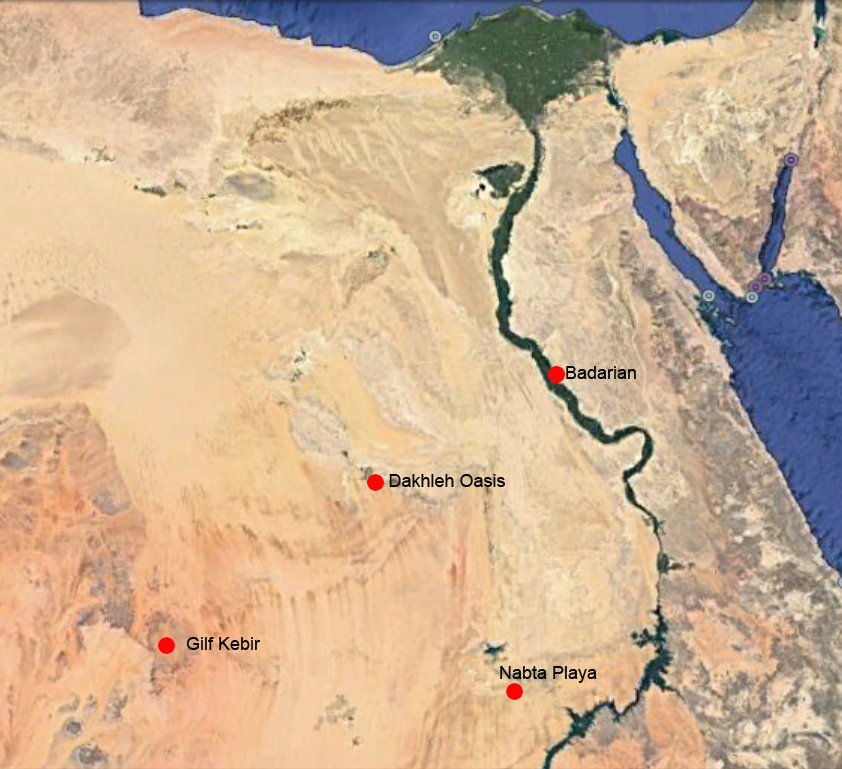 s explained within the thesis, my priority was to test the Sustainable Rural Livelihood model, which was derived from development economics. This means that the emphasis was on pushing the data to the absolute limit. This has resulted in speculative scenarios that match the data, many of which are by no means the only possible explanations and are open to challenge. I believe, however, that some speculation is a healthy move towards the creation of hypotheses that can be tested rather more empirically. I hope, because I worked at it, that the notional relationship between the raw data and my speculative extrapolations is made explicit.
One of the primary difficulties I experienced in each one of the case studies was establishing connections between the case study areas and the archaeology of neighbouring and distant regions, both during the periods of occupation and when they were abandoned. As fieldwork untangles some of these puzzles, it will eventually become possible to update the case studies, explore linkages between areas and improve the comparative findings. The ability to revise the model for any case study is one of the benefits of the SRL approach.
Links to the case studies are available below, or from the above drop-down menu. The case studies are also available to download as PDFs. Pages and PDFs date to 2018.
Nabta Playa, Ru’at el Baqar Late Neolithic (online version 19th August 2019)
PDF version 19th August 2019
The Badarian (Online version 19th August 2019)
PDF version 19th August 2019
The Gilf Kebir, Gilf C (online version 19th August 2019)
PDF version 19th August 2019
Dakhleh Oasis, Bashendi B (online version 19th August 2019)
PDF version 19th August 2019
Section last updated 19th August 2019
 Modelling Early Food Production in the Mid Holocene of the Eastern Sahara